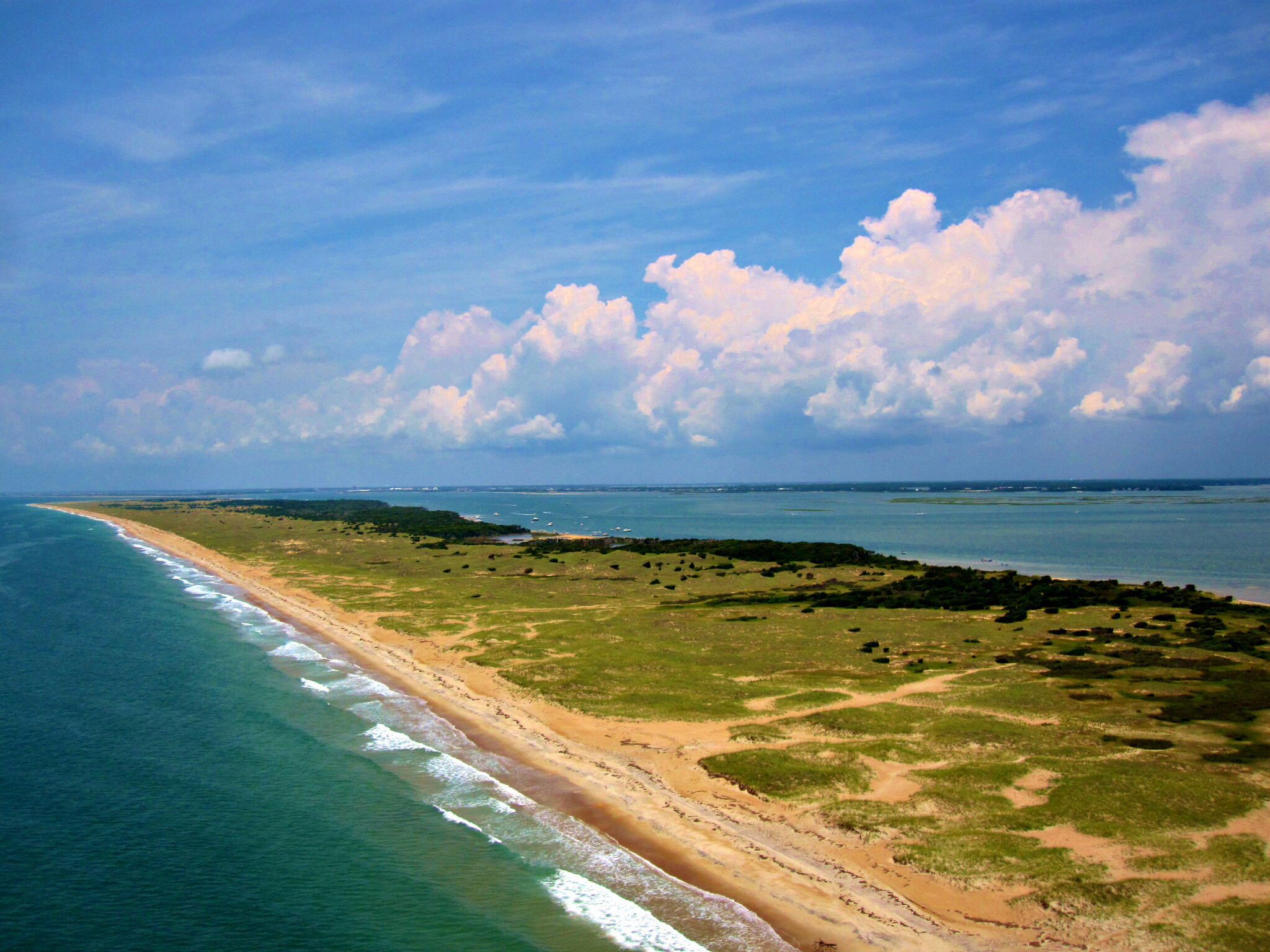


Clubs and Lodges–
–one part of the story—
local watermen working as guides and caretakers for clubs established by Northern Industrialists and out-of -county individuals as get-a-way settings for hunting and fishing

Core Banks Club—Carteret Rod and Gun Club, Cedar Banks Club, Core Banks Rod and Gun Club, Core Banks Club Properties–1899 to 1999- (click red links for more)

Members paid a daily fee of $25 to hunt or to fish–but they could hunt in the morning, fish during the day and hunt again as dusk approached (paying a double fee). Depending on the season, sport surf fishing was a big component of the adventure there. (see red links for more about the “Clubhouse”)

All that remains of this lodge is the chimney standing on Rush Island. Edwin Binney, industrialist, coastal naturalist, and also, inventor of crayons (and much more) built his lodge on the edge of South Core Banks.


very little info is currently available and members were from the neighboring county–but the camp sat in the marsh along a creek on Core Sound.
Commercial Fishing in Core sound and on Core Banks–
“It seems unlikely that anyone living on the
southern Banks, from the earliest inhabitants
onward, would not in some way or other, to
some degree or other, have fished for subsistence
purposes. Fish were simply the most easily available
and plentiful protein source to be had, and the risk
from harvesting them, especially from sounds and
rivers, was small. Surprisingly, however, large-scale
commercial fishing came fairly late to the Banks.”–

The decades between the Civil War and World War
II were the most active for commercial fisheries.
In 1902, nearly 15,000 of the 23,000 fishermen
working from North Carolina south to Florida
were in North Carolina. The state was producing
roughly 7 million pounds each of mullet, shad, and
oysters and nearly 19 million pounds of menhaden.
Totals of all species amounted to more than 67
million pounds, compared to South Carolina’s
8 million. Nearly 1,200 fishing vessels operated
out of Carteret County alone, bringing in over 25
million pounds of fish (including nearly all the
menhaden).
Although every available species was no doubt
harvested as opportunity presented itself, the
species-focused sectors of the commercial market
did not develop at the same time. Which species
were commercially attractive to fishermen at
any given time depended upon the ecology of
availability (which might in turn depend upon
the salinity of sounds that opened and closed to
saltwater as storms opened and closed inlets);
food preferences and traditions; available and
appropriate processing and storage methods
(smoking, salting, conversion to fertilizer,
refrigeration); and shipping options (sail or power
boats, rail, trucking)” (from Gateway…reference below)
Gateway to the Atlantic World: Cape Lookout National Seashore Historic Resource Study–March 2015–pages 79-94–presents a historical summary of fishing and whaling along Core and Shackleford Banks and in Back and Core Sounds (click the link below)–

Click to access CALO-HRS-Final-for-GPO_covers.pdf
Whaling did not occur from shore based settings on South Core Banks except for the Cape Lookout area. Ship-based whaling occurred in earlier times but details are sparse.
Dolphin (or porpoise, as they used to be called)–although Diamond City and Cape Lookout had porpoise fisheries, there is no documentation of this occurring north of the Cape. There is a creek named Try Yard Creek branching off of Codds Creek but the story of the origin of the name is unclear.
Fishing——In 1902, 15,000 fishermen worked the waters of North Carolina –producing 7 million pounds of mullet, shad, and oysters and nearly 19 million pounds of menhaden. All species–67 million pounds compared to 8 million brought in by South Carolina.
Fishing was a part time subsistence activity as late as the mid-1800s however. The boom in commercial fishing emerged after the Civil War.
Besides the topics listed–many varieties of marine life were harvested in season by adaptive and resourceful watermen–just as they still do today. Flounder, spot and other species harvested from Core Sound graced the table of our county and region, however, the choices of topics included here can not do justice to the full spectrum of the connection between man and water in this Down East region.
Menhaden–Steve Goodwin (author of Beyond the Crow’s Nest–The Story of Menhaden Fishery of Carteret county)–worked on Core Sound menhaden boats in the 1960s . He has documented menhaden fisheries in Smyrna (Charles W. Wallace, 1900), Williston (Alonzo T. Willis, pre-1900 and William Irvin Willis 1914), Davis (Abram Davis and Daniel Bell, early to mid 1880s, Anson Davis, 1893 and James Styron, 1984), Davis Ridge (Sutton Davis, 1891) and Oyster Creek (Warren, George and Tom Gilgo, 1900; Eddie Copeland, 1937; Cecil Morris, 1940; and Lambert Morris, 1946; and Atlantic (Hall’sPoint, Lambert Morris–early 1940s; Clem Fulcher’s Lane area–Gaston Fulcher; and Clayton Fulcher, 1954).
James Styron’s fish house was the last one in the area to take in menhaden. Not processing on site, they boxed, froze and shipped from the site. Fishing on smaller vessels, “sound boats” (some wooden), all work was by hand–setting nets and hauling in menhaden and using “bail nets” to get the haul into the hold. The catch was bound for use in lobster and crab pots or for processing into cat food or other use as bait.
David Cecelski shares the story of the Davis Shore fishery. Please check this out.
Mullet–although there is evidence of mullet camps and shoreside fisheries along Shackleford and Cedar Island, it is unlikely that the marshes and creeks inside of South Core banks ever sustained such camps. Fishing from vessels utilizing nets would have been the method used.


Shad–Of all the sea creatures, shad commanded the
highest prices except for turtles. In the early 1840s,
North Carolina shad were selling for $8.50 per
barrel in Richmond and Baltimore, when herring
were bringing $2.62. Forty years later, more than
3 million pounds of shad were going to market
annually—Crossing from open water into the inlets in
the spring, shad ascended the rivers to spawn.
Pound nets—large weirs made of wooden stakes,
running perpendicular to the shore and designed
to trap fish in transit and drive them into holding “pounds”—were introduced in the 1860s and 1870s. They became so numerous that a state law had to be passed to allow the fish to migrate.
John Smith ws one example of a shad fisherman along Core Banks in the early 1900s. He kept a notebook journal in his pocket detailing each days events and what remuneration he received for sale of his catch–1918.
Oysters— Living in eastern Carteret County, one knows that oysters are still harvested, sought after and farmed and remain cherished cultural “delicacy”.
“Taking the long view, oyster production showed
a spectacular rise between 1887 and about 1902,
but with the exception of a modest bump between
about 1918 and 1939, it fell steadily thereafter,
almost disappearing by 1970.”–(Gateway to the Atlantic World–link above.)
Shellfish: Clams, Crabs, and Shrimp—
Shrimp–Fewer than 300 full-time commercial shrimpers–mostly smaller, family-run vessels– operate within the only remaining in-shore trawling shrimp fishery along the Eastern Seaboard. Down from roughly 1,000 licensed shrimpers in the mid-1990s.
Shrimp play a crucial role in North Carolina estuarine and oceanic food webs and as one of the state’s most valuable fisheries. Commercial harvests include brown, white, and pink shrimp, and the catch rates of all three species can vary widely from year to year as a result of changes in the numbers and locations of the three populations. (NCSeagrant)
Shrimping in Core Sound became more prominent and successful after WWIi.
“Hard Crab” and “Peeler Crab—
–-“Peelers”–soft shell crabs–Several locals of a certain age have described memories of the seasonal “peeler”camps along South Core Banks. Morton davis was one:

*******

Linda’s (Linda Fulcher Mann) dad stayed there in the Spring–using a small simple fishing shack just across the creek for shedding soft crabs–he (Julius Taylor) carried a hound dog along to protect the crabs from raccoons–shipping the crabs to NY. With a low tide, you could walk over to the fish shack. Her dad shrimped, ran trout lines, put out crabs pots and more, but later with age, he went to work for the ferry service.
Up the creek (Johnson’s Creek), Linda and family shrimped and floundered. In winter, the camp was used for hunting. Linda stayed in the warmth of the cabin while hunters went to marsh or stake blinds.
****
Doily Fulcher Interview— 12-5-21
Watermen from Stacy left Sundays and stayed till Saturday at their “peeler camps” for their “springtime crabbing’–starting in the 30s and likely as early as the 20s. There were 5 camps in the Swash area, near Horse Island and South of Carolind? Creek.
From March 20th to May first, crabbers had their greatest hauls. Even then, they got 5 cents a crab.
Ivey Willis and his two sons, Alonzo Willis and Eldon Willis; Irvin Fulcher; Kyle Gaskill, Alfred Gaskill and Fernie Gaskill all had camps there. Small crabs emerging from the mud in spring all moved north up the banks and, as they moved up the banks where they would naturally be ready to shed, crabbers met them–especially in Great Island Creek (till the ’33 storm closed off many interconnections). Pairs of men would pull a 20 foot long crab net along the bottom during the night–pull in the crabs, break off the claws so they could not damage each other and then sleep during the day in the camps till the next evening. Buyers would come out and purchase the crabs and move them to mainland sites to finish the monitoring and processing.
In preparation for them shedding out on the mainland, they were put in wooden enclosures half into the water with bottom boards and sides and a net top to protect from gulls. Doily still has one small enclosure built by Roy Willis.
They slept in their camps during the day. One crew slept in their boats anchored off the Core Banks Club and another crew (Doily’s uncle) slept in the decoy house at the end of the Banks Club dock (?Leroy Davis)–then they crabbed in teams.
Later, with the advent of better gas lanterns, they would pole a 12 foot shore skiff and catch in scoop nets. Once, Doily’s uncle happened to be in the right spot when the tide “ebbed out” leaving a solid sheet of crabs exposed. He gathered select crabs about to shed that time–144 dozen prime crabs–a memorable windfall.
“They all had their own area that they monitored and “crabbed”. People from Sea Level worked Turnagen Bays area. Folkfrom Atlantic, worked from the Coast Guard Station (#189-Atlantic) northwards.
Doily remembers the J.T. Lewis camp in the 50s and the Ted and Ivey Willis camp at the head of the creek.
Homer Fulcher had a camp on Great Island Creek. Most camps were peeler camps before the war. In the 20s, 30s and 40s, one crab camp remembered was that of .Carol Brown and Charlie Brown–who late burned their camps
Eldon Wills and Elmer Salter had a camp on Grass Lump Creek. This was separate from Elmer’s camp alongside Monroe Nelson, that later became J.T.’s camp. Grass Lump Creek was behind the Big Marsh. They had aa submerged box blind alongside the marsh’s edge. ————-

Davis peeler camp—Lewis Creek (Gray Kittrell interview)
On my mother’s side, the Davis’, had what they called their “crab camp” over on Lewis’ Creek, just off Marshallberg. Ray Davis and grandfather, Gerald Davis—had a “crab camp” over there before I was born—the stakes were still there in my lifetime—I was born in 1965.
They did a lot of soft crabbing and hard crabbing—they’d bring the crabs back to put in their floats to peel out—between Brown’s Island and Marshallberg.
Loggerhead Turtles and Diamondback Terrapins–harvest of Diamondback Terrapin. Remnants of the last known existing terrapin pen is in Davis, N.C. as documented by Clay Fulcher. Click the link to see the story of turtle harvests.
Shark Fishery–the shark fishery of the county existed around the Cape shoals and Lookout Bight with processing occurring in the Morehead City area. South Core Banks was not a site for shark fishing north of the Lighthouse area.
Agar Harvest–once again, Cecelski provides us the story–of WWII era watermen harvesting seaweed.

Core Banks and the Inlets–Impact of their nature
— along the sound side shore, they are living, moving, migrating and ever-evolving. The story of harvest from the waters changes in parallel with water flow through inlets and access to to the ocean. After each major storm, over wash and transient inlets emerge, some remain continuously newly opened or closed with storm events.

One example–Old Drum Inlet, the Straits area and Core Town–is a story of flourish and demise of a community tied to such changes. Farnifold Green had established a Red Drum fishery in this area as early as 1709–the closure of the inlet in 1769 brought it and the existence of Core Town to an end.


Another more recent and man-assisted change was the opening of New Drum Inlet by the Corps of Engineers to facilitate commercial and private access to the ocean from Core Sound after “Drum Inlet” closed by force of nature. On Dec. 23, 1971. the Corps used 26 tons of dynamite to open the “New” Drum Inlet.
Commercial Ferries and Fishing Camps–

more than 230 structures in these camps alone (1977)–see map above–
(click th red links to explore more about each of these Fishing Camps)

Ammie Willis Camp—-Ammie Loren Willis established the first camp site in the area–for hunting and fishing–beginning as a guide in the late 1922. His son Carlie managed the camps after Ammie’s death on Sept. 11, 1961.

Sterling Dixon Camps–—in 1949, Sterling Dixon built his first camp and began the tradition of “Davis Island” Sports Fishing–

Winston-Salem Journal and Sentinel—May 9, 1965—Chester Davis
Davis Island: A Fisherman’s Spot (excerpted)—-
“The surf fishermen call it Davis Island. To the map makers, it is known as Core Banks,…Davis, N.C. is the jumping off place for Davis Island.
Until 1949, there were no accommodations for sports fishermen on Davis island. In February of that year, Lindsay Tucker of Winston-Salem fished the area from a crab camp which Sterling Dixon, then a commercial fisherman living in Davis, had built on the banks.
Lindsay was tremendously impressed by the sports fishing possibilities of the area. Tucker sold Dixon on building a camp for sports fishermen on the banks across Core Sound from the village of Davis. Dixon began work on his first cabin in 1949. He has been expanding his facilities ever since.
In the same period, Tucker and other individuals—many from Winston-Salem—built private camps in the same area. Today, there are four separate settlements on this section of the Outer Banks which cater to sports fishermen. Dixon has one, Marvin Murphy has another, Alger Willis has the third and Ammie Willis operates the fourth. The physical set-up, operating arrangements and costs are roughly the same in all four.
Not Fancy. Dixon, for example, has four cabins which will accommodate 40 persons. While they are not fancy, these cabins are clean and adequate. Dixon provides the linen, bedding and cooking facilities. Dixon’s fee schedule is the same as that of the other camps
Parties who desire nothing more than transportation from the village of Davis to the Outer Banks pay $2 per head for each round trip. Dixon makes his first run across the sound to the banks at almost sun-up. His last trip back to the mainland leaves the banks at 4 p.m. In between—and depending on demand—he will make other runs.
If a party also desires the use of a beach buggy while on the banks, Dixon can accommodate them. For this service, he charges $2 per person a day. The party provides the gasoline.
For full service—transportation to and from the banks and living accommodations—the fee is $6 a day per person.
From the small store he operates at his dock on the mainland Dixon can provide bait, gasoline and some groceries.
The fishing season at Davis island runs from about Easter to Christmas. Peak season is mid-to-late September through most of December. …The best sport occurs in the late fall when the big channel bass come in on the beach and when speckled trout are taken—sometimes with artificial lures…. catching channel bass, speckled trout, whiting, blues, spot, pompano, grey trout, black drum, flounder and nuisance shark and rays .”
Terry Dedmon Camp–story is another example a ” Dixon fish camp” owned by fishermen from the Piedmont.

Carlie Willis Camps–—had one five-ply and three single cabin structures which he owned, in addition to 55 other “special use” structures in the “Carlie Willis Camp” (established by private individuals or groups and which Carie served as support and transportation. In 1976, Carlie transported 1,382 visitors to the camp.
“Hamp” took over Sterling Dixon ‘s Camps after Sterling’s death from a heart attack. Alger Willis later absorbed the Dixon and Murphy Camps before the Park takeover.
Marvin Murphy Camps—following Sterling Dixon, Marvin Murphy and Alger Willis partnered initially to establish their camps –they later separated their operations.
“Algier Willis Camp”—Algier Willis operated a vehicle/passenger ferry between Davis, N.C. and the Great Island area in Core Banks where he also provided overnight accommodations for fishermen in one five-plex and two duplex structures (297 overnight stays there) and supported an additional 50 structures held by individuals. In 1976, he transported 865 visitors and 89 vehicles to his camps.

Willis operated two boats —a six-person passenger ferry and a vessel for transporting vehicles. The five-ples structure was “above standard relative to other structures found in the ‘fish camps’ on core Banks. His son, Glen, built a sturdy dock to streamline their ferry service. The numerous abandoned vehicles did create an aesthetic and safety problem in that area.


In 1976, Algier Wills was in his 70s but was still active in the daily operations. He had operated his camp and ferry for over 30 years and had built up a clientele composed primarily of fishermen at his rental structures or their own “fishing cottages”. Permits for all of these structures were slated to expire November 30, 1977.
Earl Davis Camps—further south, Earl Davis operated camps and a ferry service –he later sold his structures to individuals.


Two groups have been advocates for the surf fisherman community and partners with the Park Service to improve structures and maintain access to camps and fishing on the Banks.

D.I.F.F.–Davis Island Fishing Foundation and the Core Banks Surf Fishing Club have contributed to the ongoing access to this special fishing opportunity.
Ted Williams came to Core Banks, as did many others, to learn how to best fish for Red Drum. Williams sought out Grady Sheets to serve as his mentor. In season, today, the Banks still finds numerous surf fishermen replicating their adventure. (click link)
Banks camps and cabins–established by families or groups–used the camps for hunting and fishing. Hook and line, net fishing, flounder gigging, shrimping, clams and oysters, scallops in season–many depended on harvest from the waters for their main course each evening and brought only the “fixings”.

Gerry Smith’s family stayed often at James Styron’s camp on south Core Banks– at Jame’s camp located near where the ferry came across from Davis on Johnson’s Creek. Born in ’44, Gerry said he probably began going over to the cap in 1946 with his family. He remembers, as young boys, going back and forth to the banks often. Though he(Gerry) did not have a camp of his own, his grandfather, Hamlin Davis, had a “mullet camp” over there for shelter and somewhere to spend the night while fishing–a place to get out of the weather. These would have been little cabins or shacks built for function.
There have “always been camps over there” –including before the second World /war. But in the 50s and 60s, camps became “nicer”, clean and neat–for family use. Hamlin Davis continued with his spritsail vessel to access camp the same way he fished–next to the last commercial fishermen to use his spritsail fo work the waters. He had a small boat with a gasoline motor which he called “the snapper”. He would send others ahead in the “snapper” and follow separately in his spritsail to the camp or other destinations. Hamlin Davis was also a hunting guide of the area and is documented in Jack Dudley’s Carteret Waterfowl Heritage, page 58. (Gerry Smith interview)
A partial list of camps along South Core Banks includes: Ammie Williams, Ammie Willis, Augustine and Alice Robinson, Avon Mason—(plot north of station 189), Carteret Rod and Gun Club, Cherry Point Gun Club, Clarence Lewis—Walter Kittrell, Clifton Styron, Clinton and Charles Piner, Delmas Lewis Camp, Drum Inlet Camp, Earl Davis Camps, Eldon Willis Camp, Elmer Dewey Willis, Elmer Salter Camp, Fred Willis Camp, Jamie Lewis Camp, John Smith Fishing Camp, Kittrell, Barnes and Webb Camp, Lillie Bell, Monroe Nelson Camp, Monroe Paylor Camp, Munden-Taylor Camp, Norman Fulcher Camp, D. M. Philmon Camp, Rams Club, Seagirt—Morton Davis, Sterling Robinson Camp, “Stinkey Springs”, Styron-Alligood Camp, Terry Dedmon Camp, Tilmon Taylor Camp, Virgil Styron Camp, Walker George Camp, Wesley and Peck Salter Camps, and the Willis-Salter Camp
(click on red linked name to learn more about each of these camps)


Grayer Keith Willis began collecting information about Core Bank before me–check out his site in the link: (click on each location to see the narrative he attached to that particular area)
1910-1965 Core Banks Map – https://www.google.com/maps/d/viewer?mid=1YEFBN2XSvA7jBy1XSsUw-S8Tdd5ehlhL&usp=sharing
References :
1) Past, Present and Future Inlets of the Outer Banks Barrier Islands, North Carolina–Dec. 2008
https://geology.ecu.edu/wp-content/pv-uploads/sites/196/2019/05/Inlets-Past-present-and-future.pdf
2) Cape Lookout National Seashore–archives and files
3) Grayer Keith Willis–interview and shared resources
4) Other references noted in the text
Memories of times on South Core Banks and in Core Sound hold the hearts of of thousands of in the region–


Leave a Reply