
Contents
Story
Decoys
Credits

🟡 AVERAGE RESEARCH VOLUME
OWNERS
Julius Taylor
David and Mildred Munden
1962
OTHER ASSOCIATIONS
Marvin Murphy
LOCATION
Johnson’s Creek, Southern Core Banks
Story


do you know more? contact me.
Munden-Taylor Camp
MUNDEN-TAYLOR CAMP——————————-
Interview by phone–Linda Fulcher Mann of Davis (now of Beaufort)—
Julius Taylor , Linda’s father, of Davis (originally from Sea Level)—had a camp at the Hammock on Johnson’s Creek. Positioned in front of Marvin Murphy’s camps and just up, not far, from the boat landing. Marvin had three rental camps near by and also ran a ferry for fihermen and vehicles. Across from Davis, Marvin’s and the Taylor camp were to the south and off a channel to the right after entering the bay or creek.

The Munden-Taylor camp was three rooms with a front porch. Linda provided photos of the camp and their dune buggy. Julius Taylor and David Munden (Mundens Funeral Home) built the camp when Linda was 10-12 or in her early teens (now 74)–about 1962. There was a painted sign on the front–”Munden-Taylor Camp”. Junius built or had it built and Munden provided materials. There was an elevted water tower between this camp and the Murphy camps.

The water tower was a wooden box elevated on poles in the ground. Water was provided to Murphy’s cabins and to the Taylors. The Taylor camp was about a hundred yards from Murphy’s.

It was burned down by the NPS after the takeover–Julius was able to go over and salvage some things prior–”salvaged what he could”.

Drinkable water was sourced from a shallow horizintal well–strainers/sand filters on each end, that her first husband constucted (Utley Stallings of Harlowe)–the water “made the best tea” and was good water.

Linda’s dad stayed there in the Spring–using a small simple fishing shack just across the creek for shedding soft crabs–he caried a hound dog along to protect the crabs from racoons–shipping the crabs to NY. With a low tide, you could walk over to the fish shack. Her dad shrimped, ran trout lines, put out crabs pots and more, but later with age, he went to work for the ferry service.

Trips down to the lighthouse and Cape village were a treat. The vehicle “graveyard” provided this setting.
Up the creek, Linda and the family shrimped and floundered. In winter, the camp was used for hunting. Linda stayed in the warmth of the cabin while hunters went to marsh or stake blinds. Linda said her mom was a fabulous cook–did wonders with the fowl. Marvin and his helper (Stuart Pigott) would smell the food and come over, there was always a plenty. Decoys?–mostly wooden, possibly had some plsstic–Julius carved some decoys–could carve anything–mostly miniatures and boat models, etc.
Son in law–Bud Hill–goes over to the banks every chance he gets–works in Louisiana–son of Bobby Hill— is married to Linda’s daughter.
“Our camp had a central great room with sitting srea and kitchen..a bedroom went off each side. There was a pump for running water and later a spigot when we were connected to Marvin;s water tower. Each bedroom had a double bed–one iron and one wooden framed. Linoelum flooring with scattered throw rugs and a gas frig and stove” completed things. Nearby was a telephone pole with a crank handle–Linda could use it to call down to the Coast Guard who would patch her to her hsband stationed at Fort Macon. She was married in 1967.

They carried deisel fuel over to paint the screens each evening before puting on any kind of lights. Besides other sources, a wire ran out under the house for battery powered lights–connected by aligator clamping on to the car battery. Keeping use low preserved the battery, alternately, the car would have to be periodicslly starterd ffor battery preservation. They initially used a “slop jar” for toilet, dumped into a dug-out hole in the sand. Later the bathroom with toilet and sink was added into one of the bedrooms. A septic system was built–similar to that used on the mainland by the family–framed with cinderblocks and the bottom covered with oyster shells.

Best memories ??
–the fun
–”steak night”–they would take the grill to the beach in ther beach buggy and grill steaks once s week
—”getting s shower”—rain coming off the eaves provided a chance to shower–”nobody was watching”

C.H. DAVIS CAMP—————————————–
—was nearby–it was a little camp like ours. He used to like to go to the Banks for mullet fishing. He was a Carteret County sheriff’s deputy. Once, when friends had been mullet fishing, they flew over and dropped a tow sack of mullet from the plane for him–unfortunately, it hit the corner of his roof and did some damage. This camp was 1-2 rooms with a screen porch.
Linda remembers cars positioned 3-4 cars deep in front of the camps to catch sand and create dunes-making a “sand fence”–a whole row of abandoned vehicles surrounnded the camps for such protection. You had to watch your step on the beach–glasss and debris could be a problem occassionally.
Sterling Dixon’s daughter, Marilyn ,was Linda’s best friend.
Julius, like many from Davis, worked at the Rod and Gun Club some (hence, the photos from the Club included in this camp page).
OTHER CAMPS———
Besides C.H. Davis, there was a camp made from a bread truck and another nice camp owned by nice folk from Burlington, and 6-7 more camps scattered to the south, especially as years went by.
MARVIN MURPHY—————————————-
the camps became his main endeavor. He did have a big wide boat that could carry cars over to the banks. Marvin was some kin to Linda, she thinks
On his second trip of the morning bringing folk over, Marvin would bring whatever supplies Ms. Taylor needed. He and Stuart always brought an extra loaf of bread each morning, because Ms. Taylor would make them cinnaamon toast to go with their coffed each morning. They loved their cinnamon toast.
CLINTON PINER CAMP—————————————
–of Davis–was down south of their camp, nearer the marsh–but Linda had never vistied that camp.
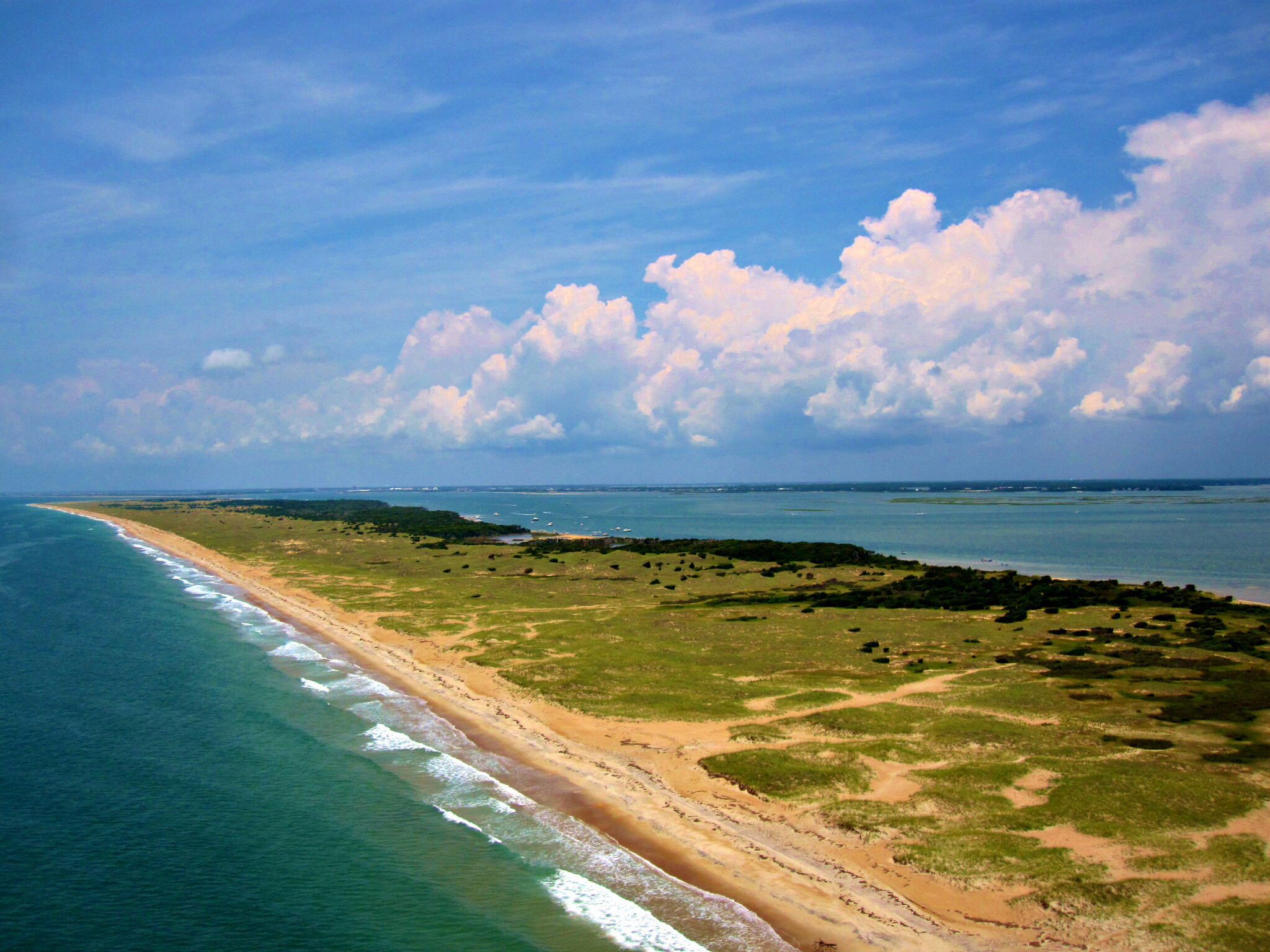
“From the shore of Davis, looking across to the banks, you can see the distant oak trees–the hammock to the right of Johnsons creek and just to the left of the trees is the site of the Murphy and Taylor camps.
Credits
- Linda Mann, Beaufort
- NPS files and archives
- Other references within text