
Contents
Story
Decoys
Credits

🟡 AVERAGE RESEARCH VOLUME
OWNERS
Elmer Salter
J. T. Salter –later years
prior to the 60s
OTHER ASSOCIATIONS
Jack Sewell
Babe Ruth–see story below
LOCATION
Southern Core Banks, head of Lewis Creek–near Horse Island
Story

do you know more? contact me.
Title
John Sewell interview–
John’s only picture of the camp–the second camp (the first burned) with screen porch facing the ocean. Back windows faced the sound–unsure of windows on the sides.
Sound side, two bedrooms with bunk beds for the kids and an adult bedroom to the south of the central kitchen-family room. Un-named–just called “the camp”. The screen porch was a frequent sleeping spot. Bead board vertical siding covered the structure. This camp had a slant roof, the original had an a-frame roof. They used kerosene hurricane lanterns or Coleman pump-up lanterns for light. The small deck to sound side was little used.
The camp photo probably was taken in about 1965-66. The original camp dated to ______?/ . The camp was about half-way between Drum Inlet and the Lighthouse at the head of Horse Island and alongside Monroe Nelson’s camp–reached by Lewis Creek. The camp car is seen to the left and the old A-Model is seen behind that–rusting away, but a vehicle for play. The camp car would often overheat on the way to Drum inlet for an outing–they stopped, opened the hood and allowed it to cool before going further.

Photo of Ethel Salter, Elmer’s wife and John Sewell’s grandmother standing alongside the pitcher pump table. The beach, telephone pole and sand fence are behind her. There were then about 200 yards of sand beach south of the camp. John describes her as a “kidster”
The camp was “ a family place to go, a refuge–to enjoy fishing, shrimping and time in nature–but they weren’t taking pictures”–these are all John could find to date –between his cousins and self.
There was a 2-hole outhouse over a pit dug in the sand–positioned to the south of the camps structure. A dusting of lye was always maintained. The waste seemed to dissipate well. John always was on the lookout for snakes–seen only once, and likely a corn snake.
Unsure of how the first camp burned, possibly lightning but also, occasionally people would break off the lock and go inside–and such an event may have led to loss of that camp.
The “Gun Club” was to the right of the photo about s mile away. It had a flagpole affixed atop a wooden tripod.
Monroe Nelson’s camp was to the right/ or north and a little closer to the marsh. There was a small winter hunting camp in the marsh a quarter mile or more to the north and out of sight. Possibly an original “peeler camp, it was used as a winter hunting camp. john only went there once.
It was a place to go–gather/be with family–John was amazed that there were so few photos
Multiple generations of the Salters and Sewell’s use the camp–as did friends–”anyone who wanted to go”–especially those connected in the Stacy community
the structure was about 50 yards from the back of the marsh and Monroe Nelson’s camp was about 25 yards to the north and slightly closer to the marsh–the peeler camp/hunting camp was out of sight-a quarter mile or more north and out in the marsh–
the peeler/hunting camp was reached thru shallow water by skiff and then walking on boards to get to the structure–had to regularly “kick out” a channel to reach the shack–
there were several stake blinds used from the shed–at least one could be walked to, because John remembers Elmer stepping into a hole on the way there and soaking inside his waders on a cold day–made for a rough trip–there were poles/stakes in the area-mostly for guiding thru the channel–no obvious site for working “peelers”–this shed had an old wooden bench, wood barrels for seats and a Coleman stove–the bathroom was in nature outside
Elmer had “a few fires going” always–crabbing/ ran a little store in Stacy, drove a truck delivering fish to inland areas, worked as a carpenter–would carve decoy heads sitting around the stove in the store( John relates that he has learned Elmer did not enjoy sanding–he cut out heads with band saw then chopped with hatchet to round them–Eldon, his carving partner, sanded his heads much smoother.
John’s sister Evelynn Sewell was the first female pharmacist in Carteret /county
—there was a large list of family that gathered at the camp in John’s day. Elmer and Ethel Salter had Papa Mac living with them for several years when he was up in age–John’s parents were Jack and Evelynn Sewell

Free-hand drawing of the camp layout
what did they eat?
mullet, clams, netted shrimp, flounder–if were short of something important to them, they would go across to Atlantic to Hill’s store–yes turtle also
any kind-John remembers green meat, sweet tasting–cut up and made into a stew with potatoes, onions, corn dumplings and a chowder-like soup like down-east style
“they will have to do some digging if they are going to prosecute”
John can still taste it, tho it has been since the 60s
once, grandfather ? Sewell—–? decided he was craving some biscuits–the camp had only a Coleman like gas stove–they “went over to visit Ole Man Hill” and asked if he had a stove top oven–”eh, I’ve got one of those here”–he went into the back dusty shelves to pull out a new boxed stove top oven–
James and John would grab the surf casting gear and head to the ocean–using identical rigs with pyramid sinkers, every cast had James pulling in a good size fish–when it struck, he would not bother reeling in but instead began running toward the dunes–dragging the fish ashore–”he had the luck of the Irish”–they were standing 5 feet apart and after repeated catches and John with none, “finally, I said, “dang it, how about switching with me”–”ok”–in no time, James was pulling in fish with John’s gear–”I got the luck of a bad fisherman”, John related—-”just having the freedom to do(be spontaneous) and go into the marsh or get the surfcasting gear and head to the ocean”–it was special
No amount of sunscreen spared us–we were burnt by he sun at days end–we took an outdoor shower from the drum elevated upon wooden base (caught rainwater)—after dinner, grandmother would break out the cards–and we would play rummy the rest of the evening–lots of laughs–she taught us all how to play–sometimes she’d get a grin and the kids would implore–Grandma, are you getting ready to go out–she would deny it but next turn she put down her cards, going out
alcohol was not a part of this family camp–with exception of hunters coming in at night and having some “to warm up”–seeming less than today
Other camps?
Algier Willis’ camps were to the south-we would walk down–one afternoon we went down late, there was no moon and no lights–we had one time finding the camp, but we did
We would sit on the porch–like an “Andy Griffith moment”–quiet-prolonged quiet, till occasionally someone would break the silence “think it’s going to rain tomorrow”–long silence, then another one replies “yep”–another pause, then, ‘well, might not”—–the lively conversation broken up at times by “see the lights?’–and they would all watch a car running down the beach from Drum Inlet o the south–might be an hour–cars had to move slow
Speaking of cars, abandoned cars were remembered—”ecologically, with oil and all, they were an issue”–using a car that broke down over there, they were often left there at site of the breakdown–”how many times I can’t say that we saw an abandoned car–we checked it out and played on and in it–and the next year, it was a sand dune” (my thought, worked better than Christmas trees?)
JT Salter took ownership after Elmer’s passing. When the Park Service was to destroy the camp since ownership had ended, the camp of Monroe Gaskill to the side was burned by mistake instead–causing loss of desirable possessions.
Babe Ruth—–
Great grandpa Jack Sewell would sometimes take Babe Ruth out hunting–even to Matamuskeet–and on one trip, word got out that Babe was coming to the area. Swansboro High School got wind of it and asked the Babe to come speak–a meet and greet. He graciously agreed. There was heavy interest in the event.
Now grandpa Jack was built nearly identical to the Babe. The Babe said, Jack, I’ve got an idea. How about you riding in my car with my chauffeur and wear my hat and I’ll come in your car another route–to avoid being mobbed. There are still “original” Babe Ruth autographs in the Swansboro area signed near entering the school, but actually signed by grandpa Jack.
Elmer Salter and later JT Lewis’s Camp (Stacy).
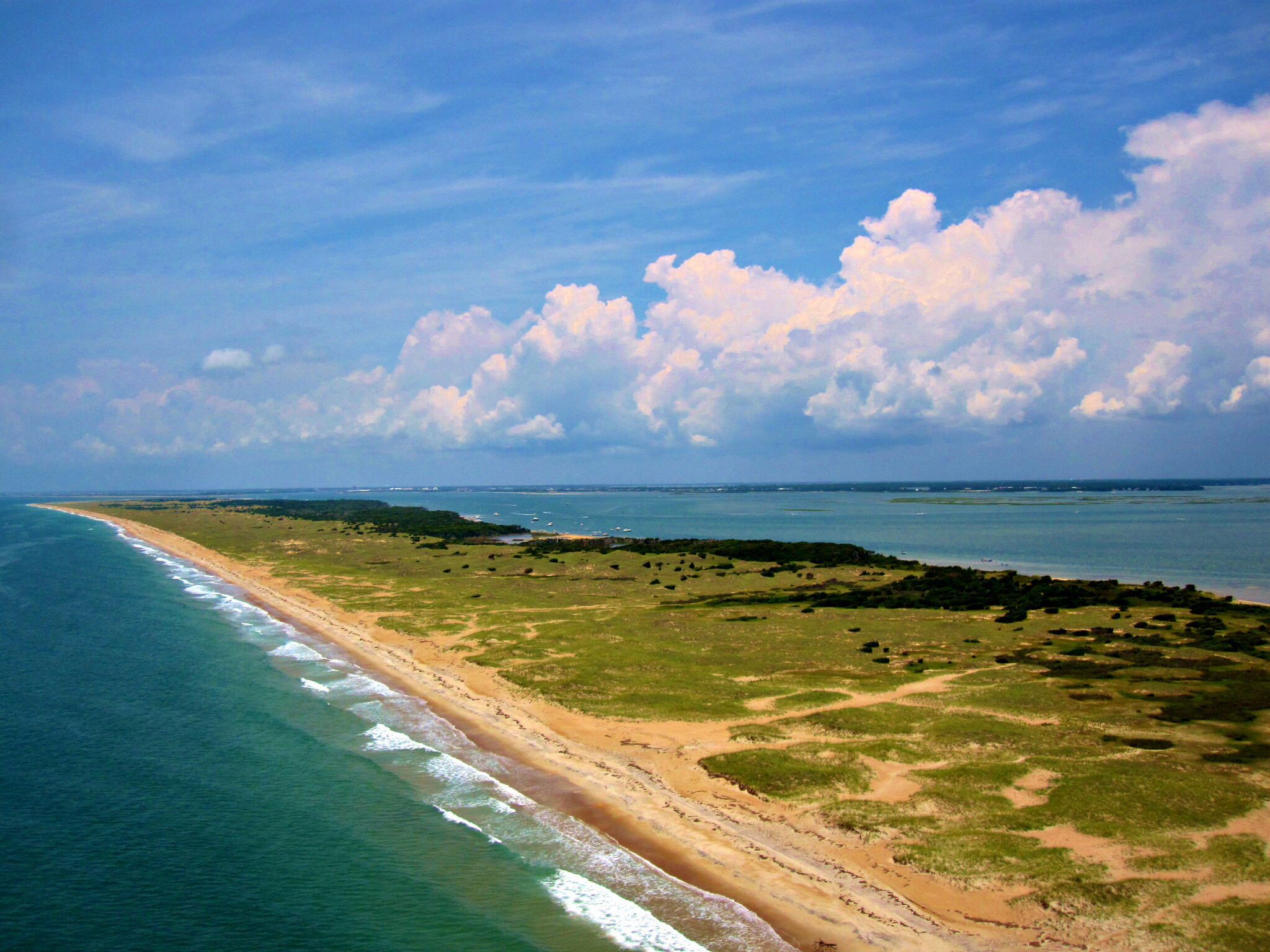
Elmer Salter and his wife, Ethel’s camp was located on South Core Banks just 4 miles across Core Sound from the Oyster Creek in Davis. The camp was built on the main banks at the head of the Horse Island. Today, the camp would be described as being located at NPS mile 28.3, which is 0.7 mile north of the NPS’s North Dock, AKA Carlie’s Dock, and 0.3 mile south of the back road ramp at mile marker 28 where the camps of Braxton Piner, Wesley and Peck Salter, Clinton and Charles Piner and Elmer Dewey Willis were located. Monroe Nelson’s camp was just 25 yards to the north.
From our harbor at the head of Willis’ Creek in Stacy, the home town of Elmer Salter and JT Lewis, it was a 5 mile boat ride south across Core Sound to the mouth of Great Island Creek and another 3/4 mile up the creek to the Salter’s camp at the head of the Horse Island. It was about an hour’s trip in Elmer’s wooden boat.
By what I have been told by family and friends, Mr. Elmer built the original camp in the late 1940 or early 1950’s. Per John Sewell’s interview, also posted here, Elmer’s original camp burned in the early 1950’s. Per my phone interview with James Malcolm Lewis on 2-21-2024, JT Lewis’ son and Elmer’s grandson, he verified that the camp did burn down. The story he was told by his father was that McKinley Smith (AKA Kinley), a family friend from Stacy, was staying at the camp and knocked over a kerosene lamp. Unable to put the fire out, the camp burnt down. James’ dad thought that alcohol may have been involved. James didn’t know the exact date the camp was rebuilt, but thought it was rebuilt back fairly quickly.
I can’t say what year the camp was rebuilt either, just that it was there when Dad started building our camp next door in 1958. Elmer’s camp was around 14 feet wide and 16 feet long with an additional 6×14 foot screened in front porch built on the front or beach side of the cabin. It had a flat tarred roof and slate covered rolled roofing paper covering the outside walls. Elmer also built a plain uncovered porch on the back side (creek side) of his camp, but without a back door leading into the camp, I don’t ever remember it being used much. They had a water cistern built on the southwest side of the cabin to catch rainwater flowing from the roof. They used that water for cleaning and washing, but not for drinking. There were a couple cars always parked on the southwest side of Elmer’s camp, but I don’t recall if they were Elmer’s or other family members. Elmer and family stayed at their camp a lot of the weekends that we stayed at ours. Many times Elmer and Dad would help each other when working on the cabins, beach buggies, and the boat docks. In the early 1950’s Elmer built my mother and father’s family house at Stacy. Elmer was a good carpenter and decoy carver. Elmer and Dad sometimes hunted together around the Horse Island, but neither one of them liked to sit in the blind very long and after a hour of two of hunting they both would leave the shore blind and walk the marsh jump shooting ducks or walk the shore side picking up stuff and shooting cripples. Elmer was also part owner of the hunting camp of Eldon Willis that was built 4.3 miles to the north on Oak Creek (See Eldon Willis’ Camp post for addition information on that camp).
Elmer had a cast-iron pitcher pump and work bench out in front of his cabin that we kids used to take our evening baths. Our families would visit together during the late afternoon or early evening. We would all sit together out on the screened in porch, talking, telling stories, and playing cards. Ethel could tell some good stories. She was always picking on us kids when we were young. After Elmer’s death in 1964, JT Lewis and his wife Judy inherited the camp and continued using it with their son James Malcolm until the NPS burnt it down in 1979. Monroe and JT were good friends and carpooled together to work at Cherry Point for years.
Ricky Nelson: 2024
Decoys
Elmer carved in partnership with Eldon Willis. It is said that Elmer focused on the bodies and Eldon, the heads. Bufflehead and Scaup from their hands–Stan Rule collection.


Credits
- John Sewell interview–October 5, 2021
- Other references within text