
Contents
Story
Decoys
Credits

🟡 EXTENSIVE RESEARCH VOLUME
OWNERS
Core Banks Club Properties, Inc
1970-1975
OTHER ASSOCIATIONS
CBC II, Inc.
LOCATION
Southern Core Banks
Story


do you know more? contact me.
Core Banks Club (these pages still under construction)
Core Banks Club underwent name and organizational changes in 1970 and 1975. John Hagan relates that this was about the time of his family joining the club which continued to include many members and visitors from the Kinston, N.C. area. The 1970 changes only shortly preceded the 1970 fire that destroyed the clubhouse. The rebuild had a different, but functional, single floor configuration.

Description below is excerpted from the 1969 appraisal:


Park Service aerial photos from before the fire (above) and rebuilding the clubhouse/completed club (below)–


Post Fire: The new clubhouse and its floor plan


CBC II. Inc. (formerly Core Banks Rod and Gun Club) is one of the few rod and gun clubs established in the so called”golden era” of waterfowl hunting in the late 1800’s and the early 1900’s on the North Carolina coast that is still in existence and active today. (until 1999)
It was established and the first clubhouse built in its present location in 1902 by a group of New York business men and named the Carteret Gun and Rod Club. Ownership of the club has changed twice, once in 1933 and again in 1947 when the name was changed to Core Banks Rod and Gun Club. It continued operation throughout the years under this name until 1974 when a new corporation was formed, although the ownership remained the same. and the name changed to CBC II (Core Banks Club II). Throughout the years the club has enjoyed a storied history and entertained many well known visitors: however, even through the name has been changed, the residents of the Carteret County area, particularly the natives, refer to it as the “Core Banks Gun Club”.
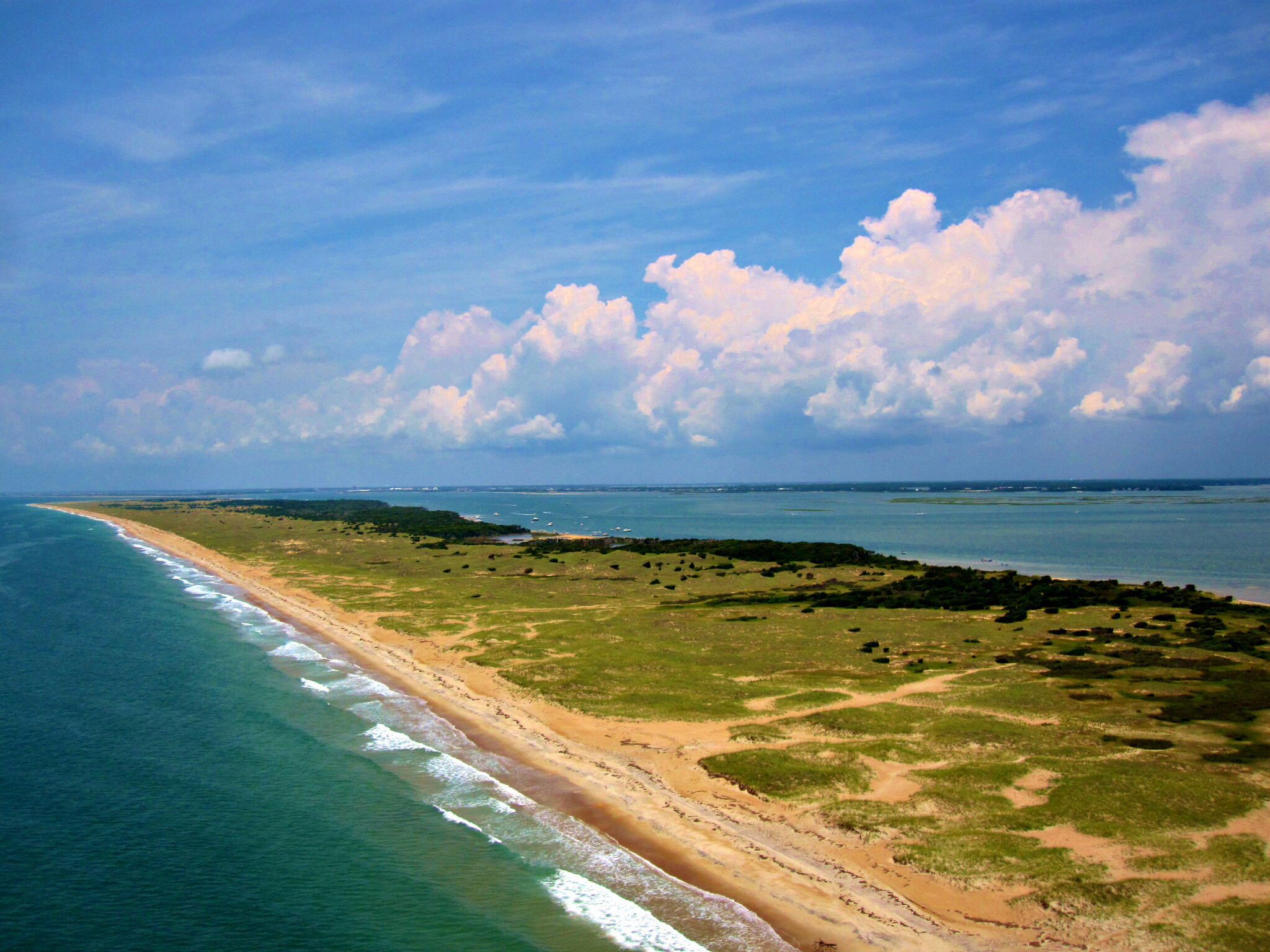
Prior to 1974 the corporation owned two miles of Core Banks from the ocean to the sound. Under the law of Imminent domain the federal government took ownership of the property as well as all other properties on Core Banks, Shackleford Banks and Portsmouth Island and established the Cape Lookout National Seashore under the Department of Interior to be operated by the National Park Service. At the time of this take over, the Department of
Interior granted the Corporation, at no cost, a twenty five year lease, ending November 23, 1999, for the clubhouse, three acres of land around It, and the adjacent private runway (1200 feet). with access to the beach and the sound. (provided by John Hagan)


Core Banks now holds the crumbling skeleton of a precious down-east community story
Why is the story of the Carteret Rod and Gun Club so precious, so special, to the local Downeast community?
The impact of the establishment of this club extended beyond the wealthy businessmen and sportsmen who came to hunt or fish with friends, clients or business associates—up to 24 at a time. Their families and friends also came to the club outside of the hunting season to vacation (though no women were allowed during the season). As the club came to be owned by in-state membership, the use by family and friends expanded. Jahn Hagan is quoted as regretting that”the kids and grandkids would no longer be able to have experiences like that of the preceding generation.”
But what about locals? “The Clubhouse”, as it was known, seemed a part of the fabric of Davis—sitting 4 miles across the shore—bringing wide impact and connection to the Downeast community. Raymond Paul, (the chief carpenter), led local builders to erect the structures (beginning as early as 1898 and completed for use in 1902). They were paid $1 a day for their ten hour day as they completed the clubhouse, accessory structures and lodgings for the caretakers. Local sailboats and skiffs ferried supplies across to ther site.
The community of Davis supplied almost all the caretakers, seasonal guides and cooks for the function of the club through the years. Materials, provisions, ferry service and mainland dockage was also provided locally through the years. Off season, the club was used by locals for family outings to the Banks or as an access point from which to head to the Cape for dances or just for visits. Church outings used the site for their gatherings. The youth are described as running up and down the dunes and cavorting on the Banks. The club pier also made for a functional and convenient access for locals.
One guide carried 10-20 redheads (preferred over turkey) from the club to local homes for Christmas dinner–club and community were interwoven.
If you talk with Ricky Nelson or Richard Gillikin about their memories of the club from youthful times, you can almost see their mind go back in time to describe the wonders and special memories they retain. Helping clean ducks for $1 each, or getting the fires going in the morning ( often using wooden decoys for starters), or the rack full of expensive Brownings—oh yes, and the food.
There was and is a sense of ownership or partnership that locals seem to feel about the Rod and Gun Club. They also share a common sense of loss, a feeling of regret, at the demise of this multi-generational community landmark.
The National Park Service purchased the club site property for one million dollars. The club also received a 3 million dollar tax deduction when The Nature Conservancy provided a “bargain sale” of the remainder of club properties (exceeding 1,000 acres and including 2 miles of beach and sound front) which TNC donated to the Park.
Gallery
Jackie Booth relates that the Carteret Rod and Gun Club had multiple members and 16-24 at the camp at a time maximum— the caretakers were just that-caring for the camp facilities.
Seasonal guides found work at the camp, and Jackie believes, provided their own decoy rigs and live decoys. He believes that the club did not itself provide the decoys and he knows of no marked decoys from the camp itself—-Amie Paul, Leckler Lewis, and many well-known carvers, however, were guides for the club at various times.


Credits
- John Hagan–Greensboro
- NPS archives and photos
- Jackie Booth–Beaufort, NC
- Lena Ennis–artwork–Carteret County
- Richard Gillikin, Harkers Island– grandson of caretaker Ward Murphy
- Other references within text