
Contents
Story
Decoys
Credits

🟡 LIMITED RESEARCH VOLUME
OWNERS
Eldon Willis
Elmer Salter
built in 1950s
OTHER ASSOCIATIONS
Roy Willis
LOCATION
Southern Core Banks-Grass Lump Creek
Story


do you know more? contact me.
Eldon Willis Camp
Doily Fulcher recalls:
Eldon Wills and Elmer Salter had a camp on Grass Lump Creek. This was separate from Elmer’s camp alongside Monroe Nelson that later became JTs camp. Grass Lump Creek was behind the Big Marsh. They had a submerged box blind alongside the marsh’s edge.
The Elmer Salter and Eldon Willis camp was built in the 1950’s and was present in the 1960’s. It was off the Grass Lump Creek on a little gut of the creek. It was built on posts over the marsh. It had bunks for four men. It was built for duck hunting. I stayed a night or two in this camp while duck hunting with my uncle Eldon Willis. The camp was close to the sandy beach.

Ricky Nelson recalls:
Eldon and RoyWillis Camp—Their camp was in the area– at the head of the “Old Channel”–similar to Nelson’s camp, but smaller and rustic built.
–It was a great spot for “sprig-tail” and geese. They had a “sink-box” that Mr. Eldon had dug out and lined with “brick and plaster” but it took on water like a sieve–”my job was to bail it out while they put out the decoys–and I had to continue to bail all through the day–continuously leaking. It was “the coldest place for feet ever, but a great place”–the blind had wooden seats, room for 3 men–about 4×8 feet.

Ricky Nelson continues:
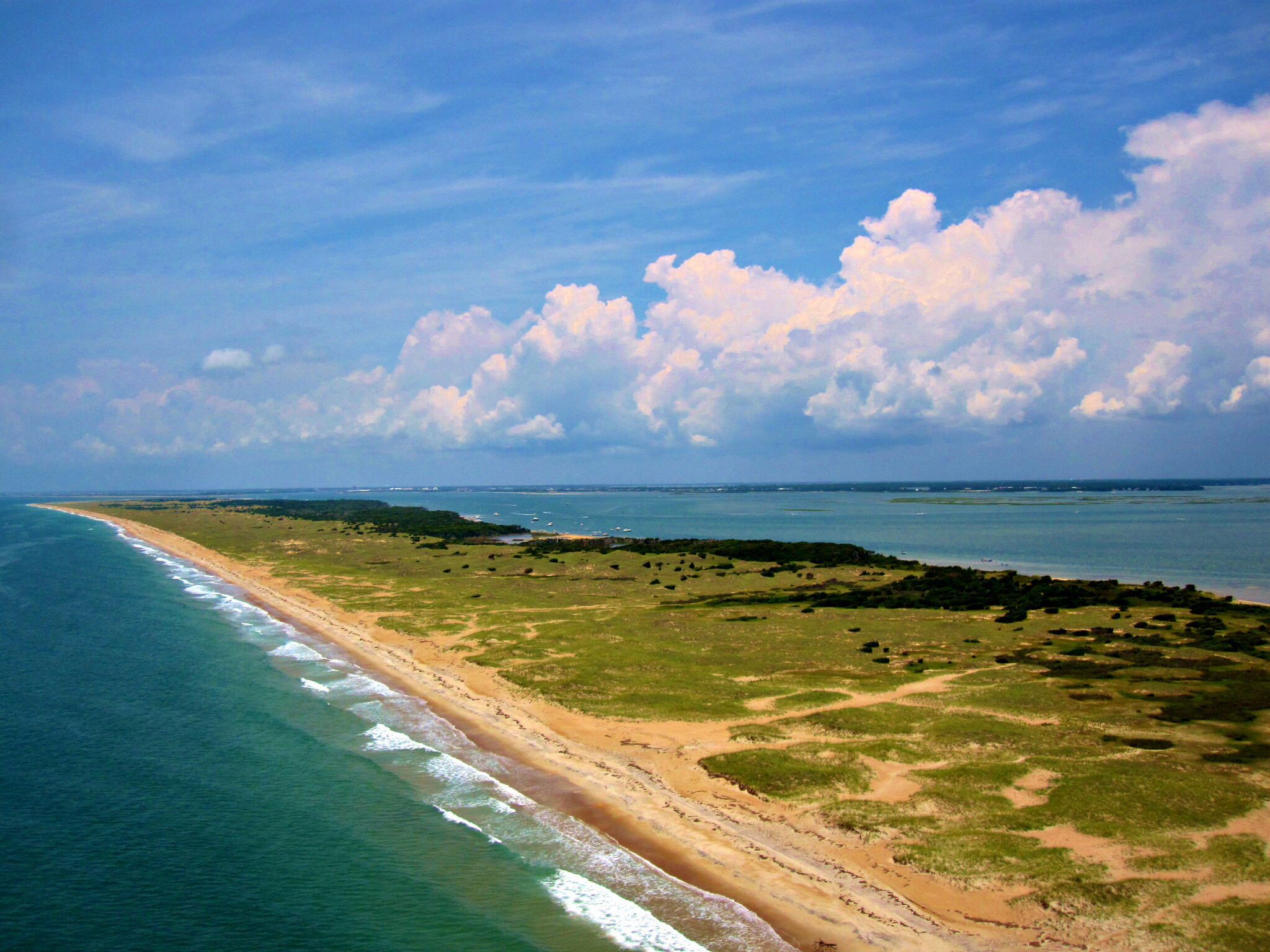
Eldon Willis’ Camp was located on South Core Banks, just across Core Sound from Stacy, and built on the north side of Oak Creek. This was a little creek heading southeast towards the beach from Grass Lump Creek which separated the Big Marsh from the main banks. Today, the camp would be described as being located at the NPS mile marker 24, which is 1.7 miles north of the Core Banks Rod and Gun Club and 4.8 miles north of the NPS’s North Dock, AKA Carlie’s Dock. Tilmon Taylor’s camp (later sold to Walter Kittrell) was .6 mile to the north. Clarence Lewis’s camp (also sold to Walter Kittrell) was 200 yards southeast up on the main banks.

From our harbor at the head of Willis Creek in the community of Stacy, the home town of Eldon Willis, it would have been a 4 mile boat ride southeast across Core Sound, running around the north side of the Big Marsh, turning right into Grass Lump Creek, then left into Oak Creek. The cabin would have been on the north side of Oak Creek and built on the marsh, some 100 yards from the beach. The camp was only accessible by boat. Eldon never had any vehicles on Core Banks that I know of.
All the stories I’ve heard over the years indicated that there were many memorable duck hunting trips to what my father, Monroe Nelson, called “Eldon’s Camp”. Although Eldon Willis, Elmer Salter and his son Major, and Joe Pepper all helped in the construction and upkeep of the camp, Eldon and Elmer were the main builders and were also close friends, hunting partners and decoy carving buddies. Since Elmer Salter already had a camp on Core Banks (located 4 miles south at the head of the Horse Island), everyone I knew referred to this camp as Eldon’s Camp. Although we never stayed at Eldon’s camp, I did visit there many times as my father, Monroe, my grandfather Ralph Nelson (owner of Ralph Nelson and Son’s Community Store in Stacy), and I oystered, clammed, set mullet nets, and hunted in and around the Big Marsh many times. I remember hunting there with my father from a sink box located on the north point of the Big Marsh, just a few hundred yards from Eldon’s camp. It was a hole dug into the marsh, about 4 feet cube, with plastered brick sides and a concrete bottom. Just big enough for 2 people and would freeze you to death as your feet stayed in cold water all day. You had to bail it out every time you used it and if the tide was up, you had to continuously keep bailing it out as it leaked like a sieve. But it was the best place I’ve ever hunted. It was even named –the “Goose Box”– as many, many geese were harvested there, as were many sprigtail, teal, mallards, black ducks, and occasionally a few blackheads, redheads, widgeon and brant. I killed my first brant there when I was 12 years old. One shot, one kill with my Harrington and Richardson, Model 158, single shot 20 gauge (still in my gun cabinet today), with Remington number 6 lead shot. I was so excited. There were several other stake and shore blinds close by Eldon’s camp that we also hunted, but the “Goose Box” was “the place” to hunt, if available.
The waters were very shallow all around the Big Marsh and Eldon’s camp, so Dad always towed our little air cooled skiff over to the banks with his larger shrimp boat. We would anchor the big boat on the sound side of the Big Marsh in deep water, load all the wooden decoys and supplies into the skiff and head to one of the blinds for a day of hunting, walking the marsh, jump shooting pond ducks, and walking the shoreside picking up old decoys, wood and all kinds of “Good Stuff” as Dad called it.
Per my conversation with Leon Peppers on 1-21-2024, he remembers the camp very well and stayed there many times with his dad and others. He describes the camp as a small camp (12×16 feet per Roy Willis’ Interview). From the boat dock on Oak Creek, it was only a couple of steps up to the porch. Stepping up onto the front porch, there was a small separate room just outside and to the right (beach side) of the front entrance door which was used to hang up and store boots and rain gear. Entering the front door, there was a cook stove on the right, next was the pot belly stove and the brick chimney, table and chairs were in the center of the cabin, storage cabinets and work benches were on the wall to the left. Walking towards the back there were two bunk rooms on either side with three built in bunks in each room. Leon said you had to be really careful not to bump your head on the bunk on top of you as you were getting into and out of the bunk as there was not much room between bunks. They used kerosene lanterns for lights. Leon remembered one night when the camp starting shaking. His dad, Joe went outside to see what was going on and saw a cow rubbing up against the corner of the cabin. Maybe the cow was scratching an itch or just ran into the cabin since it was dark. Elmer Salter would often go with Joe and Leon to the camp. Elmer would get up early and enjoyed cooking breakfast for everyone. The food was always so good over to the banks. Leon also remembered hunting the “Goose Box” with his dad and how cold that “thing” was.
Per my conversation with Dan Robinson on 2-1-2024, he verified the pictures and location of Eldon’s camp as listed above. Dan married Lura Jean Willis, Eldon Willis’ daughter. Dan stayed at the camp many times, a few times with his wife Lara Jean when they were first married, but many more times when hunting and fishing with Eldon and Roy Willis. Sometimes Doily Fulcher and his son Doily Earl Jr., would join them at the cabin and on hunts. Dan remembered the “Goose Box” very well and shared a story of him and Roy hunting there one chilly winter’s afternoon when eight Canadian geese lit in the decoys, three shots each, and none flew out. They spent the rest of the evening plucking and cleaning the geese. Since the Goose Box was too small for three people, Eldon would often stay at the camp piddling and doing repairs which he loved to do anyway. Sometimes Eldon would go with them and walk the Big Marsh jump shooting pond ducks or walking the shore side picking up stuff and shooting cripples. Dan had many great hunts there and at Roy Willis’ stake blind, located 1.7 miles to the southwest on the Battery Shoal which was just northwest (sound side) of the Core Banks Rod and Gun Club. Many redheads, sprigtails and dippers were harvested there. Dan recalled one hunt when he and a friend were hunting the Battery Shoal blind. It was a good hunt and they harvested many different kinds of ducks. When Roy came to pick them up that evening, he counted the ducks and they were a few redheads over their limit. Roy got upset and threatened to make them walk back to the camp. Thankfully, he didn’t.
One night Dan was floundering around the Big Marsh when a bad thunder storm made up right over him. He cranked up the motor and headed to the camp as fast as possible as lighting was popping all around him. Taking shelter inside the cabin, he didn’t come out until the next morning. He was very thankful that the camp was there that night.

This cabin was burnt by the NPS in the late 70’s. Up until Hurricane Florence in 2018, the remnants of the camp’s old cedar post and almost all of the fallen down brick chimney could still be found there. I’ve taken several people there over the years to show them where the camp was, even Eldon’s grandsons, Brownie Lawrence and Scotty Robinson stood there and reminisced beside the old chimney. Hurricane Florence washed several feet of sand over Eldon’s camp’s former location, completely filling in Oak Creek and several hundred yards of Grass Lump Creek with sand, making it impassable by boat now. You can now walk all the way from the Big Marsh to the beach on dry land. Nothing is left there now to indicate where the camp was located or where the many enjoyable days of hunting, fishing, oystering, and clamming took place. All I have now is just my great memories of Eldon’s Camp, Oak Creek, Grass Lump Creek and the “Goose Box” out on the Big Marsh.
Ricky Nelson: 2024

Just as a disclaimer, the NPS maps you have of Core Banks indicates that the name of what I call Grass Lump Creek is listed as Gutters Creek. Even Google Earth has it listed as such. I have never heard of it being referred to as Gutters Creek by any of my family or residents of Stacy, Sea Level, or Atlantic, so I will call it by its name known to me as “Grass Lump Creek. Just a side note, Tilmon Taylor’s camp was built on Gutters Creek located .6 mile to the north of Eldon Willis’ camp. (Ricky Nelson)
Decoys
Examples of Willis-Salter decoys


Credits
- Blair Boyd
- Doily Fulcher–Stacy and Virginia
- Ricky Nelson–Stacy, NC
- Other references within text
- NPS files and archives