
Contents
Story
Decoys
Credits

🟡 AVERAGE RESEARCH VOLUME
OWNERS
Monroe Nelson
built late 50’s or early 60’s
OTHER ASSOCIATIONS
alongside, north of, Elmer Salter’s camp
LOCATION
Southern Core Banks
Story


do you know more? contact me.
Title

“When I step out of the boat and onto those banks, I feel I am in a different world”—Casey Arthur
The father of Ricky Nelson, Monroe – built his camp in the late 50s or early 60s.
Monroe had a quick-claim deed of ownership. (Monroe’s father was Ralph Nelson).
Ricky says they have no pictures–they had no camera–that was not their focus when on the Banks. Elizabeth Lawrence Nelson, of Ottway -was Ricky’s mom.
In ’72-’73, Ricky remembered the Park Service shut-down starting.
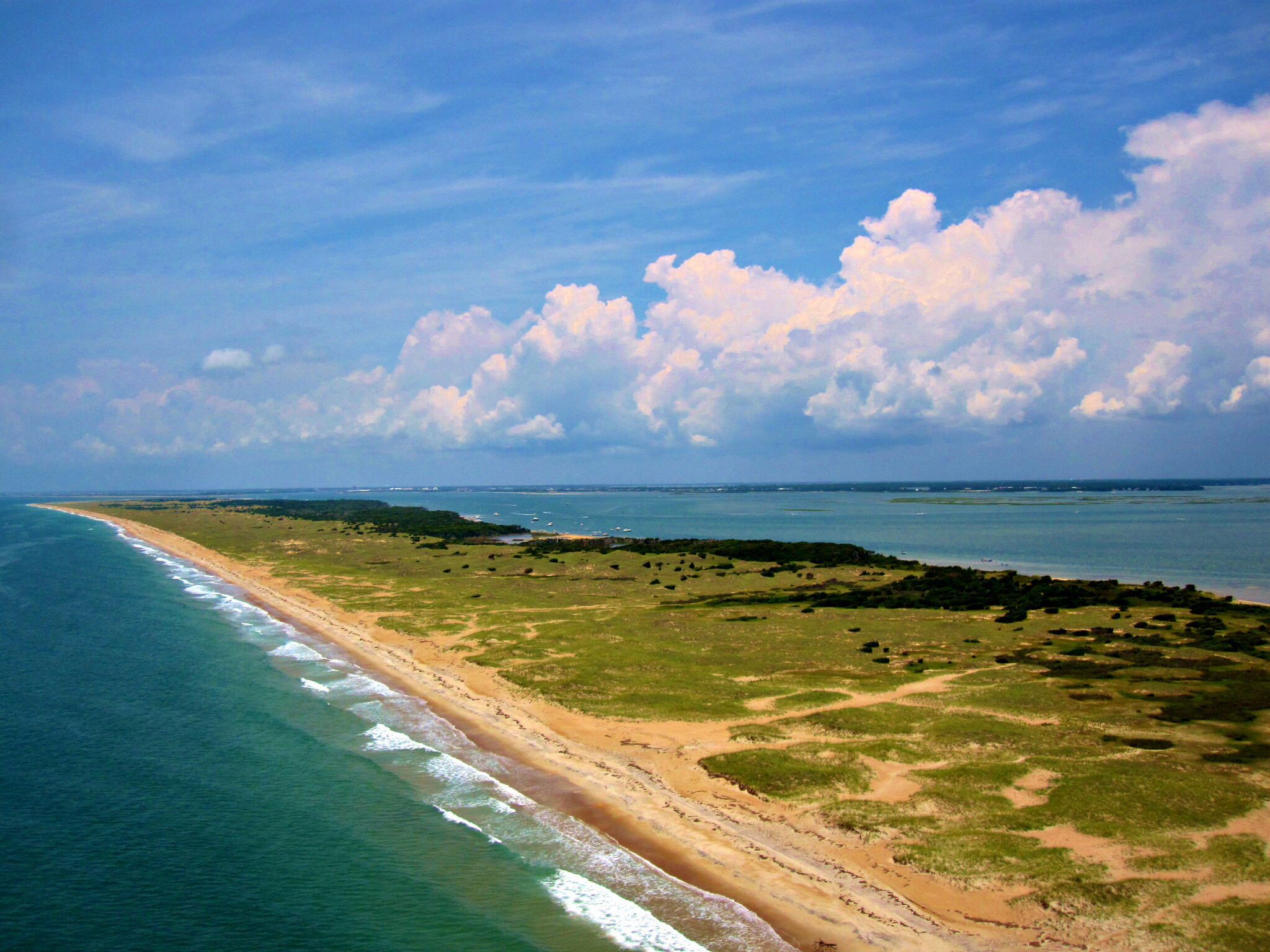
The camp was on South Core Banks, just north of Algier’s camp—3/4 mile north estimated–at the head of Horse Island.


Burgess and Quentin Piner, of Davis, had a camp about a half mile to the north.

The Nelson camp had a cast iron hand pump, they dug a hole and then drove a pipe into the sand–had a “point” (filter fitting”) on the end.
They used an old axle with gears still attached–placed over the pipe and used to hammer the pipe down ( similar to current fence post placement system).
Hammering a galvanized pipe and hitting water about 16 ft down that was drinkable and functional, they set up their pump.
Ricky remembers the water as cool—and fine for drinking.
Beside them was the camp of ELMER SALTER about 20 yds away to the south. (photo below andon his camp page). These were the only two camps in this area. When Elmer passed away, the camp went to the J.T. Lewis family of Stacy.
Elmer and Monroe worked together to establish and maintain their dock and camps. When one tarred his roof the other helped him, then moved to their other camp for tar application–using mops to apply tar—Ricky remembers having that chore.
The camp faced south , with 3 rooms, a flat roof.
Monroe would take duck hunters over to the Banks–Ricky remembers needing to be on his best, quiet, and controlled behavior if he was to be included in the hunts.
Ricky said he had to keep out of sight/out of mind –if he had hopes to go long.
Ricky says believably, that he was “raised on Core Banks”.– meaning that his character and love for nature was molded there.
Monroe worked at Cherry Point–Friday , he would arrive home to find the truck packed and readied to go due to his wife’s efforts–they were off to the banks for the weekend.
“Vacations” —they were just longer trips to the banks –no need for more. Better than any Disney experience.”
Ricky remembered, in later years, that Monroe had an old Plymouth car with a slant six engine,–straight shift of course. The cabin was 50-60 yards to the beach and Ricky learned to drive to the beach, and to drive in reverse back to the camp–his dad said he drove best backwards—learniong to drive this way.
‘Ricky was not trusted to drive down the beach for fear of getting stuck and stranded.
Monroe went to court to get a Quit-Claim Deed–in those days, nobody wanted that land –he had a document from the state giving him a 1/2 to one acre plot.
Ricky thinks that Elmer and others likely did the same–he thinks the state still retained ownership but allowed use–he is unsure, but bases this on the fact that they lost their camp with NPS takeover.

Elmer Salter’s camp, above–photo courtesy of John Sewell–Monroe’s camp was scheduled to be burned a year before the Sewell camp, but mistakenly, the Sewell camp was burned first and without notice.
Elijah Caraway Nelson, Ricky’s GGGF, had deed to 700 acres on the banks in this general area previously–20 people had to sign one deed as heirs.
The Nelson camp was 24×24 Ricky guesses, with a porch facing southwest–three rooms– entering from the porch there was a great room with the sink and hand pump to the left of the entrance and the kerosene stove to the right of the door and further right, the pot bellied stove.
Across the room was a long table and chairs along the north wall–a “daybed” was to the left of the table.
To the left or north was the bedroom for Monroe and wife–having a double bed and a dresser.
A second bedroom was to the north and left–for Ricky and his sister–with a couple of bunk beds.
Admirably, all trash was carried out to the mainland–no trash was left on site—as a matter of conscience for this family. They had no trash pile, as did many other camps.
They hauled their trash home when they left. A “slop bucket” was their bathroom facilities (Many homes on mainland and even the Piedmont had slop jars for night or full-time use–to avoid going to the outhouse in rain or darkness). The toilet “slop jar” was emptied into a dug-out area in the sand behind the cabin–sand was thrown over and new digs made when needed (the dig-out was about 50 ft behind the cabin).
The porch was later closed in as a screen porch and roof extended. A kerosene cookstove had a stove-top oven attachment. The metal table and chairs took little time to add a rusted patina. Wood for the stove was gathered from driftwood and other found wood.
There was a water pump nearby–with two lengths of pipe and a bottom strainer point. Back-up water could be obtained from the cistern at Elmer Salter’s neighboring camp–the primary source of water till the pump was put in.

Ethel Salter at the “pitcher pump”–
When the gnats were bad, the family would keep the kerosene lamp low to draw them less and would wipe down the screens in kerosene.
Their dock was built by Elmer and Monroe and jointly maintained–each docking on one side. The camp was behind Horse Island, up on the “beach”–meaning up into the banks but still behind the dunes.
The Creek bringing them to ther site was Swash Creek , as Ricky remembers–now a recent hurricane has filled in the creek’s division of the banks and Horse Island, preventing going through.
There were “crab shacks” in the marsh across from these family camps–”peeler camps” elevated on poles (pilings). Michael B. Fulcher of Stacy and family/associates used these camps.
Every weekend was ”a mini-vacation–a family thing”–they occasionally pulled a small “try net” behind the small skiff–to catch green-tail shrimp–the skiff had an air cooled Briggs and Stratton motor.
Parents, Ricky and sister–occasionally GM and GF-all often went—they enjoyed “all the little stuff”—It was “ a different day in time”.

Remembering The Core Banks Rod and Gun Club—Ricky says- I’d ”never seen money like that”—new trucks/planes flying in to the camp/–both parked at back door of the camp. His dad helped as a caretaker sometimes–they all knew each other and Ricky was welcome there and known there. (-coming in the back door, there was a big ice machine that made real fine ice–almost like that of a snow-cone.)
In 1999, Ricky was there , as the lease had ended, and he saw the last boat depart the dock loaded with the last of the gear–the owners had cleaned out
–the NPS “let it go”–deterioration had occurred with decreased repair as the final date approached, but the structure was still solid and could have been maintained well.

Decoys
Ricky remembers the men sitting together at the store alongside a bucket of cut-out head blanks. Many who came by to visit picked up a head from the bucket and carved as they visited–then as they left, they tossed the head back in the bucket. This is likely true of more than one gathering place.

Monroe Nelson patterns–Ricky nelson collection


Credits
- Ricky Nelson–Stacy
- Casey Arthur–Beaufort
- John Sewell, Beaufort
- NPS archives and files
- Other references within text