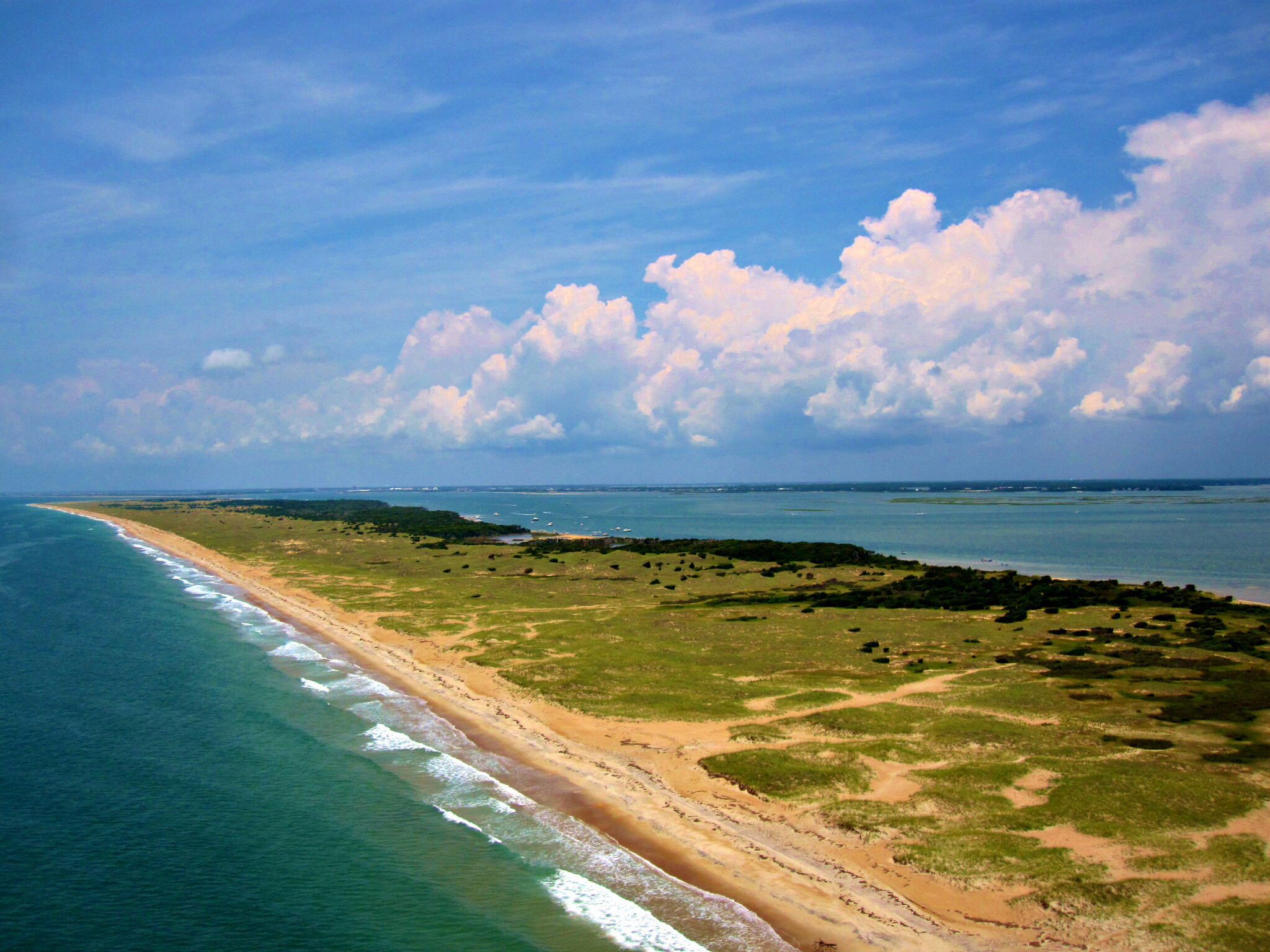

—Central to both life and leisure—

Portsmouth Village–
With the gradual end of maritime trading at Portsmouth after the Civil War, fishing became one of the primary means of livelihood for the residents.
Fishing was not at a commercial scale, but rather for subsistence and barter. As described by George Brown Goode, a researcher for the U.S. Commission on Fish and Fisheries:
The fishing is not extensive, and there are no large seines or pounds requiring the labor of any considerable number of men. The people do not fish with any regularity, many of them going out only during the height of the season….In January, parties having large vessels or large boats are engaged in gathering oysters and clams, which they exchange with the people of the mainland for corn. … This business continues till April, when nearly all turn their attention to their small garden patches, where they raise such vegetables as are needed for their family use. The summer fishing is quite small, and only for local supply… Early in September the fishing becomes quite extensive, and all of the fishermen are soon engaged in the capture of hogfish, spot, mullet, trout (Cynoscion regale), and small bluefish, for salting… The catch in this fishery averages about 10 to 15 barrels of salted fish to the man. Early in November nearly all resort to the ocean shore for bluefish, where they are usually engaged till Christmas.
In addition to the above, there is an extensive fishery for clams or quahaugs to supply the clam cannery of Maltby & Edwards in Ocracoke Inlet.
(George Brown Goode, The Fisheries and Fishery Industries of the United States (Washington, D.C.: Government Printing Office, 1887), 483-484. Goode notes that the one seafood that was not eaten by the Bankers was shrimp, in spite of their abundance of this resource.)
Shell Castle.
In 1789, John Wallace of Portsmouth and John Gray Blount purchased five islands and began to develop a shipping and trading center on Shell Castle Island.

. . . a rock of oyster shells, half a mile in length and about sixty feet in width, dry at low
water. . . . Wallace’s channel runs on the south side, within forty feet of the rock: its depth there is three fathoms and one half [about 21 feet]. . . . Besides [John Wallace’s] dwelling-house and its out-houses, which are commodious, here are ware-houses for a large quantity of produce and merchandize, a lumber yard and a wharf. . . .”( Johnathan Price, 1795)
Blount and Wallace developed a complex of commercial structures including wharves, warehouses, a store, a grist mill and windmill, and other port facilities. Ships arriving at Ocracoke Bar had their cargoes taken by lighter to the island’s warehouses, where the goods were stored until they could be sent inland. The island survived a hurricane in August 1795 without major damage, and further construction in the following years included additional warehouses, cisterns, and a porpoise fishery.

Grey’s Factory—


Portsmouth Fisheries Company–Casey’s Point (Casey’s Island)
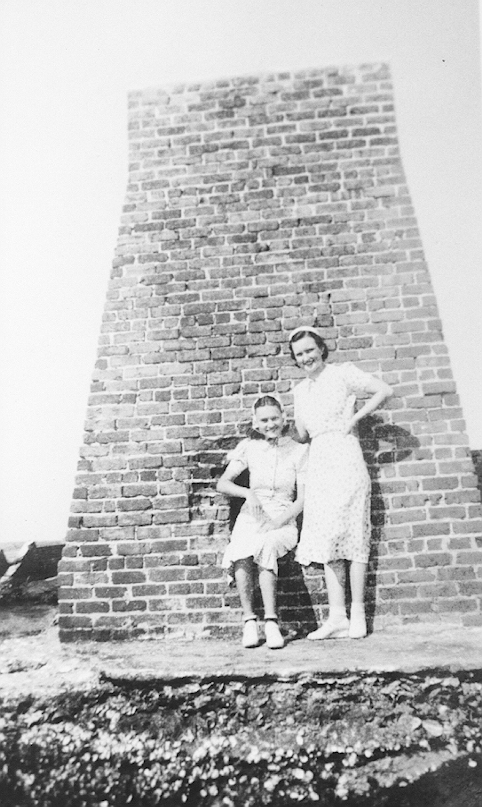
Portsmouth Fisheries obtained the property on Dec. 15, 1917 from one of the partners, W.M. Web. By mid-October, the fish factory was nearing completion. Company officials recognized the need to deepen the channel and some of the shallows, but the rented dredge sank and brought great expense and difficulty. The Bell-Wallace Co. of Morehead ‘City had built two 75 foot boats—”The” Captain” and “The Colonel”. Operating from Casey’s island, the boats had access to both Core and Pamlico Sounds, as well as the Atlantic Ocean thru Ocracoke Inlet. The menhaden operation lasted only a year. Water for the factory had to be brought over from Portsmouth till Morris Fulford and Ted Salter were employed to drive a well to tap into a natural artesian spring.
In 1919, the factory burned after the night watchman dropped his lantern and the fire could not be contained. Foundation remnants, waist high, remained in 1978 when the island was last purchased.
Mr. Grey’s opinion about prospects for a fishery held true.
Hunting and Fishing Camps
(click on red links to see more about each topic)

Ira and Don Morris “Kabin Kamps”
“He’ll Ferry you to Fish“–Ira and, later, son Don ran a surf fishing business from 1936 through the late 1970s–becoming a concession for the Park Service in the mid-1970s. Tranporting and supporting at least 2,600 surf fishermen and transporting 500 vehicles each season.


The site of these camps became the “Wib’s” community of camps and cabins at the head of the creek. This site was recently chosen as the new Park location for rental cabins due to its history of stability in storms and hurricanes. George Hill had a home near the sound side shore till it was destroyed in the 1933 storm. Hill’s chimney base remains a few steps from the narrow road running from dunes to the creek head. (click rd link to see more)


The Pilentary-1899-1933
The most grand of the clubs or lodges of the southern outer banks–built by Theodore Rogers, famous for the Jordan L. Mott III era, and with the James Mason (Atlantic) family central to all its story. Franklin Roosevelt visited here.


in Portsmouth Village–this was one of several post WWII recreational camps in or near Portsmouth village

Charlie Vellines and the Fabulous Flying Fishermen


Cabins and Camps along North Core Banks—
–just some of the individual camps and cabins existing on North Core Banks in the 1900s–harvesting from the water was a valued part of time spent on the Banks…..flounder gigging, fishing with net and line, oysters and clams, and occasional turtle dinners —
Lionel Gilgo remembers leaving Portsmouth Village on southbound outings with his dad during which he saw and visited what seemed continuous family compounds scattered all along the sound-side shore of Portsmouth Island. The documented history of the village likely misses the story of some–or many– of these families. They would have depended on the bounty from the waters of sound and ocean for subsistence.
(click the red linked names to see more about each)
Armtex and the Armfields in Portsmouth Village, the Battle Boys Lodge on Sheep Island, the Beacon Island Camp, Billy and Janice Smith, Blanchard Lupton’s camp, Bruce Willet, Manley and Walter “Brother” Gaskill, camps on Casey’s Island, Charles Perry Styron, Clay Fulcher, Jr.’s camp (nicknamed Pilentary), Clay Fulcher, III and June’s camp at Wib’s Creek, the Daniels-Brittingham camp, Dick Smith’s camp, Daryl Willis, the camp on Dump Island, Fred Cox’s camps, Freddy Hooper, Henry Kirk, the High Hills camp, Jack Rose’s camp at Wib’s, James Ray Willis at Wib’s, Frank Nelson’s camp at Wib’s, Lawrence, Lynwood Parker’s camp, Melvin, Raymond and Benny Styron’s camp, the Montford Nelson camp, the Noe camp on Doctor’s Creek, Ross Salter’s camp, the “Scotch Bonnet”, and Julian Hamilton’s “Evergreens”
Commercial Fishing along North Core Banks–
Long-Haul Fishing–
Long-haul fishing, as developed in North Carolina’s Carteret county at the turn of the Century, is still an economical and efficient method of harvesting fish in shallow water.
—Alewife, Croaker, Bluefish, Pigfish, Spot, Spotted Seatrout, Weakfish were of more than 35 species of fish harvested by this method. The record largest single haul by this method was 258,000 pounds. After development of the long-haul fishery, the catch of spot in North Carolina rose from less than a half-million pounds to often reaching 5 million pounds between 1910 and 1930. (see Long-Haul reference at end)
—-Lionel Gilgo, Jr. (a former menhaden captain himself) is proud of the story of his father’s career as a “long-hauler”. Lionel, Sr.—while previously living on Portsmouth, and at the time of their move away, was a fisherman. He initially took work on a dredge boat (the “Hatteras”) after their move—then, he took a “job no one wanted”—long-hauling with Herman Hill.
Lionel Gilgo. Sr. became a “long hauler”— Lionel, Jr. described that demanding line of work to me. There were two large boats on which the crew lived. Leaving each Sunday night for the week, the crew of twelve became dedicated to each other. Also on Sundays, Captains of the twelve fishing crews drew names for the previously established haul routes. No one but your boat and crew could do that ” haul”—hauling five days a week. The boats would go into Sheep Island Slue (near the Salter Boys camp) to anchor at night. Friday evening, they went into Atlantic where they spread their nets on posts and rails along the shore.
Boats were about 40 feet long and pulled a “5 acre bag” , The cotton nets were pulled up /wound up on shore and were rinsed with lime to preserve them. Mens hands grew raw—“almost bones showing”-from the task. The men of the boat crew would coat the nets with grease after they were pulled up and rinsed. Saturday morning, the crew got up and began repair of nets till evening. After that, the cook headed to the store to get ready to load food and water aboard…..when the crew finished with chores, they had the rest of their Saturday night off.
After church on Sunday, they gathered on the boat to begin again. If you were late, you were fined $5. They launched the skiffs and poled out to the nets spread over the water and pulled them into the boats.
When they set the nets, they ran out 1,600 yard total and towed the net from deep water (after 4-5 hours) to a site on a shoal where a man could touch bottom. One crew member got into the water and secured the net bottom weight with his foot—called “footing the net” as the net was gathered. There was always danger of a sting from a ray or other injury as the net lay against one’s lower leg and foot.
The long-haul method of fishing originated in Carteret County–that history is documented in the link below.
—-The Long-Haul Fishery of North Carolina—Guthrie et al.—National Marine Fisheries—https://spo.nmfs.noaa.gov/sites/default/files/pdf-content/mfr35126.pdf (to learn more, click the link)
The Menhaden Fishery—
Steve Goodwin has documented the story of the fishery in Carteret County (see reference at end). The western shoreline was a continuous array of docks, anchorages, boats and fish fisheries. In Atlantic, N.C., Hall’s Point Fishery in the early 1940s was a Lambert Morris enterprise. The Clem Fulcher’s Lane area-Gaston Fulcher, and Clayton Fulcher’s (1954) were also menhaden fisheries.
The 1866 Excelsior Oil and Guano Fishery on Portsmouth and the 1917 Portsmouth Fisheries on Casey’s Point (later called Casey’s Island) preceded most others *****(they are discussed above)****.
Dolphin–Porpoising—
Dolphin
Dolphin (or porpoise, as they used to be called) skins had been used since Biblical times for making sandals, and their hides and oil were highly valued for centuries. The oil served as a lubricant, leather dressing, or illuminating oil, and was used in soap stock.
But until the 1920s, David Cecelski observes, “Most coastal residents considered dolphins . . . an exploitable resource at best andpests at worst”; they were eventually hunted almost to extinction in North Carolina waters.
The hunting began early. A porpoise fishery was established by John Gray Blount and John Wallace on Shell Castle Island as early as 1793, using their lighter vessel, the Beaver.
Within a decade, Cecelski says, slave watermen had established a dolphin factory near Ocracoke Inlet. By 1810, “immense herds” of porpoise were sustaining a major industry from Hatteras to Bear Inlet, in which huge 800-yard-long seines were used. A season’s catch could run from 400 to 500 dolphins, which might produce from 70 to a 100barrels of oil. The industry waned during and after the Civil War, but one observer reported that during the winter of 1874–1875 dolphins were so numerous in Hatteras Inlet that the waters “seethed and foamed” with them, and the dolphin harvesting revived.
The market began to decline in the 1890s, the species came under legal protection in the 1920s, and by 1929 the industry had disappeared. (reference for more info—Cecelski, A Historian’s Coast, 83–84.)
(excerpted from Gateway to the Atlantic World)
Mullet

The most important fish with regard to economic recovery on the Banks during the post-Civil War period, Fred Mallison argues, was mullet. Mallison quotes a Beaufort observer who in 1871 reported “enormous” numbers of mullet being harvested—up to 500 barrels in a single haul and 12,000 barrels in a single September day of fishing. Salted or smoked and packed in barrels, mullet were “savory and saleable.” In 1880, a standard barrel brought $2.75 to $3.50. A substantial portion of the catch was loaded on schooners, hauled across the sound, and traded with farmers for corn—five bushels of corn for a barrel of mullet.
Some mullet fishermen were mainlanders who In the late 1880s, when Carteret County was the center of mullet fishing in the United States, mullet fishing camps sprang up by the score along the sound-side banks from May to November, when the fish were running. These distinctive, circular, thatched huts with conical or hemispherical roofs were featured in National Geographic in 1908.
Using small dragnets in the sounds and much larger gill (or sweep) nets or seines in open water. The largest nets could be 12 to 18 feet deep and 900 to 1200 feet long. Sweep nets were 200 to 300 feet long and 4 to 6 feet deep. One or more small boats would tow the nets out to where lookouts had spotted a school, surround the fish with the net, beat on the boats to drive the fish into the net, then draw the fish-laden nets into the boat.
The process for the largest nets was different. One end was attached to a rope on shore, while the other end was towed out to the school by boat, brought into a circle around the school,
and then circled back to shore, where fifteen to twenty men—sometimes using “backing” seines behind the main one to pick up the overflow—were required to beach the catch. On shore at the temporary camps, men would stand at rough tables, slitting and gutting the fish before they were washed in sea water, salted, and packed in barrels. Since the fish bled into the salt, they would
frequently be unpacked, washed, and repacked before sale. Fairly formalized “lay” systems were employed to determine how much each man was paid from the catch.
Special conditions and methods at Portsmouth gave fish taken and packed there a special niche in the market. The foot-deep shoal waters of the sound allowed fishermen to surround the schooling fish, frighten them into the nets, and break their necks, leaving them in the nets until all had been killed before loading them into the boats.
Onshore processing was a matter of great pride: removing the backbone, gutting, washing, and rubbing off the dark cavity lining. On the market, their superior appearance and (many said) better taste put them in high demand.
Heavy fishing caused the mullet take to decline, and by 1907 the only remaining mullet fishery on the banks was at Mullet Pond on Shackleford. (excerpted from Gateway to the Atlantic World)
David Cecelski offered many windows into the areas work on the water–please seek his books and website out to learn ore–colorfully presented.
Loggerhead Turtles and Diamondback Terrapins
Loggerhead sea turtles were once hunted for their meat, eggs, and fat (which was used for cosmetics and medications). The supply of diamondbacks was already depleted by World War I, no doubt because they commanded “the highest price per pound of any of the sea creatures.” They had been aggressively sought for the culinary market at least since 1849, when J. B. Etheridge of Bodie Island sold 4,150 of them for $750.00 (about 18 cents each).

One remnant of a terrapin pen still can be seen in Davis, N.C. and another site in Sea Level was documented by Clay Fulcher, III.
Loggerhead turtles faced a renewed threat during World War II rationing of foodstuffs. “Fresh red meat which requires no ration points,” the Raleigh News and Observer reported in July 1945, is being eaten by residents of the Outer Banks, who are lucky enough to get it . . . . Choice steaks may be sliced from the meats . . . and OPA [Office of Price Adjustment] are not likely to do anything about it due to the scarcity of the choice cuts . . . which [come] from Loggerheads . . . . (excerpt–Gateway to the Atlantic World)

Shellfish: Clams, Crabs, and Shrimp
North Carolina’s returns on its crab harvest duringthe 1940s continued to be modest because of the lack of adequate processing facilities, but by the 1960s the hard blue-crab industry was in a major growth mode,
A five-year study reported in 1954 that clamming had emerged as an important North Carolina industry as early as the 1830s, with Maryland and Virginia
buyers coming especially to the Ocracoke Inlet area. A processing factory opened at Ocracoke in 1898, and by 1902, over a million pounds were shipped.
The shrimp industry was slow to start. It began to rise after about 1916, had a fairly stable, if low-level run in the 1920s, and then turned up sharply in the early 1930s before climbing even more steeply in the late 1930s and 1940s.
At the end of World War II, the state commissioned a major study of the industry aimed at increasing production and profitability.
A year later, the Asheville Citizen reported that the industry had “ballooned” and that “all the fishermen have gone shrimping”; an estimated 500 boats were active on Pamlico Sound alone. Buy-boat operators were buying shrimp for 22 cents a pound and selling it for 54, and customers were paying 85 to 90. Harvests were surpassing even menhaden.
By 1951, some 1,500 men were working on nearly 1,200 shrimp boats, and the labor force in the packinghouses raised total employment to around 4,000. Word was out about the abundant shrimp to be had in North Carolina waters. In short order,
shrimpers from other states moved in, and the call went out for restrictions. After a sharp drop in the later 1950s, shrimp catches rose modestly but uncertainly in the early 1970s.

SHAD
Of all the sea creatures, shad commanded the highest prices except for turtles. In the early 1840s, North Carolina shad were selling for $8.50 per barrel in Richmond and Baltimore, when herring were bringing $2.62. Forty years later, more than 3 million pounds of shad were going to market annually.
Crossing from open water into the inlets in the spring, shad ascended the rivers to spawn. Pound nets—large weirs made of wooden stakes, running perpendicular to the shore and designed to trap fish in transit and drive them into holding “pounds”—were introduced in the 1860s and 1870s. They became so numerous that a state law had to be passed to allow the fish to migrate.
The herring fisheries were more north and in river tributary settings. Soft-shell crab camps may have existed on North ‘core banks but I have found no examples of this. certainly, whatever manner of harvest was feasible existed. Catches on the Baks and in the sounds all went to markets along the western shore–evidenced by the fish houses and bases of operations for the boats of the industry.
Oysters–
Writing at the turn of the twenty-first century, David Cecelski noted that oysters had practically vanished from the North Carolina coast.
Then state laws opened the oyster rocks without restrictions, and oyster harvesting “hit like a gold rush in the winter of 1889–90.”
A conflict between North Carolina and Chesapeake oystermen moved the legislature to ban oystering after the 1890 season, but Chesapeake oystermen first ignored the ban and then moved to the Gulf of Mexico. By 1898, only two North Carolina canneries were still operating and the supply was drastically depleted.
Note to Readers:
Realizing that this posting is insufficient in the representation of the Banks culture, the lives of the watermen, or the intertwining of the sounds and ocean that surrounded them into their existence, I hold the hope that I have preserved and presented sufficient information to bring some memories to mind or to open new curiosity into the history of the Banks culture that has faded from common knowledge. My earliest goal was, and continues to be, to tell the stories of those people, camps, lodges and homes that stood on this special place and were sacrificed to create what became the Cape Lookout National Seashore.
Every Park that is special enough to become a national treasure seems always to have already been found precious to those from which the Park lands were taken. Our seashore acquisition, many feel, did not treat this group fairly or in an even-handed way. And, in addition, the rich stories seemed inadequately told—of settlers here in the late 1600s, of the communities that followed, of the culture of use (for fishing and hunting, especially) by regional citizens, of the 400 plus owners of camps (an understated number) at time of the acquisition, and of the experiences of the likely 20,000 local citizens who (as of 1976) had spent time at one or more of these camps.
My snapshots of what I have learned hopefully expresses the reverence I hold for the many facets of this culture. Thank You for reading—and thank you to the many who have helped , and continue to assist me, along this journey.
Selected References:
Gateway to the Atlantic World—Cape Lookout National Seashore Historic Resource Study—
https://www.nps.gov/calo/learn/management/upload/CALO-HRS-Final-for-GPO_covers.pdf
The Long-Haul Fishery of North Carolina—Guthrie et al.—National Marine Fisheries—
https://spo.nmfs.noaa.gov/sites/default/files/pdf-content/mfr35126.pdf
Beyond the Crow’s Nest—The Story of the Menhaden Fishery of Carteret County, N.C.—Steve Goodwin
A Historian’s Coast: Adventures into the Tidewater Past–David Cecelski https://davidcecelski.com/books/
David Cecelski has written numerous articles about our coast–exploring them will be worth the time

Leave a Reply