
The Pilentary–its Origin Story
Future posts will deal with Lawrence Pike, Theodore Rogers and the Mott family, but it all started and continued with James Mason and his family.

The grandest of camps and lodges on the southern outer banks had its origin through one man and his family—James Mason. Through all the changes in ownership—Lawrence Pike, Theodore Rogers, Jordan Mott and Robert Lasiter—James Mason and his family were integral. Owning and living on this property, preceding others, building the lodge and some of its boats, serving as constant caretakers and being the only ones there at its 1933 destruction—the Mason family was always there.

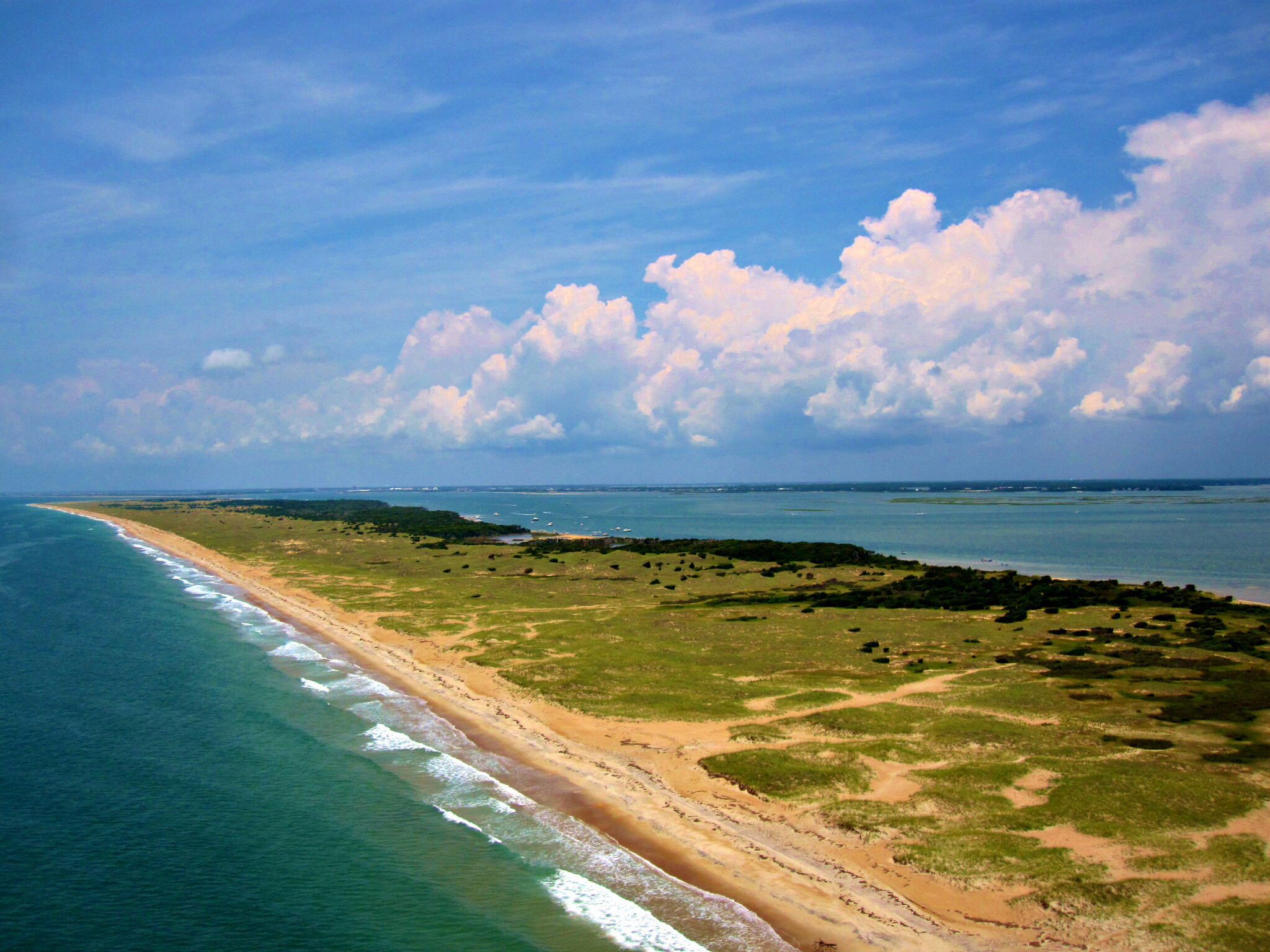
The area of the Banks and the name of the camp are thought to derive from the Pilentary Bush that grew in that area. Known also as “the toothache bush” or Hercules Club, the hard spikes on the trunk could make a formidable weapon, but Franklin Roosevelt found the numbing effect on the gums when the leaves are chewed to be more interesting. (this particular plant sits in front of the Core Banks Club ruins doorway)
The Pilentary brought financial and employment benefits to the citizens of Atlantic (or Hunting Quarters as known at the time) in provision of commerce, jobs during the almost constant construction, and caretaker duties. It has been said that almost 20 local individuals lived at the site at one time.
Mutual respect and friendship between the owners and the community emerged from the half century of its presence. The Pilentery remains —90 years after its loss—a keystone memory to the Down East community.
In addition, the James Mason story interweaves with the origin and preservation of our nation, with self-reliant independence in life-style, with the local hunting and fishing cultural history, with European connections, with Franklin Roosevelt, and now, a county breaming with James Mason descendants.

James Hill Mason– (photo courtesy of Worth Mason)
In 1822, James Hill Mason was born into the ancestral line of founding father George Mason (who inspired Jefferson’s opening to the Declaration of Independence ). James’ branch of the family had moved from Virginia to Hyde County, and later settled in “Mason Town” near the Carteret County sites of Sea Level and Atlantic.

In 1859, as much of the Mason family moved from Mason Town to the Beaufort area, James acquired land grants on the Banks. There, he and Belinda, after their marriage, built their home and James ran his schooner from that shore.
The Pilentary Club would later sit on lands deeded in multiple Land Grants from the State of North Carolina to James Mason (Grants #897, #904, #905—15, 53, and 50 acres respectively—were representative)—the going rate was 25 cents per acre at the time. Multiple Grants also are recorded in the names of Augustus and Stephen Mason.
Eventually, on December 27, 1883, James Mason deeded two tracts (15 and 50 acres) to Lawrence Pike—the contiguous lands to and just south of the eventual Pilentary site and called Pike’s Hammock today. (Ellen Cloud’s collection of deeds outline transactions in this area).

The Pilentary was just south and inshore of Swimming Creek–about 8 miles south of Portsmouth Village. (1976 NPS map)
Theodore Rogers, of New York, in 1885, began purchasing Core Banks lands as follows: 5 acres from Stephen and Frances Mason; 25 acres from William Skidmore in 1885–the Evergreens; 8 acres from Joseph Styron (Shell Island), 8 acres from C. B. and Annie Styron, about 600 acres from James Mason (1883-1886), 25 acres from John and William Fulcher ( Shell island) and additional acquisitions. He acquired multiple tracts from the Harbor Island Club, and several grants from the State of North Carolina (Mullet Shoal Lump and Myrtles Hammock, among them). Rogers thus amassed widely spaced lands for his club and hunting grounds that later would be purchased by Jordan Mott.
The James Mason family appeared to be the earliest of land-holders living on this 16 mile stretch of the Banks. Lawrence Pike, in late 1883 built on a site south and contiguous with the eventual Pilentary property. Theodore Rogers began his holdings in 1885 and added property over the next few years. Jordan Mott purchased the property in 1905 that were being held by executors and interim owners after the death of Rogers.

Above the designation “hrd” are a cluster of structures surrounded by fence–this represents the Pilentery during the Rogers era and was also the general site of the Mason home which burned in the 1870s.
——————————–
Little is documented about their time there with the exception of Nathaniel Bishop’s description of his visit at their home—included in “The Voyage of the Paper Canoe”.
———(The author left Quebec, Dominion of Canada, July 4, 1874, with a single assistant, in a wooden canoe eighteen feet in length, bound for the Gulf of Mexico.)–excerpted here:
[—Portsmouth Island is nearly eight miles long. Whalebone Inlet is at its lower end, but is too shallow to be of any service to commerce. Hatteras and Ocracoke inlets admit sea-going vessels. It is thirty-eight miles from Whalebone Inlet to Cape Lookout, which projects like a wedge into the sea nearly three miles from the mainland, and there is not another passage through the narrow beach in all that distance that is of any use to the mariner. Following the trend of the coast for eleven miles from the point of Cape Lookout, there is an inlet, but, from the character of its channel and its shallowness, it is not of much value.
Leaving Portsmouth, the canoe entered Core Sound, which grew narrower as the shoals inside of Whalebone Inlet were crossed, partly by rowing and partly by wading on the sand-flats. As night came on, a barren stretch of beach on my left hand was followed until I espied the only house within a distance of sixteen miles along the sea. It was occupied by a coasting skipper, whose fine little schooner was anchored a long distance from the land on account of the shoalness of the water. Dreary sand-hills protected the cottage from the bleak winds of the ocean.
While yet a long distance from the skipper’s home, a black object could be seen crawling up the sides of a mound of white sand, and after it reached the apex it remained in one position, while I rowed, and waded, and pulled my canoe towards the shore. When the goal was reached, and the boat was landed high up among the scrub growth, I shouldered my blankets and charts, and plodded through the soft soil towards the dark object, which I now recognized to be a man on a lookout post. He did not move from his position until I reached the hillock, when he suddenly slid down the bank and landed at my feet, with a cheery —
“Well, now, I thought it was you. Sez I to myself, That’s him, sure, when I seed you four miles away. Fust thinks I, It’s only a log, or a piece of wrak-stuff afloating. Pretty soon up comes your head and shoulders into sight; then sez I, It’s a man, sure, but where is his boat? for you see, I couldn’t see your boat, it was so low down in the water. Then I reckoned it was a man afloating on a log, but arter a while the boat loomed up too, and I says, I’ll be dog-goned if that isn’t him. I went up to Newbern, some time ago, in the schooner, and the people there said there was a man coming down the coast a-rowing a paper boat on a bet. The boat weighed only fifty-eight pounds, and the man had a heft of only eighty pounds. When pa and me went up to the city agin, the folks said the man was close on to us, and this time they said the man and his boat together weighed only eighty pounds. Now I should think you weighed more than that yourself, letting alone the boat.”
Having assured the young man that I was indeed myself, and that the Newbern people had played upon his credulity, we walked on to the house, where the family of Captain James Mason kindly welcomed me to a glowing wood-fire and hearty supper. Though I had never heard of their existence till I entered Core Sound, the kindness of these people was like that of old friends.
Half a mile below Captain Mason’s home, a short time before my visit, a new breach had been made by the ocean through the beach. About twenty years before a similar breach had occurred in the same locality, and was known during its short life as “Pillintary Inlet.” The next day I crossed the sound, which is here four miles in width, and coasted along to the oystermen’s village of Hunting Quarters, on the mainland. The houses were very small, but the hearts of the poor folks were very large. They came to the water’s edge and carried the canoe into the only store in the neighborhood. Its proprietor, Mr. William H. Stewart, insisted upon my sharing his bachelor’s quarters in an unfinished room of the storehouse. My young host was hardly out of his teens.—]
(note —this is the earliest reference to the name- Pilentery -which I have found thus far)————————-

Elmo Gaskill writes of the Christmas Weddings in The Researcher
—————————————————————-
“James Hill Mason was a “Buffalo”, a North Carolina Yankee (Union) North Carolina volunteer of the 1st N. C. Union Volunteers. He served the whole war at the captured Confederate Forts Hatteras and Clark as a guard at captured Cape Hatteras. He volunteered at 43 years old in Beaufort after Beaufort was captured in 1862. He was the only Grandfather Union volunteer in the Mason family. One Dickinson was a Union Volunteer. He lies in a grave at the Christian Church Cemetery north of Beaufort near Highway 101. All other Mason family members were all Confederate. James Mason volunteered with the understanding that he would serve only at Fort Hatteras for the duration of the war. When the war ended in 1865, he returned home to the Outer Banks east of Cedar Island. See “The Voyage of the Paper Canoe” written by a U. S. Navy Veteran after the “War to Prevent Southern Independence” about his voyage in a small canoe from Canada to Alabama down the east coast of the U. S. He stopped at Grandpa James Mason home over night and then paddled to Altantic (he called Oyster Town) and stopped overnight. It is a damned comedy. The novel is on line. Google it. It is still in print at Amazon-exciting too. He was paid by the canoe manufacturer. I suppose Granpa wanted to get away from all those Rebels ashore. He sold his salted fish at Newbern, a post war Yankee enclave. “
(Ishmel “Worth” Mason)
Clay Fulcher, III related that “grandfather Jim, and Augustus as a boy, were at the Pilentery area when Bishop came with the paper canoe adventure about 1871.”
Clay added, “grandfather Jim’s house burned about 1876 ?and they bought the Hammock’s House in Beaufort–probably 1874, when they moved to Beaufort.
“This is the Hammock House in Beaufort as it looked early in this century. The photograph belongs to George Huntley Jr., Beaufort. According to Elizabeth Springle, Beaufort, the small house in the background was the home of Augusta ‘Gus’ Mason and his wife Elvira. Their two sons, Allen and Whitford Mason, were captains in the Coast Guard. They also had a daughter, Ida. The small house, believed to be located on Spring Cut leading into Taylor’s Creek, burned many years ago. The spring was a source of drinking water for many residents in the area.”


Returning to Atlantic, Mason had already sold 3 tracts of land to Lawrence Pike (New York owner of the Harbor Island Club) in 1883 and in 1885, Theodore Rogers (President of the Bank of the Metropolis–Manhattan) purchased twenty tracts in the area.

Rogers had previously hunted in Currituck Sound up until 1885, but connected with Mason and the Pilentery area. James sold Rogers property, provided transportation, arranged for cooks and staff, supervised construction of the lodge, and after Roger’s death, the Mason family served as caretakers till 1905 when the Mott family bought the site.

Clay Fulcher, III shared the framework for much of the Mason story –his family story–serving to explain to me the deep roots that his and other families have in the sandy soil of the Banks.
A family history follows—mostly focused on 1905-1926–the Mott era.


Ancestors and Descendants:
James Mason established his family on the Banks and after losing their home, becomes istrumental in Lawsrence Pike establishing his home at Pike’s Hammock, sells the property to Theodore Rogers and then oversees the building of The Pilentary. James builds a boat or boats for Rogers and he and family are integral in Theodore Rogers’ experience there. After Rogers death, the family looks after the Pilentery till Joseph Mott purchases it and their close Mott-Mason ties enrich the experience for both. Robert Lassiter’s purchase sees a different group of the family serve as caretakers. Their survival story during the 1933 hurricane is legendary. (see Jack Dudley’s—“Southern Outer Banks” for more about the storm and the Mason family)
The family weaves through the Pilentary story.
References—-
1—The Masons of Eastern North Carolina—William H. Mason
2—Worth Mason, Beaufort
3—Nathaniel Bishop—“The Voyage of the Paper Canoe”
4—Elmo Gaskill—The Researcher, Summer 2004—Carteret County Historical Society
5—Clay Fulcher, III—Atlantic
6—Jack Dudley—“Southern Outer Banks”
7—“Carteret Waterfowl Heritage”, 1993—Jack Dudley—additional resource
8—Ellen Cloud archives—Carteret Waterfowl Museum

Leave a Reply