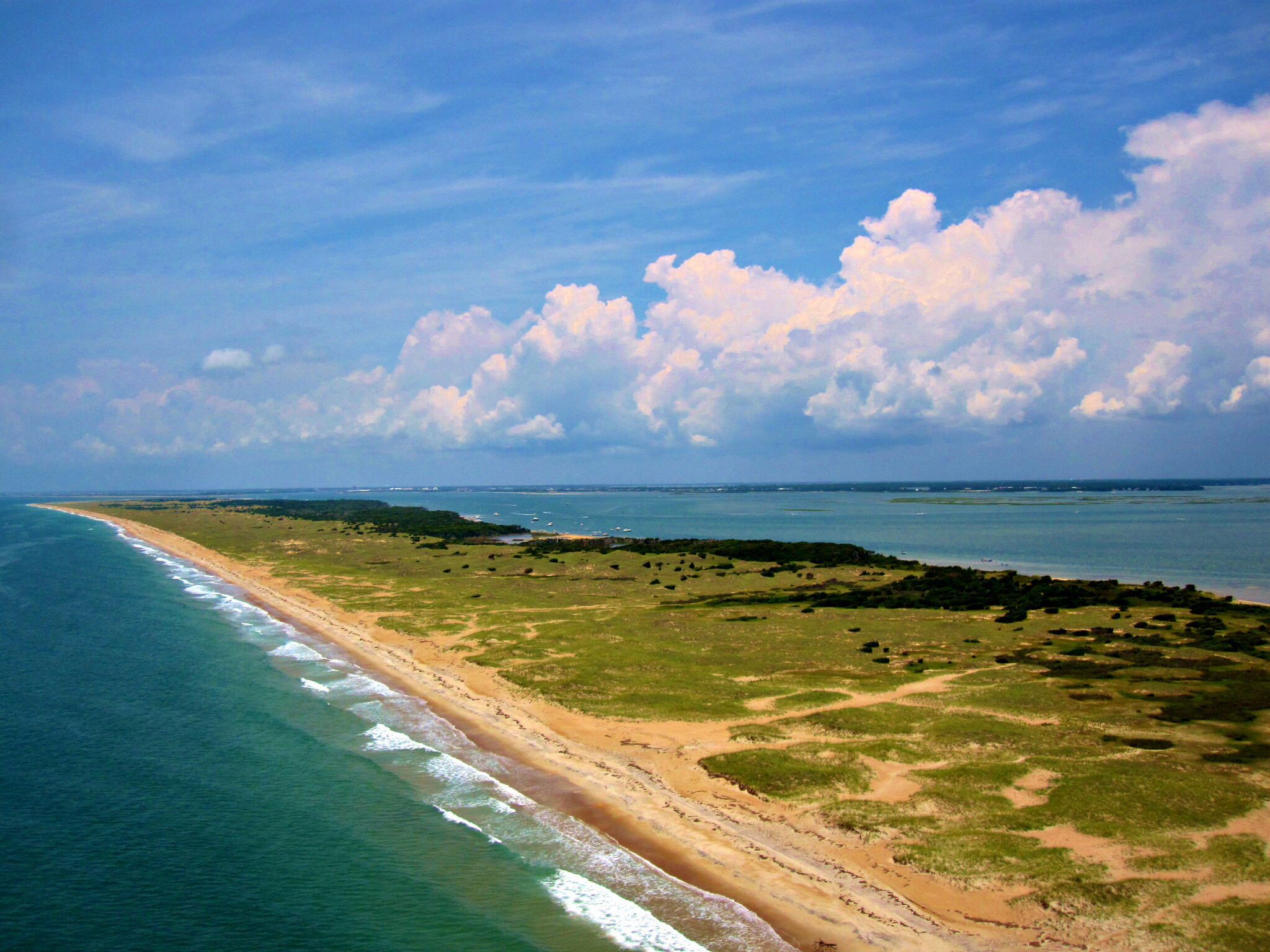


During the half-century story of the Pilentary Club on North Core Banks, it was the most grand and storied of clubs on the Southern Outer Banks. Initially built for Theodore Rogers (beginning in 1887) by the James Mason family, the Motts and finally, the Lassiter’s gathered here. Multiple generations of the Mason family served as caretakers and guides for the owners and their guests.

James Mason (click highlighted name to see further info) obtained multiple tracts of land, as grants, on North Core Banks in 1859 for 25 cents an acre. He built his home there and ran his schooner from that site. Bishop visited him there and included meeting him in his book..

After obtaining land grants from the state in 1859, James Mason built his home on North Core Banks, Portsmouth Island. His home site would be just north of the eventual site of the Pilentary . A little offshore in the sound, his schooner anchored for use in oystering and transporting cargo to New Bern or Beaufort. The Mason home burned in the late 1970s after which they moved to the Hammock House in Beaufort. He and his family were caretakers, boat builders, camp builders and guides for all owners later to come to the Pilentary.
Theodore Rogers’ archived letters include communication to Capt. Mason and Mason family members about building the initial camp, shoreside structures, the kitchen addition, and a spritsail skiff–along with other caretaker details.
———-
Lawrence Pike (a member of the Harbor Island Club) bought land in 1883 from Mason and built a home on what is now known as Pike’s Hammock–just south of the Pilentary site. He later sold his structure and land to Theodore Rogers. The Pike house was moved to the Pilentary site to become part of the evolving camp complex.

—————-
Theodore Rogers began to hunt and fish on Core Banks in the 1880s. Previously making regular outings to the Currituck area along with hunting shorebirds on Long Island, he and his friends switched their base to the lands purchased from James Mason. Mason built the initial simple hunting camp, followed by building more elaborate additions over time. Rogers also had Captain Mason and his family build a spritsail skiff, docks and net houses–whatever was needed. Theodore Rogers was the president of the Bank of the Metropolis in Manhattan. In 1903, Rogers died from “apoplexy” (now referred to as a stroke).

Nov. 1885—“We are making preparations to spend the most of January on Core Sound—that is Oakley, Nostrand and myself and possibly Rodman. Have forwarded plans to James Mason of Beaufort NC for a shanty to be put up on the Evergreens—anticipate a good time in getting ready as well as the shooting when we get there. (initial camp construction)

These were productive waters for fishermen.

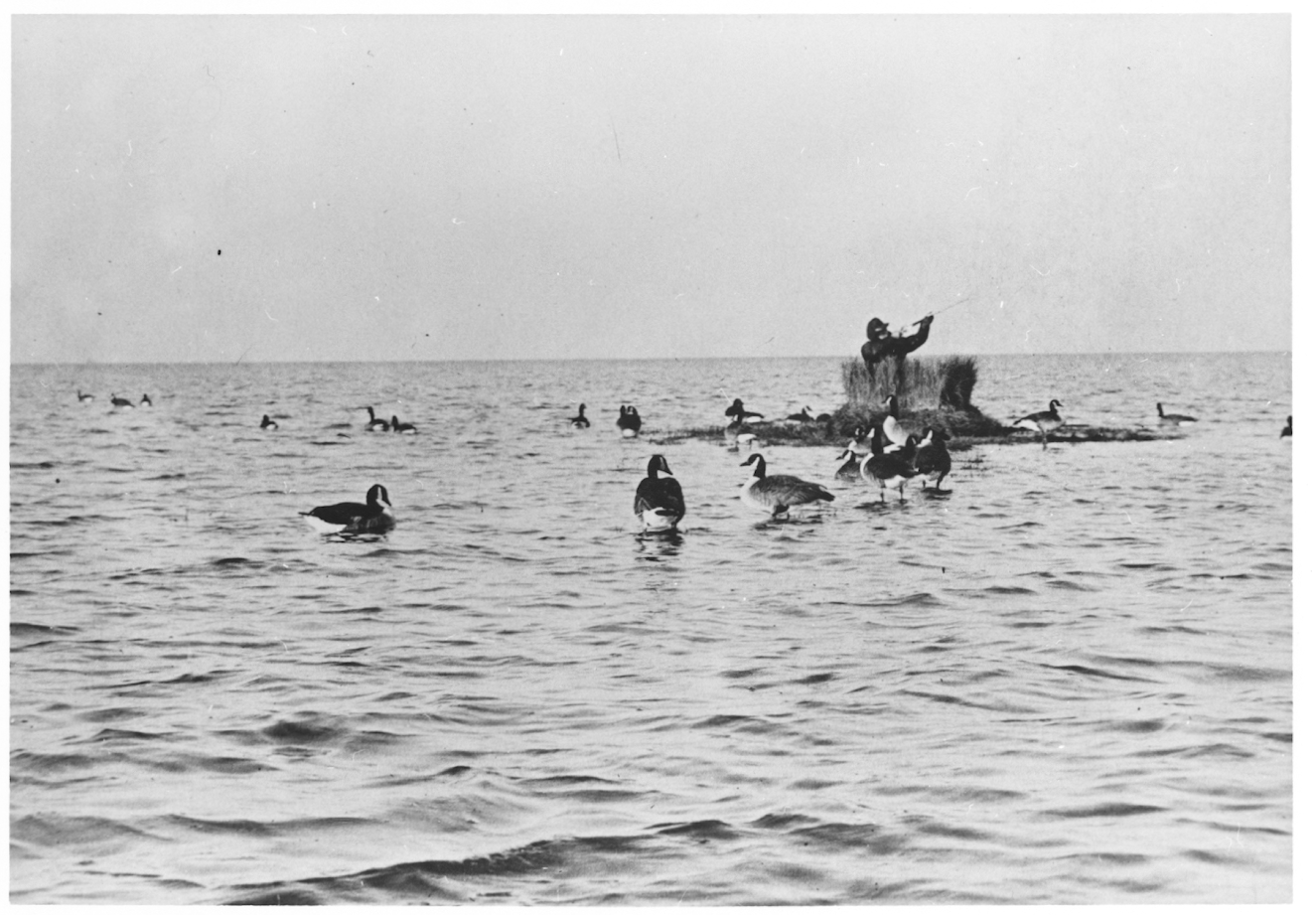
Depending on season, activities included fishing, shorebird and snipe hunting, duck hunting, and “turtling”

Theodore Rogers refers to the Pilentary on Core Banks in his journal in November of 1887. Rogers had James Mason build his initial hunting camp on the banks and later build his hunting club.
Arthur Kemp Styron obtained the Core Banks holdings from the Rogers estate, which he conveyed to Jordan Mott. Clay Fulcher (a Mason family descendant) related that Styron had never visited the site. A schooner arrived about a year after Roger’s death with the executor bringing a check to the Masons to pay them for their interim duties and ongoing care of the club site.
The Pilentary Bush

The area of the Banks and the name of the camp are thought to derive from the Pilentary Bush that grew in that area. Known also as “the toothache bush” or Hercules Club, the hard spikes on the trunk could make a formidable weapon, but Franklin Roosevelt found the numbing effect on the gums when the leaves are chewed to be more interesting. (this particular plant sits in front of the Core Banks Club ruins doorway).
Governor Broughton, encouraged by Roosevelt, sent a team to study the plant and banks area.
Nathaniel H. Bishop, 1878, made the first mention of the Pilentery region (that I have found) of North Core Banks–the region James Mason acquired by grant from the state of North Carolina. His visit to James Mason’s home is described in his book. (Voyage of the Paper Canoe-see link below)
“Half a mile below Captain Mason’s home, a short time before my visit, a new breach had been made by the ocean through the beach. About twenty years before a similar breach had occurred in the same locality, and was known during its short life as “Pillintary Inlet.” The next day I crossed the sound, which is here four miles in width, and coasted along to the oystermen’s village of Hunting Quarters, on the mainland.”

In December, 1905, Kemp (who obtained T. Rogers lands from his estate) sold the property to Mott. Later, Alvin Mason deeded two additional tracts to Mott in 1907. Alvin was caretaker and guide at the Pilentary (along with others of the Mason family–one descendant states that up to 17 of the Mason family were present there during one of the Mott visits.)


The Motts were favorites of the area–the Banks and Hunting Quarters–and they valued how they were perceived by the locals. World War I and economic shifts saw decreased use of distant camp retreats.


December 21, 1919, the Motts sold the property to Robert Lassiter (of the Charlotte area).

Robert Lassiter — (industrialist and banker) owned the lodge in its latter days. The holdings were gifted to the state as a game preserve prior to the 1933 storm. Lassiter had 3,000 acres in his holdings which were later included in the Cape Lookout National Seashor.
The 1933 Storm–an un-named storm–destroyed the lodge, leaving only the cisterns visible to mark the location over the years. They are buried in sand now.


Franklin D. Roosevelt had visited the Pilentary during the time when he was serving as Asst. Secretary of the Navy. Roosevelt archives hold a few photos of that visit.

Roosevelt climbing into the ox-driven cart driven by Alvin Mason as Mott looks on. Transportation along the banks and to/from hunting sites usually employed this rig.


Clay Fulcher, III of Atlantic related many details of the Mason family involvement with the Pilentary to the author.


Clay’s father created a hand drawn map of the Pilentary compound as he understood it from family history. The prior Pike property is to the left with a pond inshore from it.

“The Pilentary Hunting Club—
About February 1908 my cousin, who was club housekeeper for a group of men from New York, asked my father to allow me to get away from school two or three weeks that I might wait on the table for the group. He gave his permission and I went. My job was to bring in wood for three fireplaces and wait on the table. In the kitchen, they burned coal. I had a good time and for 17 days made eighteen dollars, which was perhaps my first experience in the “outside world.”
The house and equipment was about the best on the coast—the Pilentary Club.
While i was there we had a shipwreck—the “Melrose”, a three master, came ashore with a cargo of salt in the morning with a Portugese crew. There was a young man about 25 years of age who was brought along to hunt, but the main reason he came with his father and mother, was to be kept from liquor on board. Yes, he got drunk and buried severaal bottles in the sand hills.
The Pilentary Hunting Club was about half the distance from Portsmouth and Core Banks Station. Drum Inlet in 1908 was not open. This location meant both Portsmouth and Core Banks Station handled the lifesaving. Aobut an hour after sun-up, the two crews were ready to shoot the line for the breeches buoy. It was most thrilling for me to see the crew one at a time brought to the beach in the swinging breeches, often dipping in the surf. They spent the following night on pallets in the Club kitchen, which was about 15 feet square.
During a storm in September 1933 Drum Inlet was opened and all the club houses and camps on the beach were washed away. The Pilentary Club had previously been given to the Government for a game preserve.”
(“Core Sounder”—Clarence. Robinson)
It had been a beautiful age of adventure on the Banks, with successful northerners seeking escape on the banks to fish and hunt –and escape they did. They boarded majestic steam engines, transferred to comfortable ships or to functional sailing vessels to travel across the sounds for weeks to months of nature and a different pace of life. They had the resources to choose whatever they desired–they wanted to be on the Southern Banks among a resourceful and resilient people and an unspoiled environment that still appeared as if God had just completed it yesterday..
Credits:
- Voyage of the Paper Canoe–
http://ibiblio.org/eldritch/nhb/paperc/c10.html#hatteras (Voyage of the Paper Canoe–Bishop)
2) Theodore Rogers letters, journals and archives–held by Queens Library, New York City.
3. Mott Street–by Jordan L. Mott, VI–Gateway Press, Inc. 1986, Baltimore–detailing family history, including their time at the Pilentary.
4. Clay Fulcher, III–Atlantic NC–a Mason maternal family descendant.
5. Jackie Booth, Beaufort NC–a Mason family descendant–provided Pilentary photos and has Mott, Rogers and Harbor Island Club decoys he allowed to be photographed.
6. NPS files and archives
7. Clarence Robinson–“Core Sounder”–1970, self-published
8. For excellent additional history and photo content–see Jack Dudley’s books–Southern Outer Banks and Carteret Waterfowl Heritage

Leave a Reply