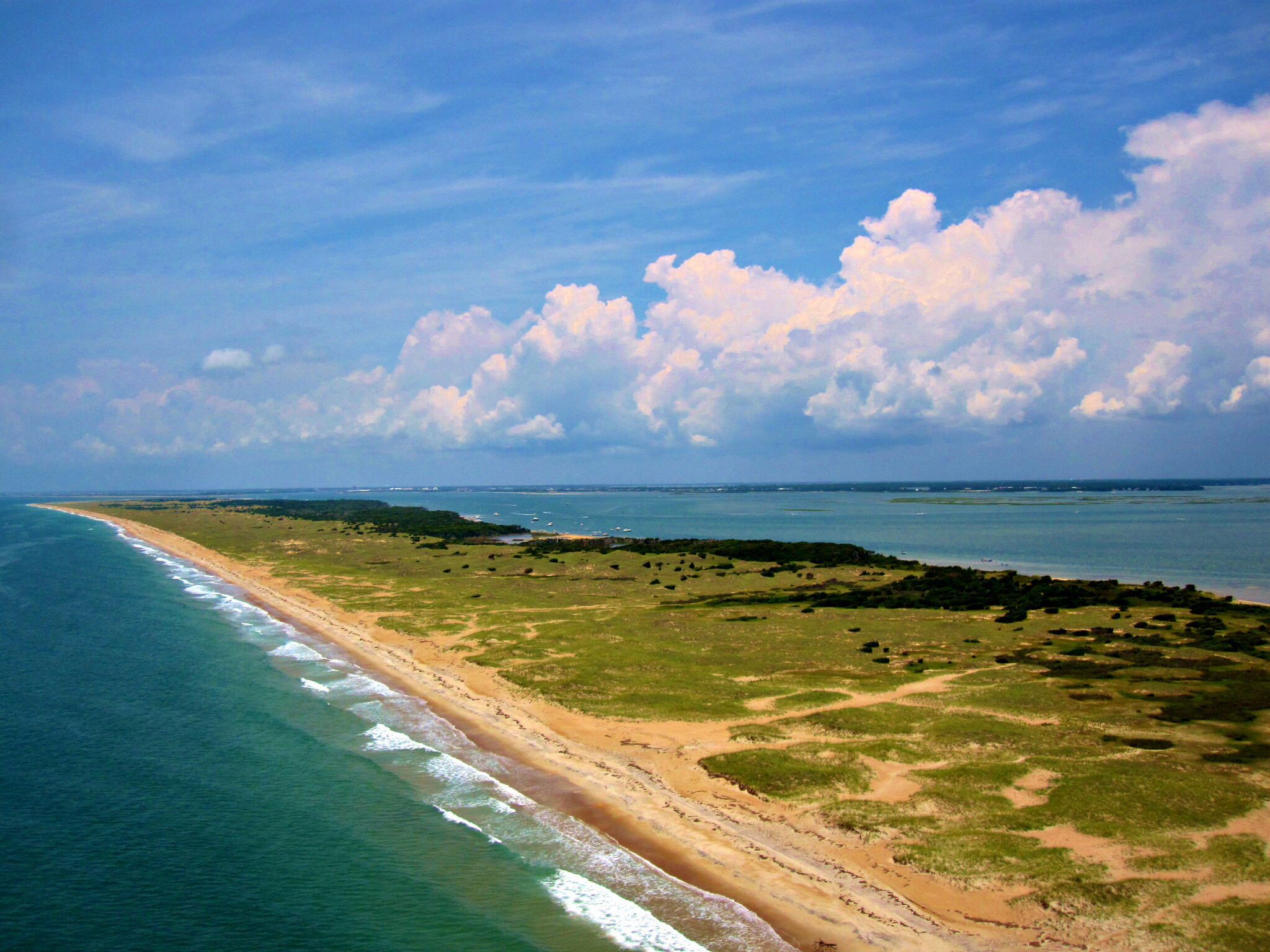


Cape Lookout Bight has always been home to fishing through all of documented history. Menhaden, Mullet, Shad, Turtles, Bottlenose Dolphin, and many other fish varieties were harvested.

“Core Banks estimated 7,000 years old“–researchers Dr. Duncan Heron and Thomas Moslow (geologists for the Park Service) determined the Cape’s age from carbon dating. Cape Lookout was thought , they said, to be much younger than the rest of the Banks although a 5,000 year-old spear point was found there in recent years.

“CROATAN. A village in 1585 on an island then called by the same name, which appears to have been that on which C. Lookout is situated on the coast of Carteret Co., N.C. The inhabitants seem to have been independent of the chiefs of Secotan. “–Hodge.
The 85 persons of that village,( it is reasonable to assume, though not documented) were there for seasonal periods of favorable fishing–seasons and migrations that still guide fishing efforts today.
Earliest Documentation

Shackleford Banks and Cape Lookout north to old Drum Inlet were one continuous island at the time–separated in 1933 by that severe hurricane. Settlers had come to what is now Carteret County in the late 1600s to 1709. Fishermen (who were also often whalers) populated the Banks sparsely.
Caleb Davis, in the mid-1700s, managed a two-story “ordinary” (providing pub, lodging and board) in the Bight. Capt. Lobb (of the Sloop “Viper”) erected a 50 foot flagstaff near the Davis House to guide vessels to a favorable anchorage.


A notation on Christoph von Graffenried’s map of New Bern in 1710 described Core Sound as being populated almost entirely by Englishmen, who furnished seafood of all kinds to the settlers.–Charles L. Paul
Fishermen based on Shackleford Banks and Cape Lookout sailed or rowed their catch to Beaufort until the 1933 storm cut through the area now known as Barden’s Inlet. Gasoline motors became available only after the 19-teens.
Whaling–

Orlando Phillips was interviewed by Bruce Weber regarding fishing and whaling in this region–to explore more, click the red link.
Whales stranded on the beach comprised about half of the total number harvested thru the years. The last whale captured in the region was in 1916. Reeves estimates that about two whales per person in the population were harvested in a lifetime–see his excellent research, linked in the references below.
The oil and baleen brought necessary cash or barter to items that the resourceful Bankers could not grow or harvest seasonally.

Fish Houses and Fishermen at the Cape–1870s-early 1900s—
The next earliest documentation of fishing activity at the Cape was the 1914 court case, but ongoing activity since colonial times is certain. The evolution of a large (population 500) community at Lookout Woods (later renamed Diamond City) was composed of such individuals.


Cape Lookout Village, Rose Town and the fishing village on the Cape were said to have had 80 structures at their peak–with school and post office during one period. There were full time residents and seasonal fishermen as well–the ratio is uncertain.
In the late 1890s, Bankers suffered several storms–The tide washed over the graveyards and exposed the skeletons there. Livestock were lost, water supply was corrupted and the gardens were sterile due to the deposited salt. They had lost boat, nets, gear and homes.
David Yeomans-:-HI Fishermen–after everyone had moved away, “the fishing crews had to get re-established. Some of the crews went over to Cape Lookout and built small shanties, one for sleeping and cooking and one for storing the fish. Mullet fishing was the only type of fishing done then because there was no refrigeration for other type of fish. The mullet were split, washed and salted in barrels.”-(-Ann Rose–Harkers Island Past and Present)

A 1914 Court Case regarding ownership (excerpted at this link) offers a partial snapshot of the numerous fishermen based at Cape Lookout during the period 1850s-till 1914————-more than 50 individuals are mentioned in this single document
Porpoise Factory–of Mr. Dye–at Lazy Hill is discussed in this testimony. Porpoise were caught and processed for their oil and skin–they were brought ashore to Lazy Hill and “tryed”, i.e. processed there

positioned between the Lifesaving Service and their station and the keepers quarters of the lighthouse contained the cluster of the Cape community.

Cape Lookout had its own Ichthyologist—-Russell Coles

https://davidcecelski.com/category/shark-hunter-russell-coles-at-cape-lookout
Russell Coles was intrigued by marine nature and seemed driven to find challenging approaches to exploring creatures of the ocean.

Coles became expert in the capture of sharks and manta rays (using self-made harpoons) and helped establish the local “shark factory” harvesting skin and livers for commercial use–See the Cecelski link– in red –above for more.

Marine specimens were acquired and sent to the Smithsonian, to Paris and to other European museums. Publication of many research articles on marine anatomy and behavior brought him acknowledgement and respect in the scientific community.
Teddy Roosevelt developed a deep friendship–a kinship– with Coles as they planned and experienced marine adventures together.


Lucy Moore Benjamin and husband Carl (Navy Radioman at the Cape) lived in a small 3 room house near the station. She remembers about a dozen houses and one store at the Cape while Carl was stationed there in 1924-1925—about 30 people in all. Ms. Benjamin told that during fishing season “more would come on a temporary basis”.—-1979 Bruce Weber interview.

Russell Coles’ time at the Cape overlapped the period when the jetty was being constructed–led by Carl Josenhans. Josenhans photographed Coles there.
Local fishermen assisted Coles through the years and also supported Coles and Teddy Roosevelt’s Florida Keys adventures.

David Cecelski weaves together the story of our local fishermen who supported–enabled–the research and adventures of Coles and Roosevelt.

Turtles
Harvest of turtles was almost exclusively done for personal and local use–with the exception of the Diamondback Terrapin, which were localized in the creeks and marshes of the sounds.


Diving on turtles was a method originating locally–grabbing hold and forcing the turtle to the surface before boating them–documented in local history of the period.

“Black Fishermen”
This name given to the group of Scandinavian fishermen who (in the early 1900s) fished offshore for black fish, Black Fishermen used the Cape as their harbor of refuge in times of dangerous stormy weather.
Impact of the 1933 Storm

The Storm of 1933 brought dramatic changes for fishermen who were based at Cape Lookout. Motorized vessels and availability of ice had begun changes, but the storm’s opening of what is now called Barden’s Inlet gave favorable access to the Cape and back to various fish houses by another route. The exodus from Diamond City and Cape Village had already occurred by 1901 due to severe hurricanes.
Floyd Simmons–built an outpost of the Morehead Villa Hotel for fishing by his guests (click to red link to learn more)
1926-1939, two week excursions at Cape Lookout was one offering for sportsmen wishing to fish and hunt there. Though elaborate plans were rendered, the actual facility appears spartan.


Simmons failed in several Cape projects . Developers, before and after, failed to succeed at capitalizing on the Cape’s special setting. We are fortunate to have the Cape in its “wilderness” form and they are fortunate that they did not lose all their proposed aspirations to relentless forces of nature.
Pogy Boats–the Mighty Menhaden
Steve Goodwin tells this part of the story best in his two books (reference at bottom) and in The Researcher, 2010.
In 1865 the first menhaden factory in North Carolina was established on the shores of Harkers Island (I believe it was called Harper’s Island at the time). Without a doubt, it was just a simple
operation, consisting of iron kettles for cooking the fish over open fire, wooden hand presses for removing the oil from the fish, and the fish scrap being spread over an open area to be dried by
the sun. They would be turned occasionally and covered if the weather was bad. The fish were caught in gill nets from open skiffs or sail craft. This operation lasted until 1873, when the fac- tory equipment was moved to Cape Lookout, but it never continued in business at that location.’

for Menhaden Fishing Days–David Cecelski–click the red link above
Mullet Fishing–James Rose CALO interview


DANNY ROSE’S LUMP—James A. Rose CALO interview

“The Great Marsh Island, well, it’s like this now, that name has changed—this is, we call it Danny’s Island….Rose’s Island. He had a little camp built right on here, had a net spread and everything on there.”. “Yeah, he had his little boat and had his net spread right there, right next to the camp. The camp was no bigger than this room. it was real little….I would say 12 by 14 feet. It wasn’t big. You have bunks in one end of it and a little table or something to sit down to.” (James Allen Rose Interview—CALO project—Connie Mason)
Samuel “Leeby” Willis remembers the house just to the west of the drain, on a small sandy lump and felt that he may well have lived there….just as you went around the turn, there was a lump..it was a lump off from it and he built a camp on it. It was always sitting out by itself, surrounded by water all the time…What you done, you used a skiff whenever you had to and walked across it when you could.”
!950s in the Bight

DOUG GUTHRIE–grandfather of Parker and Evan–of Harkers Island (2-25-21 interview)—
In 1958, and years surrounding, Doug fished out of camps at the Cape during fishing season/ seasonal favorable times , such as, late summer and trout season.
He initially fished and lived with Albert Wade who had a camp near the lighthouse–labelled #1 on his representation on a nautical chart. The structure, and also the other 3 camps he marked, were rectangular simple construction with simple furnishings and a kerosene stove.
Jim Miller Willis had the next camp (#2) moving further from the lighthouse. He was described as older than the others. His son, Bonner, was there part of the time.
Further still was the camp of Worth Davis positioned on a “high hill”. (#3)
Telford Rose had the next camp (#4), even further from the lighthouse. Telford was described as tough–the toughest. Doug joined Telford to fish and live after Albert had stopped. In the bight of the cape, they would run out a long net after the moon went down and pulled it in after overnight .
Doug knew Fred Guthrie well and also Dr Fulcher–he said Dr Fulcher was such a good doctor–not like any other. Especially, he could care for a stingray injury so much better than others and certainly better tan today. Dr Fulcher would cut out a core from an area injury by the ray stinger
H remembered Jack Davis at the Cape, as officer in the Coast Guard–being a little wild, he died after rolling over his jeep while riding wild over the dunes.
Doug went on to commercial fish in Florida and later ran a small scallop house in Harkers island with his brother. He invented the mechanism to “kick up” clams,
Several camps remained in the 1970s as the National Park Service established the Cape Lookout Seaashore
——Skeletons of three centuries of heritage—–

James Rose, in his CALO interview, told of the fishing camp his mom and dad had at Cape Lookout. He told of Billy Guthrie’s camp as well “towards the Glade” (an area of tall grass and water). Made up of marsh and sand, the Glade was the site to ” go up in there ever so often and shoot a couple of dicks or something”
The Rose camp had “bunk beds, everything that they had in there. An old wood stove. Well, he (dad) sold it to another guy–Dallas Sutton”.
The Roses had another camp in Cape Lookout Hills. “my first trip to the Cape was a fishing trip. My dad decided he would take me over there and I was only five years old. I remember, Connie, playing with that little boat. I remember that from camp. The camp was built on short pilings, but I had plenty of room to walk under it because one night while we were there Uncle Edwin, he stayed to the camp to clean up from supper. And he did the cooking and cleaning. They left him in the camp to do that. That was his part. Edwin Hanson Rose.


Captain Jim-Bob Willis–structure #4
Terry Reeves remembers his name as “Jim Bob Willis” but though Terry helped build the A-frame Reeves cottage, he remembers no structure on the site. Bud Doughton remembers this or a cottage similar more toward the point atop a dune.
Terry recalls it being told that Capt. Jim Bob would take his boat across the submarine net at night to take vegetables, produce and supplies out to the German subs. “Harkers Islanders were not too much invested in that war”—at least at that time.”
Les Moore was in a platoon watching for local interaction with subs—that platoon’s raid caught a boat near Core Banks in the act of meeting German sailors. The capture resulted in several German POWs and local “traitors”—as told. Both Les and Sallie told this story to David Reeves.
(history provided by Sam Bass after consulting Terry Reeves)


Cape Lookout Seashore –the new era


Keith Rittmaster established a Marine Science program at the Cape–in the decommissioned Coast Guard Station–the Casablanca gang always stood ready to help Keith.


Keith Rittmaster led research on Cape and Banks marine mammals. “Spy Hop”, his vessel upgrade were funded by the Casablanca crew.
Congress mandated return of the Seashore to a wilderness status as it was established. Vigorous and persistent advocacy by fishermen brought continued surf fishing and controlled vehicle access.

Cape Lookout is a magical spot. More than three centuries of known history and thousands of years of fishing in these waters supported Native Americans.
This story, I realize, is only partially told here. I have enjoyed exploring the topic , but I have learned that many individuals have already brought this history forward. David Cecelski, Jack Dudley, Barbara Garrity-Blake, Steve Goodwin and Connie Mason and others have helped preserve this history. I thank the all sincerely.
Next, I will move on to explore and present the story of South Core banks and North Core Banks and their special history of fishing camps and commercial fishing. Share this site with others if you have found this interesting. Stan
References—
–Handbook of American Indians North of Mexico–edited by Frederick Webb Hodge–Smithsonian Institution, Bureau of American Ethnology–1907
–North Carolina- Carteret County During the American Revolution—1765-1785, edited by Jean Bruyere Kell—Carteret County Bicentinnial Commison, 1975.
–The History of a North Carolina Town, Charles L. Paul, 1965–found on the Town of Beaufort web site noted below:
—https://www.beaufortnc.org/media/3471
—Reeves–History of Whaling In and Near North Carolina, Randall R. Reeves and Edward Mitchell, National Marine Fisheries Service, March, 1988—NOAA Technical Report , NMFS65
Steve Goodwin–Beyond the Crow’s Nest–the story of the Menhaden Fishery of Carteret County, N.C.


Leave a Reply