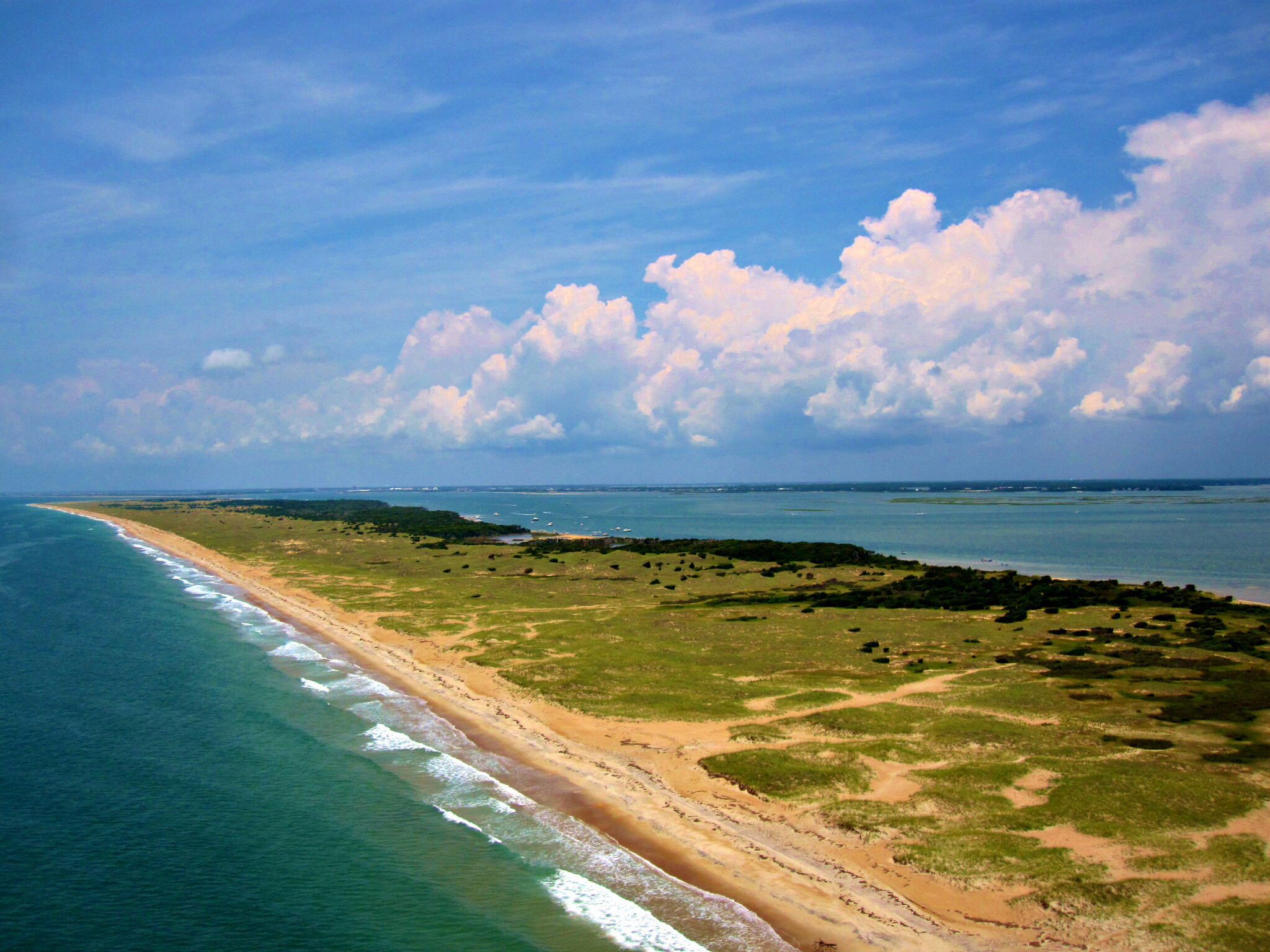

“He used to sit for hours in the sun and stare out over the sea, with a far-off look in his eyes—Like he saw eternity.”
“And playing near his feet, a child followed his gaze ‘out there,’ And having a curious nature–moved closer to his chair.”
“What do you see out there, Ole Pa? There’s a sad look on your face….And down a wet and furrowed cheek–A tear small fingers traced.”
“The old man lifted his hand and said, “Out there.”–but with a second thought, “oh no”, I mean o’er they’re on Shackleford Banks–are the wonder years of long ago.”
(Gretchen Guthrie–The Old Man and the Child–Carteret Love Song)


It seems clear to me(the author) that when the C’ae Bankers moved their homes from Diamond City and Shackleford Banks following the storms, their souls seem to have spiritually kept one foot in the sand of their old home and another foot at their new home, leaving their hearts straddled and hovering over Back Sound–the waters that had always sustained them.
There has been, and remains, the desire to stay justifiably connected over time and distance–for themselves– their descendants and for those “from off” (like the author)–to understand and preserve the memory of a special place and time.

Ira Lewis map–from memory–

excerpted/adapted from:
The Outer Banks of North Carolina, David Stick-1958
[ “There is something akin to reverence in their voices as they talk of Diamond City and a note of longing for the happy days in the whaling community on the Banks before the storm came. Let them tell the story of Diamond City as they knew it as children in the 1890s…..” ]
Acquiring the name Diamond City about 1885, this community about a mile west of the current Cape Lookout lighthouse had been earlier called Lookout Woods. Though brothers-in-law Enoch Ward and John Shackleford acquired and divided the Banks in 1723, the earliest permanent house built there by the 1760s was attributed to a man named Davis. The heirs of John Shackleford had earlier sold several tracts of the Banks along with fishing and whaling rights in the 1750s to Joseph Morss and Edward Fuller. Also, Captain Lobb of the H. M. S. Viper, 1764, on his detailed survey of Cape Lookout showed several structures just west of the cape which he labelled “Whalers Huts”.
With the first U.S. Coast Survey of Shackleford Banks, the whales, porpoises and mullet had attracted a sizable community. Several buildings were shown on the beach and a larger settlement was located at “Lookout Woods”—a mile or so from the 1812 lighthouse—according to Stick.
By 1880, there was a veritable city in Lookout Woods. A number of people were employed in the Gardiner porpoise processing plant. The settlement had no established name, being called ‘the eastern end” to differentiate it from th settlements of Wade Shore and the Mullet Pond. The settlement near the lighthouse was known as “Cape Hills”. Joe Etheridge suggested the name-“Diamond City” in the winter of 1885—the name took hold..
“Who lived at Diamond City?” ……Tom Salter and wife Jenny Lind; widow Caroline Salter and sons John, Tom and Sam and daughter Nicey; Yankee soldier James Johnson who married Sally Ann; Charley Hancock who ran a store; his wife Aggie and children Louie, and Louisa; the Willises (so many); one family of Nixons, another of Wades; two named Styron; and the Yeomanes and Roses.————Wade’s Hammock housed some Guthries, but most were Lewises, Myerses, Moores and Davises.
With 300 to 500 people—Diamond City was spread over half the island. Maybe a hundred or more lived on the other end of Shackleford Banks—Wade Hammock and the Mullet Hole ; five families at Kib Guthrie’s Lump and Sam Windsor’s family at Sam Windsor’s Lump; —there were many graveyards—-little ones —off beside the houses and one big one—the Ben Riles Graveyard (as they called it)— right in th middle of Diamond City—with as many as 500 graves.

Other stores besides Charley Hancock’s—Ambrose Lee Guthrie, Clifford Hancock—small stores carrying a little bit of everything—and a man named Johnson who ran a boat to bring supplies and mail to the stores from Beaufort.
The people built a big schoolhouse at Diamond City (Tom Arendell of Morehead taught there)— —used only a month or two in the summer—another smaller schoolhouse was down at Wade’s Hammock.
The schoolhouses also held services of the Methodists, Baptists, Mormon and Pentecostals when gathered—Pentecostals also held large camp meetings on the Banks—for 2-3 weeks long at times.

Boatbuilding, of fine whaling boats and workboats, was a part of Shackleford Banks culture–Devine Guthrie was a whaler, minister and respected boatbuilder
(more from David Stick)
Midwives did most of the doctoring at Diamond City—Margaret Ann Willis and Rachel Willis.
The porpoise factory started by the New Jersey man (Gardiner) lasted only a few years, others tried an oyster house (Druden) and then a crab-packing house owned by a big company. People caught the peelers and sold them to the plants, and when the peelers shed, the soft crabs were packed up and shipped away. In 1897 or 1898, some men came down from up the Banks to try sturgeon fishing.
Of course, whaling was key to the community spirit and subsistence. (Stick discusses this in more detail)
The people at Diamond City had built their own homes or their ancestors had and many had been moved there from other places. Eugene Yeoman, for example, had built a home on Harkers Island about 1870, then tore it down and moved it to Diamond City board by board, where he set it up again by 1888. Another man moved his Diamond City home up the Banks to Guthries Hammock, then back to Diamond City again, taking his house each time he moved.
William Henry Guthrie was first to leave after the 1899 storm…..After that, there was hardly a week went by that some house wasn’t torn down at Diamond City, loaded on sailboats, and moved across the sound to Harkers Island. It kept up all thru 1901 and 1902, and by 1902 there wasn’t a house or person at Diamond City, only some old deserted shacks and what was left of the graveyards.
Some houses were torn down board by board and rebuilt. Others were cut in half, or even moved whole, using a couple of boats joined together by big planks. sort of twin-hulled barges. It took only two or three days to move a house—and 30-40 men joined in to help—no money exchanged—in turn, getting help when they moved their home—the owners only had to provide plenty to eat.
The people from Diamond City lived in the their same homes after moving off and, naturally, kept right on doing what they had at Diamond City before—they fished for mullet and for porpoise off the beach at Diamond City, and in February, March and April, they set up their watch for whales—camping there for weeks at a time—where their houses used to be. But the whales stopped coming?—(last one caught in 1909) — and even the fishermen eventually stopped going back to Diamond City—leaving only their stock to graze along the paths and streets.
(Joel Hancock shares)
My Aunt Lee in her history says that by nineteen o-one, there would be no one left at Diamond City, it would be a ghost town. In the meantime, Harkers Island had gone from being twenty eight families, to almost two hundred families in a matter of two years. And so, it had been cataclysmic for both places.
The first Mormon missionaries stayed with family of Tyre Moore, Dr. Moore’s father, at the mouth of Whale Creek, at their arrival. Whale Creek was an area rich in fig and chainey trees (Chinaberry trees)—eighteen families in that area at that time—nearby was the home of the Sam Windsor’s family– near the dipping vat.
Diamond City’s terrain was dominated by the large sand hill that sat right in the middle of the community. And some of the people over there had houses on one (dunes), often having a house on the sound side protected from the southwesters, and then they had a fishing camp on the other side ( Diamond City having been called Lookout Woods until the eighteen eighties)
Between Shackleford and Cape Lookout obviously then, was not Barden’s Inlet, it was place that they called the “ditch”, and it could be walked across, especially at low tide.
. The homes in this city (Diamond City) were small, very little and small, however, one couple Mr. and Mrs. T.W. Styron had a two room house with a bed in each room. So the good people in this neighborhood made arrangements that these two people let us (the missionaries) stay with them and the others feed us.

When the Bankers left, some moved the bodies of loved ones near their new homes–at least five cemeteries existed on Shackleford Banks in addition to smaller family cemeteries alongside home settings on the Banks.

Wade Shore Cemetery still can be found up from the shore–all others are under water, washed away or difficult to locate. See Shackleford Cemeteries for more
(Excerpted from Mrs. Earl Davis and Thelma Simpson)–Cape Lookout Interviews:
At Whale Creek, the fig trees grew dense and wild…”a small church had been built there by the Southern Methodists, but it was used by any denomination that needed its facilities.”
These “proggers” of Back sound—made their living amid the marshes and on the tide plain that skirted their island home. Rich with bottom fish, shellfish, flounder and crabs, the tide plain offered harvest from the shallow sound…”There, literally at the water’s edge, was nearly everything necessary to sustain their humble way of living.”
———-“But they were unwilling to effect a total separation from the only home most of them had ever known.”
————“Refugees from the Banks still would be able to gaze across to the sites of their former homes.” The proximity allowed them to continue to work the same bays and marshes they had known so long and so intimately before having been forced to leave.
“Another distinctive tradition that followed these newcomers (of HI) was their passionate love for both the hunting and eating of loons. A 1900 visitor to Diamond City documented the hunting of loons by the remaining popultion there—gathered on the beach shore to “shoot at loons” —“a community hunt”. (for more on Loon Hunting see)


Many established new homes within their sight, across Back Sound, of the site of their prior home. They fished and harvested from the same creeks, marshes and sound that had always sustained them.
Stella Yeomans—(b. 3-18-04) recalls– at the North end of Shackleford near the Mullet Pond and Cemetery.
“Her Banks family home was a two-story house up in the woods surrounded by a white-washed picket fence.
..they ate well..taters, collards, summer watermelons, had a milk cow and pigs..goats..chickens and a bounty of seafood—in winter, wild ducks
—she visited grandpa Joe Lewis— was wed there to Furnie B. Yeomans

Mrs. Earl Davis shared:
“Shackleford…near Mullet Pond… One family was known as Brady. Charles Brady, a peddler from Virginia, fell in love with Ella Lewis on some of his trips to Carteret. Before too long, they were married and lived the remains of their life there.
Fishing was foremost (of occupations)—some earned money by building boats…when whaling season was over, and the fish weren’t plentiful, there were always the oyster rocks and clam beds to furnish food..…they often turned to these to make a little money also..
Before the storms began to come so often, all who wanted to could have gardens. Some have told me of sweet potatoes, as well as other vegetables, which grew well there. …they remembered having all the fig and peach trees they wanted…some had a few cows and there were always pigs in the pens to kill when winter came.
Their homes were simple ones ..and what little furniture there was in them was made by their owners.
“Another thing the women were noted for was the pride they took in their simple homes —floors scrubbed spotless..chairs as well.…most of the furnishings were unpainted , as well as the floors—and everything had to be cleaned——“You must have some of that Shackleford blood in you”— was given as a compliment.
Bankers had little in the way of social life and entertainment—though they had the moonlit night walks,
Summer Camp Meetings…near Tyre Moore’s home—held in the two school buildings—Diamond City and Wade Shore—being used as churches also—the school, of one room, lasted a couple of month.s only—the last school closed in 1915 at the Cape when the population was only 15 at the time.

Thelma Simpson- in —Our Sacred Past—related—
Sam Windsor had died before 1850, but his descendants were still living on Shackleford Banks, but according to oral history sources, they all left when the storms of the 1890s forced most of the residents to leave the Banks forever.
In 1915, —“we took a boat trip over to these Banks in search of grapes, which we had been told, were plentiful. There were plenty of grapes, but plenty of chiggers too. Only one house remained in that area, in which lived a man named Joe Lane Lewis, who gave us water from a cistern located fifty feet out on a shoal. (These remnants can be seen even now at low tide.)
Joe Lane Lewis—maternal grandfather of Stella “Stellie” Yeomans—b. 1904 at Cape—
————Loving his home (Shackleford), he spent most of his time living there after others abandoned land and homes.

Between Bald Hill Bay and Whale Creek lie the remains of the old livestock “dipping vat” and the site of a small cemetery documented by a NPS survey to include Sam Windsor’s grave.
Staying Connected—
As they left their Banks homes, many positioned their new homes within sight of where they had left part of their soul. They continued to fish the waters of Back Sound and reap harvest from the same creeks and marshes which had always sustained them in the past.
Their surviving livestock—sheep, goats, pigs, cattle and horses—still grazed the deserted paths but Shackleford still served owners as a natural pasture. Pennings of horses, cattle and sheep continued till the 1970s. The events were of regional interest.


Bankers continued to harvest ducks and loons in season—often in community hunts—though the robins and “tee’-tee” birds may have been spared. Till the 1958 federal intervention, loon hunting was a right of passage for young men. (see The Last Loon Hunt post)
Descendants keep the memories—the heritage —alive in their poetry, books and story telling. While doing almost 200 interviews, I have been pleasantly surprised to hear young people (four or five decades my junior) tell me that when their toes touch the sand on Shackleford, they have feeling of coming home. This is the essence of what Banker descendants have hoped to pass forward.
Camps on Shackleford Banks —the focus of this historical blog—involved thousands of Carteret citizens and C’ae Banker descendants. The spiritual connection to the Banks has validated the special, and likely, never repeated, story of resilient, self-sufficient people in harmony with nature and in community with neighbors. They not only survived but flourished in a challenging setting. They would likely choose to go back, it seems, from the memories they share.


Ther upcoming Diamond City Homecoming celebrates these ongoing connections. Being “from off”, and having so many special people share their story with me, I get it. I value it— and I honor it. Yes, descendants are absorbing these stories and—yes again, it has also become a hallowed spiritual part of me.
…….”The wise old Banker once said:–You have captured the Spirit of the Coastal banks.
I thought about those words, then felt I must reply: –No, the Spirit of the Banks has captured me.”
(Billie Jean Huling–The Child’s View of the Coast)
References:
Carteret Love Song–Gretchen Guthrie Guthrie–1975
The Outer Banks of North Carolina–David /stick–1958
Island Born and Bred–Harkers island United Methodist Women–cookbook-1987
Ethnohistorical Description of /four Communities Associated with Cape Lookout National seashore–Barbara Garrity-Blake and James Sabella–2009
Core Sound Christmas, Christmas Kin, Remembering Christmas Past, Old Christmas Memories–4 books presented as Seasonal Keepsakes from The Mailboat–1990-1995–by the Core Sound Waterfowl Museum
Strengthened by the Storm–Joel Hancock–1993 –(as well as, excerpts from talks/interviews)
National Park Service files and archives–including interviews


Leave a Reply