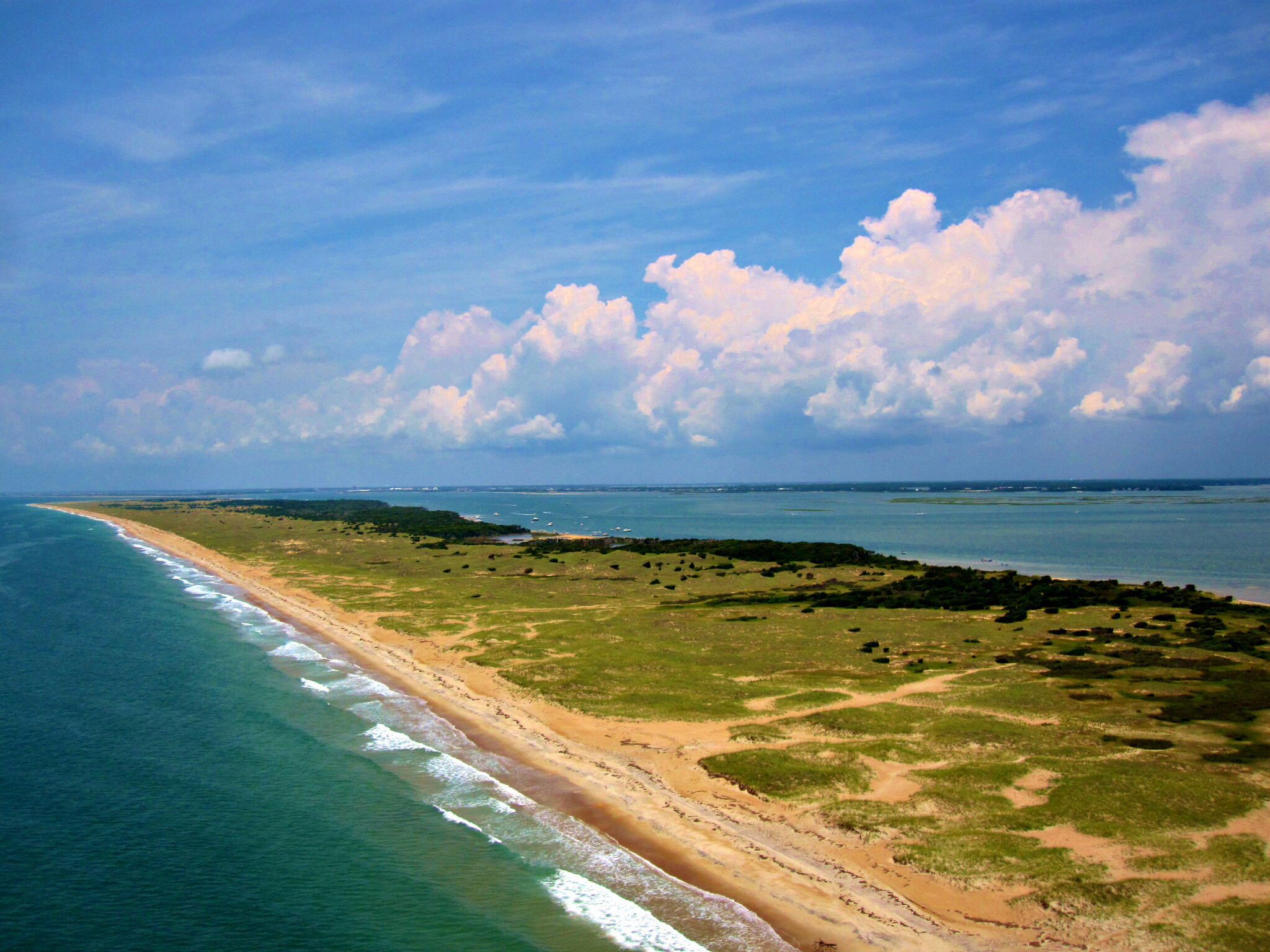


“ I want to climb that hill one more time!”—he said to his son. Then Leslie Rose began stripping to his boxer shorts and climbed over the gunnels into the shallows near the shore at the Cape– and began wading ashore to ascend the hill that still sat, and sits, as a landmark of the site of his childhood home and the keeper of memories of Rose Town. Leslie’s son and family had dedicated the day to an outing to Cape Lookout and “Diamond City” (what they called east Shackleford Banks) in the late days of Leslies’s declining health from cancer—his last pilgrimage.
Granted his last known wish, Leslie stood on the tip-top to look out over the ocean. Rose Town surrounded this hill in his childhood. He had left the Cape when 12-14 years old.
Tillman and Hettie Rose’s brown house, (above) sits to the left, with the hill visible behind it–the same hill Emma Rose played upon in later years and the site of the WWII machine gun nest, positioned for its broad high view of the beachhead. (the stone remains of the machine gun nest remain to be found there). Emma Rose played there– just as her dad had—a touchstone.
Emma Rose Guthrie, 93, provides the historical, genealogical and spiritual link to Rose Town through her dad Leslie and grandparents Tillman and Hettie. Though born in 1933, after the Roses had moved off the Cape, her summers were spent at the Cape with her beloved Hettie. Emma Rose has memories both of the pre-WWII and post-WWII years there, of the Bakers and other community members, and of the rich freedom of childhood experiences in the shadow of that “high” hill.


Besides Tillman and Hettie Rose, others at Rose Town included:
John and Laura Rose, George and Maggie Mae Fulcher Rose, (Maggie Rose-served as Postmaster in 1915), Thomas Rose, Daniel Rose & Luther and Lydia Willis, Samuel Wllis, Jimmy Lewis, Odell and Agnes Guthrie, Horace Nelson, Leslie Moore, “Bull” Hunter, Lafayette Jones, Dominic and Mary Asdenti and Luther and Hanna Guthrie.
———————–
Early in the 1900s , the Cape mullet fishermen functioned in crews—including the “Cape Shore Crew” consisting of Tillman Rose and sons—Iredell, Howard, Charles and Leslie.
Other crews were:
—Cape Hills Crew—John S. Rose, and sons John W., George A., Thomas, Joel and Dannie.
—another Cape Shore crew: George Rose and sons Telford, Edd, Dallas, and Cletus.
—Wreck Point Crew: Eugene Yeomans and sons Walter, Dan, Luther, Fernie, and Kendall.
—the Hook of the Cape Crew: Alfonzo Guthrie and sons Allen, Billie, Louie, and Alfonzo’s brother Henry Guthrie and his sons Johnnie, David, and Odell.
—a second Hook of Cape Crew: Sam E. Wllis and sons Kelly, Sammie, Luther and Eddiie.
The head of each crew or household, by census records, owned their own houses in the community.

“Fisherman Tillman Rose had been living on the Cape for more than thirty years.”—a statement based upon a US census quote-census data of 1880, 1900-1910. Emma Rose , however, relates that he had been born there and lived there till he and Hettie moved to Harkers Island—to a site on the shore that looked across Back Sound to their generational family homes.
Tillman and Hettie’s Cape house was at the base of a hill—the highest hill in the area—across from the current site of David Yeoman’s Boathouse. A large cedar tree alongside the sandy road, by Emma’s childhood memory, had “Rose” carved into the circle of a large cut-off limb at the entry to the village.
Tillman and Hettie owned 30 acres at the Cape and 15 acres on Shackleford Banks, Emma believes. She relates that their holdings were “stolen” from them. A 1921 deed documents transfer of ownership from the Rose’s to the Cape Lookout Development Company–encompassing larger holdings of lands from Horsepen Creek (8 miles north of the lighthouse) to the the “middle camp line …near Diamond City”.
Hetties’ twins were born in 1928 and Tillman died 2 years later (1930) after an epidemic (flu?). He did get his wish to live long enough to see the twins walk. Hettie died November 11, 1951. Leslie was born in 1907—and died at 79 years.
When they had moved to Harkers Island (about 1919) , they had a house near the present Rose Brothers Boat Works.
Emma remembers a large willow tree at the edge of a bank there—her grandmother would send her up the tree to see if the fishing boats—sailing skiffs (and rowing dories)—were returning from the Drain , from the fishing grounds, so she could prepare for the supper meal.
Emma and Garland Guthrie, after WWII, had use of a friend’s cabin at the Cape, across from the army dock—till it was washed to sea in a storm. Connections to the Cape were carried forward.
The short-lived Cape post office opened about 1910 and closed in 1911.
The Cape Lookout School operated from at least 1900, with teacher Charles S. Davis living on the Cape in that year. The one-room school led by teacher, Mrs. Pearl Whitley of Harkers Island, had twenty-five children in attendance in the mid-1910s. The school closed at the end of 1919. Some thirty to forty houses were moved from the Cape to Harkers Island—the population had declined from its peak in 1900.
The houses left at the Cape became fishing shacks, with only Life-Saving Station crews and lighthouse associated familes remaining as full-time residents—by one account.
Yet, the 1920 census still records 16 families living on the Cape, including 64 year old Tillman (misspelled Tilmon in some documents) Rose, who with his son Howard was still fishing.
In the 1920s, Dominic Asdenti, “Bull” Hiunter, and Carey Davis still operated stores at the Cape. The mailboat came twice daily, at 7am and 3pm.
Fred A. Olds (who had been instrumental in establishing a school at the Cape in 1900) —returning to the Cape, found the Cape mostly abandined and wrote “Cape Lookout, Lonesome Place” {1921 Orphan’s Friend and Masonic Journal article—full article below)— Jack Dudley exceprted—“he noted that only two or three famiies were living there year round and most of the houses were shacks, innocent of paint”. Olds went on to note that “ the landscspe was littered with thousands of rusted cans, and grass or anything green was conspicuous in its rarity”. (A foreshadowing of the situation with debris the Park Service would face at the Seashore’s inception.)
Dudley quotes Gordon Willis (born on the Cape in 1916) as remembering that after the exodus from the Cape, most of the permanent dwellers, his family included, did return during summer fishing seasons. Willis further recalled, in times before the “exodus”, that most meals consisted of fresh seafood and garden-grown vegetables—supplemented with staples from one of the three stores at the Cape.
Stores were supplied by the deliveries of the “buy-boats” from the fish houses (a sideline for them) and the twice daily mailboat. Fishermen traded barrels of salted mullet to mainlanders for items not grown or available at the Cape.
The expectations of positive changes both from construction of the rock jetty intended to help establish a harbor of refuge and also the plans for private development of the Cape, were unfulfilled as both failed to come to fruition. Other factors likely contributed to community decline–World War II, the less than expected use by merchant vessels of the harbor, the advent of motored vessels instead of use of sail and oars, evolutions in the fishing industry, and the loss of the neighboring Diamond City community —were some likely factors, Availability of ice and new shipping options may have caused changes in the fishing industry methods, this author suspects.
Emma Rose Guthrie, 92, believes that the Rose’s were the first to live at the Cape (possibly before the keepers of the lighthouse). They had crossed from Marshallberg and built homes and lived in the area that now is occupied by remnants of Cape Village. At one time, it was called Rose Town. Interestingly, Emma Rose told me their name was originally “Rouse” and converted to Rose. The signatures on the 1921 deed was an “x”, suggesting limited literacy.

All of the Roses and others at the Cape were commercial fishermen. They built their own houses, their furniture, and their dories. They also built vessels for the Lifesaving Station—Emma believes this included the bigger lifesaving boats, as well.
Leslie, Emma Rose’s father, was born at the Cape—the child of Tillman and Hettie Rose. He was between 12 and 14 years when they moved from the Cape to Harkers Island–after closure of the post office and school, and downsizing of the lighthouse and life- saving crews. Diamond City’s earlier exodus had begun in the late 1890s , with the last resident leaving in 1905.
Hettie was Emma Rose’s favorite—“my idol”, Emma said—15 years younger than Tillman (she was his second wife—Tillman’s first wife died earlier leaving one son and three daughters}.
Emma never knew Tillman, who had died before her birth in 1933 (also the year of the great un-named storm—both forces blew into the Island that same year).
Hettie cooked over an open hearth inside the house at the Cape and at the Harkers Island home.
One of Emma’s memories from Hettie included one story of a stranded merchant ship at the Cape area—it was loaded with “bales of cloth”. Hettie told Emma that that year she had more clothes than ever in her life.


A photo of this era, labelled by the Park Service as Diamond City setting but identified by locals as Rose Town/Cape Village–the communities were only separated by the “drain” and a short stroll.

It may be surprising to the reader, it was to me, that the Cape setting was so devoid of trees and vegetation at that time. Many trees were planted in th 60s and 70s by those on the Cape.
Interview—Conducted by: Bruce Weber and Keith Voges(l) Date: October 23, 1979 at Park Headquarters, Beaufort, N. C.
Subject: Cape Lookout
Mrs. Benjamin, a cousin of Judy Spitsbergen, has many connections with Cape Lookout. She is the great-grandaughter of Manson Washington Mason (b 1822 ₫ 1883) who was appointed lighthouse keeper May 21, 1869. Her grandmother, Charlotte Ann Mason (b 1854) was the only female ever to be an assistant keeper, receiving her appointment August 21, 1872. An M. J. Mason, (possibly Emily Julia, another relative) served as Acting Keeper from August 22, 1876, to March 13, 1877, when formally appointed to the post.
Mrs. Benjamin, who was raised in Morehead City, married Carl Hardin, a radio operator for the Navy radio station at Cape Lookout. They lived together at Cape Lookout 1924-1925. Mrs. Benjamin and her husband lived in a small, 3 room house near the station, for which they paid $5.00 per month.
In those days there were about a dozen houses plus a store at the Cape. Ten to 15 men lived at the Coast Guard Station. Five men lived at the Navy station. In all, about 30 people were living at the Cape, but during the fishing season more would come from Harkers Island on a temporary basis.
She remembers the everyday life at the Cape. Everyone kept a garden- growing such things as collards, butter beans, green beans and field peas. They kept chickens (racoons and opossums weren’t a problem). Supplemental groceries and can goods were brought regularly to the Cape by George Lewis who operated a boat from Morehead City. Everyone made their own bread. People hunted and fished in season. They went flounder gigging using a fire basket (grasses and pine needles) suspended from the front of their boats. Mosquitoes and fireflies were plentiful. (Connie Mason clarified for me that a fire burning in a wire basket suspended from the bow of the boat was used for floundering and firelighting of waterfowl).
Church services were held regularly by a preacher from Harkers Island at the Coast Guard Station and sometimes in a small meeting hall, where dances were also held.
In former years, school was held in the meeting hall for about three months a year.
Some people had record players at the Cape and some had crystal radio sets on which they could pick up weak signals.
Many feral animals wandered the banks, some of which were rounded up at yearly pennings. Sea turtles were regular visitors to the Cape and eggs were gathered and eaten. There was no whaling at that time; whales had long ceased coming to the Cape. There were no poisonous snakes on the banks; the black snake was the most common. Two Clydesdale horses were assigned to the Coast Guard Station and used to tow the boat cart to the beach and the sound.
She did not recollect anything about Diamond City, only that a cousin, in 1927, had walked over to that area and reported finding a grave that had been uncovered by the wind and waves. A skeleton with red hair was exposed. Neither did she recollect the area known as the “drain” where Bardens Inlet is now located.
The present Cape Lookout Coast Guard Station building and kitchen were already built at this time. Immediately west of the kitchen was the old life-saving station, which was then used as headguarters and dormitory of the Navy personnel. Five men were assigned to the Navy station. They operated a wireless unit from a “radio shack” located adjacent to the dormitory. Mrs. Benjamin recalls that the telegraph key was always manned and the operator carried on “conversations” with ships. The purpose of the radio was to enable ships to find their bearings at sea.


Mrs. Benjamin vividly remembers Dr. Russel J . Cole, a Smithsonian marine scientist who lived at the Cape during this time (1924-25). He was studying sharks and octopi (among other things) and trying to devise ways to make leather from them.

He was a rotund, colorful character who always wore a rope around his waist in place of a belt. He was full of stories including his account of hunting on a safari with Theodore Roosevelt in Africa. He lived in an elaborate house-boat stationed at the Cape and regularly gave rides in his motor boat to Beaufort. At that time, Bardens Inlet was not yet open and boats had to travel through Beaufort Inlet and along the “outside” of Shackleford Banks to get to the bight.
Mrs. Benjamin heard many stories of there once being more trees out at the Cape and the eventual migration of people and houses to Harkers Island and Morehead City. She knows where one of these houses is located.


When fishermen left Portsmouth Village and Cape Lookout Village, many of them took their houses with them. The oldest private dwelling currently at the Cape is the Luther Guthrie House built about 1910. This small side-gabled house with engaged porch is apparently typical of the earlier houses that have disappeared. David Yeomans, youngest son of Cape fisherman Eugene Yeomans, a life-long resident of Harkers Island and Cape Lookout Village, recalls that the houses moved off the Cape about 1919 were of identical form to the Luther Guthrie House. Thus the few dwellings left at these villages are rare survivors, a legacy from the lost era of
Yeomans interview. –NPS–CALO
Rose Town seems worth remembering–as does the story of the Roses. Many other families also lived in the community at the turn of that century, but it is worthwhile not to forget that what is now called Cape Village had an earlier history and name (or nickname) and to preserve all the story possible from that time.


Leave a Reply