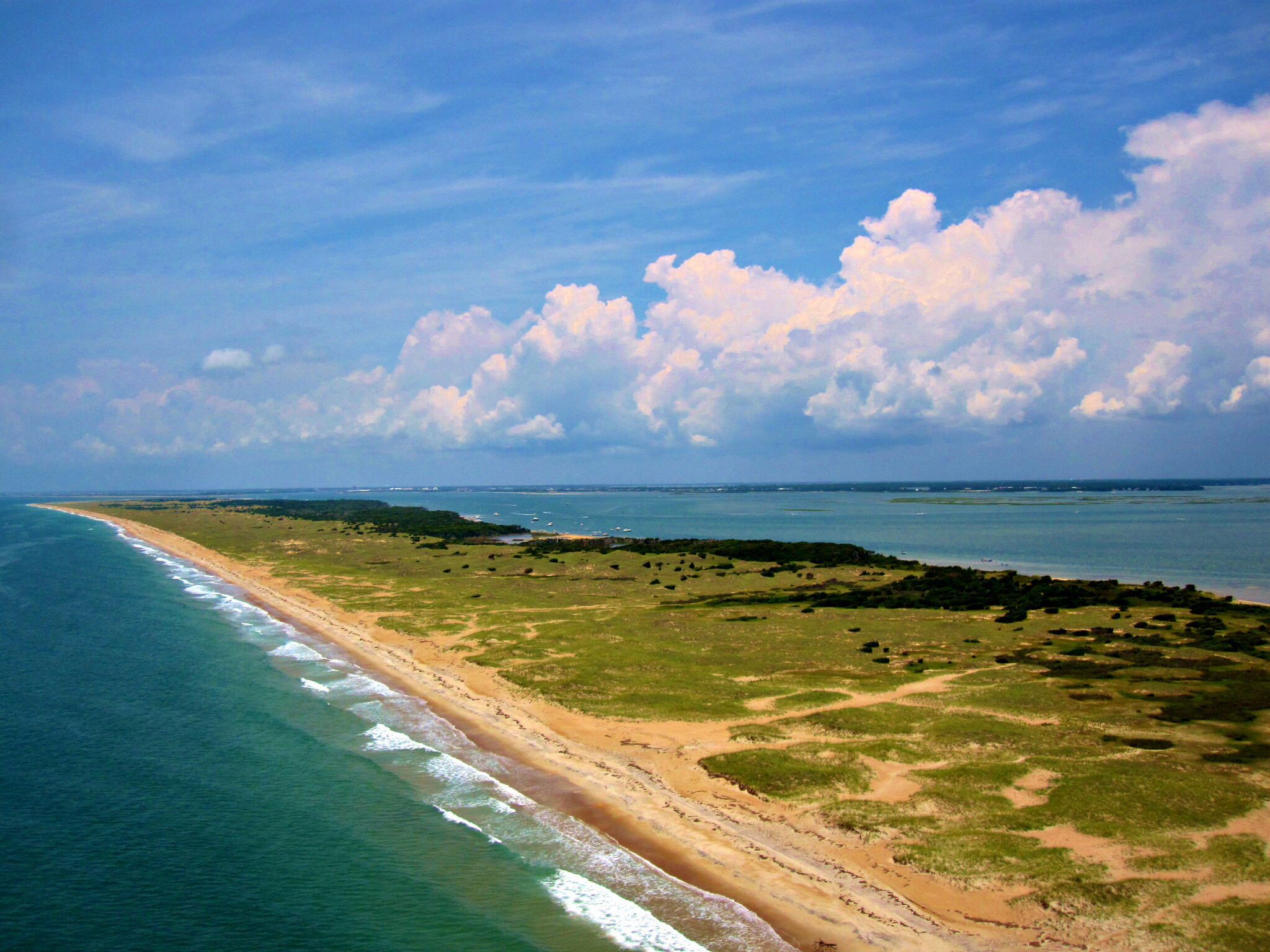


We are blessed by our community connection to the sea and sound. Efforts to protect this resource and, at the same time, sustainably protect the efforts of local fishermen has been ongoing for a long time. This blog post is not directly about the threats to fishermen and our access to quality seafood but it will attempt to show how intertwined the Core Banks and Carteret County community is and has been since the late 1600s with the waters that join them.

Advocacy—-
Before the twentieth century, those harvesting from local waters faced and well handled challenges from Mother Nature and “fortune”. The twentieth century added the necessity of locals as providers and/or consumers to advocate for continuing their way of life–commercial and sports fishermen, consumers, nature lovers.
Barbara Garrity-Blake interviewed Jule Wheatley about his experiences in the menhaden industry. June chaired the Board of Directors of our hospital when I was Chief of Staff. He was an impressive figure.
Jule Wheatley: Raising the Story of Menhaden Fishing–You Tube–Coastal Carolina Voices–Jan. 3, 2022.

Whether it is Carteret Catch is promoting North Carolina seafood, or fishermen challenging new regulations, or surf fishermen advocating for continued access to the shore of the Cape Lookout Seashore, and even the 1960s debate on the creation and form of the new national park–advocacy has become a component of the Banks story.
In the news this past year and still an ongoing threat to fishermen.

I was raised in the Piedmont—we had frozen fish sticks at home and school and my family rarely visited the “fish camp” restaurant that served only fried flounder from ?wherever. “Dingbatter” or “Dit-dotter”, I happily moved here in 1983 and have met many resilient people who make their living from our waters—many follow the footsteps of their family. Self-sufficient and hard-working, they follow generations of “proggers”—those who live from their environmnt harvesting whatever is in season or gives opportunity. The spirit of Diamond City and other Banks communities parallels their life path.
I do not profess to define the correct course of action for our state and region, but working on this research blog has brought knowledge of the history of those working these waters for their sustenance. Fishing is a long-standing and noble calling. Individual sport fishing and those supporting sportsmen has also provided income opportunities to locals for more than 150 years.
I have chosen to explore, through this year, the history of “fishing” along our Banks—the harvest of resources of our waters—that is multi-generational and connected by heart and muscle to carrying on the heritage of the Banks and our Downeast community. I believe that, just as Alaskan natives deserve to be allowed to follow historical harvest from their waters, a case can be made that local fishermen should be protected from decisions “from off”. I do not want everyone to go back to settling for fish sticks—or shrimp only from Asia–nor to see precious culture destroyed from outside forces that does not know them or their story. Again, I do not know the answer or the best path, but I can tell the story of those that preceded them. (I say this as a strongly environmentally conscious being)
Early History of Fishing——
Though historical opinions vary, there is evidence that the Banks earliest white settlers inhabited the area as early as the late 1600s. The banks provided protected shoreline, sounds, bays and creeks from which a variety of marine life could be harvested.
Earliest Fishermen–the Coree Indians (of the the Iriquois nation)—
— in 1585, explorers found a tribe of 85 living at what we now call Cape Lookout–they called it “Croatan”

Of course, we know European settlers were not the first to fish the waters of Core Sound. The Coree Indians preceded them (Core Sound and Core Banks bear their name)–in 1709–John Lawson wrote , the Coree “were known as excellent fishermen” and evidence shows they were here 5-8,000 years ago.
Early Settlement and Fishing History–

Pre-1900 map of Shackleford Banks–
Eventually, communities would be established along the shores of Shackleford Banks, Cape Lookout bight, Portsmouth Village and scattered along the sound in between.
1709--explorer John Lawson listed 41 types of fish and 18 varieties of shellfish found along this coast.
Before 1709, red drum –a fish Lawson described as being found in great numbers–were already being caught, salted, and exported to other colonies by local fishermen—hence the name given to the original Drum Inlet across from the Straits area.
In 1710, Christoph von Graffenreid described the export of red drum and other seafood from the Core Sound and the Beaufort area–‘fish, oysters, crabs, clams, and many other “things” were brought to this colony (New Bern) from the Core Sound area.”
Fishermen and whalers are documented living along Shackleford Banks and Cape Lookout in the pre-revolutionary era. They had to sail or row their catch to Beaufort for sale, if it was not used on the Banks.
Collier Cobb reported on fishing camp structures on Shackleford banks, Cedar Island, Core Banks and Carrot Island in his 1908 National Geographic article. Apparently, this ongoing yearly activity occurred in the late 1800s and early 1900s.

Farmers , in their off-season, would join Bankers to form a crew to fish for shad and mullet along the Banks.
Beaufort was first known as Fishtown because fishing was and remains an important part of its history.
The previous century saw Core Banks and Beaufort being known for its Menhaden fleet and fishermen.


Additional commercial harvest from the waters included fishermen from Core Banks engaged in the activity of whaling, porpoising, turtling, “peeler camps” (soft-shell crabs), and much more–whatever was running or in season. Included in commercial fishing, of course, is shrimping (although shrimp were early on nicknamed “bugs” and thought a nuisance interfering with harvest of the target fish of the day.
(click red letter links to explore more about that topic)
The story of fishing is so huge that it will take several posts and much more research to present to you. I do not know the story, so you can follow as I research and present what I find–to include Commercial Fishing, Individual Fishermen, Fishing Clubs, Guide services and Fishing Camps, Marine Research, Fishermen Advocating for National Park access for shoreside fishing, and the history of fishing for daily survival and for sale (another aspect of survival). And the variations of fishing experience in the localities along the Banks.
Some information has been gathered already but I realize now that I should dig deeper to give this story justice. Upcoming posts will outline what I gather. I will gladly accept input and ideas. This is not my story, but instead, a story I will gather for preservation.
Leave comments , leads or ideas below or reach out to my email–stan_rule@yahoo.com. Also–corrections needed.
Some examples follow:
Individual Fishing Experiences—-


Chris Sabiston, Grey Sabsiton and family fish near Edna Heslep’s Camp on Shackleford Banks. Miss Edna’s Camp was an experience for many families of friends. There were 400 such structures on the Banks in 1976.
Grady Sheets—of Winston-Salem–fished Core Banks and became well-known as the best surf fisherman. This led to his mentorship of Ted Williams for drum fishing.

D.I.F.F.–Davis Island Fishing Foundation–

Fishing Clubs—–

The Brandt Rock Club–-Charlie Vellines flew fishermen to Portsmouth for a fishing experience. His camp was the decommissioned Coast Guard Station.

The Core Banks Club existed from 1899 t0 1999, established by northern sportsmen but later used by regional owners. Hunting and fishing from the site, Babe Ruth, Bob Timberlake, Sam Sneed and others visited there.
The Pilentary Club and Edwin Binney’s Nine Islands Lodge were other historic sportsman sites. The Edgewater Club of Floyd Simmons and several PortsmouthVillage clubs existed as well.
Guides, Ferries and Fishing Camps—-


Today, there are rental camp structures at Great Island and Long Point–serviced by the Park Service.
Earl Davis, Marvin Murphy, Algier Willis, Sterling Dixon, Amie Willis, Carlie Willis,Avon Mason, Wilbur Nelson, Ira Morris, and Don Morris operated fishing camps on the banks along with ferry access.
Marine Research and Education—
Today Carteret County hosts one of the largest groups of marine research facilities including those of Duke, U.N.C., N.C. State, UNC- Wilmington, N.O.A.A., N.C. Marine fisheries.
One of the special stories is that of Dr. Russell Coles–as sportsman and self-taught ichythiologist who frequented Cape Lookout. His friendship with Teddy Roosevelt evolved from such shared interest.

https://davidcecelski.com/category/shark-hunter-russell-coles-at-cape-lookout
In the 1960s, Carteret County Schools fostered a Marine Ecology program beginning in the 4th grade and including educational field work on Shackleford Banks for seniors.


This program was far ahead of its time–even today. Local students were recognized by the Governor of N.C. and at West Point.
Upcoming posts will explore these and other fishing related topics by category or by location on the Banks.
I look froward to learning and sharing more about working the waters of Core and Back Sound. I would bet that I find more stories of self-sufficient, inventive, and resilient citizens.
The strength of connection to these waters and Banks and the generational ties will help understanding the context of emotions and commitment involved in continued advocacy for this way of life and culture.

–the document above can be found on the Beaufort Town History webpage
Follow along with me on this exploration-Stan


Leave a Reply