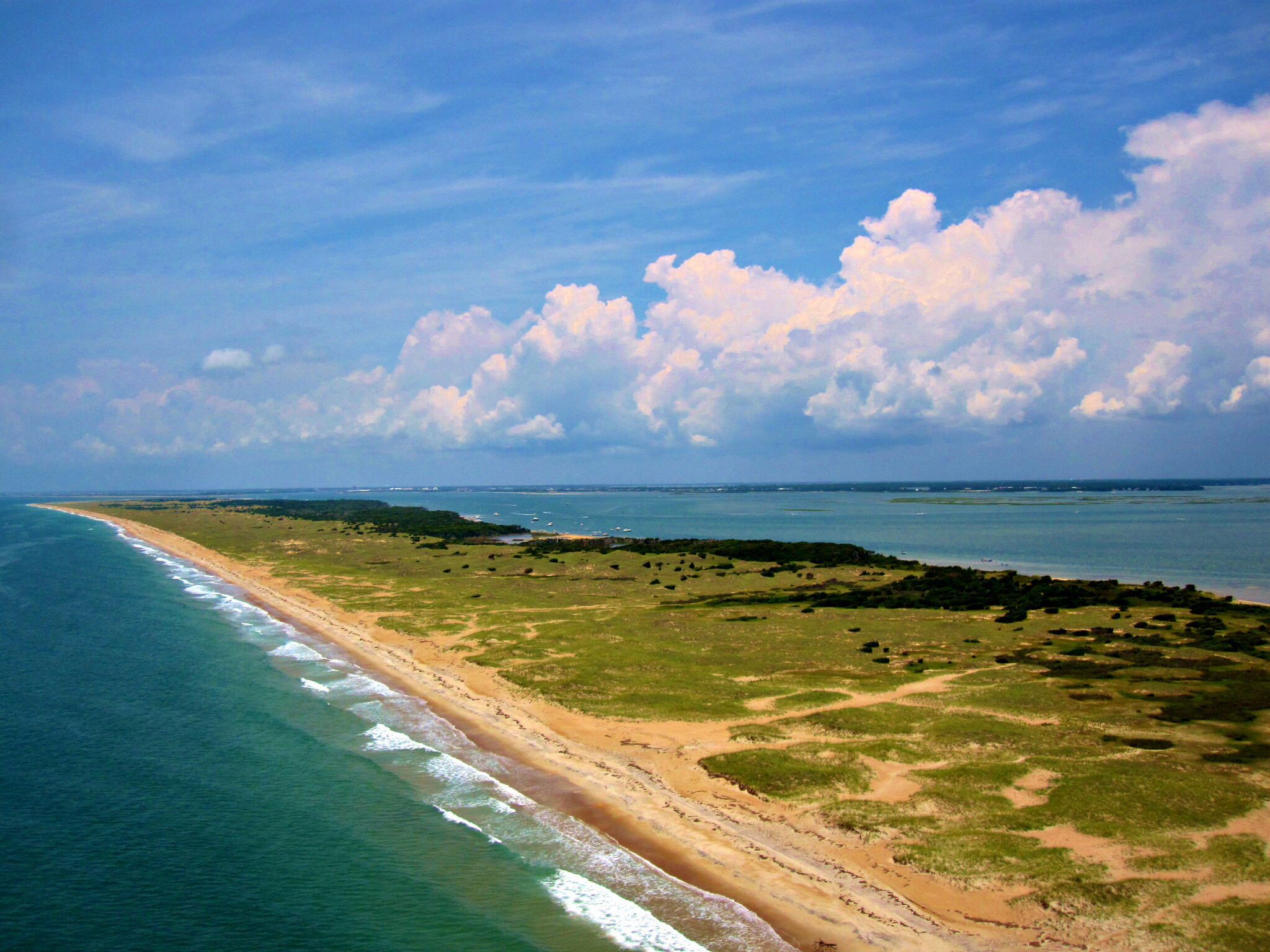

Shackleford Banks and Southern Outer Banks
Diamond City Methodist Church –Ben Riles Graveyard
Bell’s Island Community Cemetery
Sam Windsor/ ?Moore family cemetery–near Bill Moore camp
Wade Shore Cemetery
Lewis family cemetery–near Mullet Pond–not confirmed

Graveyards (burial sites as part of church property) and Cemeteries (not as part of a church) south of the Portsmouth community existed primarily on Shackleford Banks. Wade Shore Cemetery can still be visited. It lies nestled into the trees just a little east of the Park Service docks and jetty inshore of Back Sound.


Excerpts from Ann Rose’s –“Harkers Island, Past and Present”——
Early Communities—
Diamond City–500 people –-Ben Riles Cemetery there–500 graves
Bell’s Island (also a small cemetery there)
Bald Hill Bay
Sam Windsor’s Lump–(also known as Devine Guthrie’s Lump)–five families plus a small cemetery
Whale Creek
Tyre Moore’s camp–a small store there
Ed Moore’s Point
Joe Lewis neighborhood (cemetery there–a part of which remains)
(this likely is a reference to the Wade Shore Cemetery but the Lewis family may have had a separate cemetery)
the Mullet Pond
In the late 1890s, several storms–The tide washed over the graveyards and exposed the skeletons there.
Cemeteries and Graveyards on the southern Banks
Interview with Emma Rose Guthrie (Jan. 17, 2022)
—by Olivia Blount and Stan Rule
“Let’s talk about the Cemeteries:
“ I know of three–they always said there was four”
“All my life I was all over Cape Lookout–if ever there was one on Cape Lookout, I do not know it’–”never a cemetery there”
“I was clamming–between Bell’s Island and Diamond City–the tide had gone all the way down–it would be in deep water now–I came upon seven or eight headstones. They looked like they were made of cedar–”I came to a solid row of wood headstones in the ground”. “Just east of the horse pens–when I saw them lined up, I knew it had to be a cemetery–had to be a graveyard for Diamond City and Cape Lookout–I was so sure it was a cemetery that I left.”
“They were yeah-wide and rounded on top”–”beautifully carved–some were broke off—“some had spindles on the edges and they all had a little round ball of wood carved (at the peak)”–some had ‘like a kings crown’ “–they were all the same width -”the same size, the same height and spread apart”.–”it was a cemetery from way back”.
“Just to the west of our house on Bell’s Island was another cemetery–it had been washed out as well.” The site was “washed out in the 1885 and 1889 storms”–over-washed–”over-wash in the late 1890s washed people out of the ground”–”mama and grandmother both told me (about it)–the women’s long hair was still knotted behind their heads and their combs were in the knots still”–”knobs of hair in back of their head–they found combs still in the hair.”
When at their camp for a while, and before coming home to Harkers Island, she would always walk through the Wade’s Shore Cemetery, she relates. She expressed it today, and in other interviews, like unto a spiritual obligation–she visits there still.”
Emma Rose remembers the area west of Bell’s Island as the homesite of Devine Guthrie (mother’s cousin on maternal side) and son Joseph who lived and worked there. He was a famous boat builder but also a preacher.
Emma’s grandmother Hettie attended the Methodist Church in Diamond City. It was moved to Harkers Island at the time of the exodus, and added onto, and still functions. The church was situated on the Bell’s Island side of Diamond City and the headstones Emma came upon are from that graveyard, she feels sure. (Structures and sites are underwater with the changes in the banks, but also, Emma feels, as a result of dredging the Barden Inlet from shallow wash to a full navigable channel. This was the only church over there and served as the school site as well. Emma believes that a number of Roses and Willis’s, as well as, late, Gaskills and Brooks were in the Diamond City graveyard.
She suspects that each community had its own little cemetery–”you can’t walk from one end of the island to the other to bury somebody” (Shackleford is ten miles long). She thinks that there were probably cemeteries “all up and down” the banks.”–”just like on Harkers Island”.
With the exodus from the Cape and Shackleford Banks after the storms, Emma believes –”some of the people (Bankers) pulled them up (bodies/caskets) and brought them along with them.”
“I going to tell you how they buried them.”–”they made everything.” “They made the casket-(searching for the word casket–’like in Egypt’)__” a square box about six foot long , or how big they were, and three foot wide–‘they cut down all our trees’—the top was made separate. They died one day and were buried the next” (there was no embalming or preparation, she clarified). “They would wrap them up in a handmade quilt that they all had–‘like a mummy’–and nailed the lid on all around. Coffins were made of cypress, pine or juniper–whatever they had around”–whatever they had for boatbuilding she clarified. The coffins were used unpainted. They were buried on higher ground to be above the water table.
She was told that they would sing Amazing grace and have a prayer, just as during her early life. “They were always very religious people”
Of the 4th cemetery, “I do not know.”–maybe at the Moore’s, or other family areas.
Emma felt that Cape Lookout families may have used the Diamond City site since it was the only church structure and graveyard and the wash between the two was a foot or less deep at that time.
Emma Rose has also uncovered bones when clamming. The cemetery west of Bell’s Island was in line with “a big oyster rock that was a prime site for clamming–(I found) bones that didn’t look like any animal”–”didn’t want to clam there but needed to make a living”
Emma remembers her dad pulling his boat ashore on HI above the tide line and turning it over and setting the anchor to keep from losing it. She wondered why it was upside down but remembers sitting on it many a time to look out over the water.
Whalers Ridge was to the west of Bell’s Island–Emma related that people did not dump clam and oyster shells in their yard but added them to the peak of the high dune or ridge, which was used for a lookout spot –looking for the spout of a whale–”a spout like a waterfall”
There were 13 houses at Bell’s Island when she was there. She recalls the baseball field and adult-youth baseball games–”always , a ball-field everywhere” I was
Emma remembers the Boy Scouts putting a fence around the Wade Shore Cemetery and clearing the area –in prior but more recent years.
JB Brooks Camp—Camp #28 on NPS structure survey–

Brooks built his camp atop the Bells’ Island cemetery site. Years later, a mysterious light from the area of his camp could be seen from the Harkers Island shore during several nights—going over to investigate , the “boys” could not find the source. (Emma Rose Guthrie)

Camp #44–Bill Moore–Harkers Island–east of Whale Creek and just west of Bald Hill Bay–in-shore of Sam Winter’s Lump–
erected in 1950s
hand pump in yard
Coastal Geodetic Survey Marker #3and #4, 1962
shantie in poor condition
wood frame on creosote piling
plywood siding and asphlt shingles
white
2 doors 2 windows
trashy area
pony pen ot the west
footbridge between here and Dr. Moore’s
Garden fenced in. Graveyard(?) fenced in
Eugene Gaskill was contact
228 sq ft
graveyard behind about a hundred feet–Sam Winters and several other graves (see Ann Rose’s history above)

The Wade Shore Cemetery is near the Mullet Pond–home and fishing camp of the Lewis family at the turn of the last century–see faint “CEM” marking near the shoreline.
(see also Having Dinner at Home–The Mullet Pond blog)
As Emma Rose Guthrie expressed, gravesites and cemeteries may well have existed away from the communities- all along the 56 miles of the Southern Outer Banks. Portsmouth Community and Sheep Island gravesites are documented elsewhere.

Leave a Reply