

Interrupting one spiritual tie to the Banks tradition, and blocking one way to return “home”
May, 1950 brought one more disconnect from Banks tradition to those with two and a half centuries of deep roots in that sandy soil. Displaced by the storms of the late 1800s, remaining cultural connections like loon hunting were one dear continuing connection for former Bankers and their descendants. Participation in loon hunts was a “right of passage” to the young, an anticipated community event to adults, a source of valued Spring sustenance for the table (rivaling goose and turkey for many), and what must have had the feeling of a “God-given right” connecting to preceding generations of self-sufficient, inventive locals. Though the 1918 Migratory Bird Act legally mandated cessation of such harvests, It wasn’t until 1950 that loon hunting for C’ae Bankers —a event paralleling community pony pennings (continuing till the 1970s)—came to an end. .
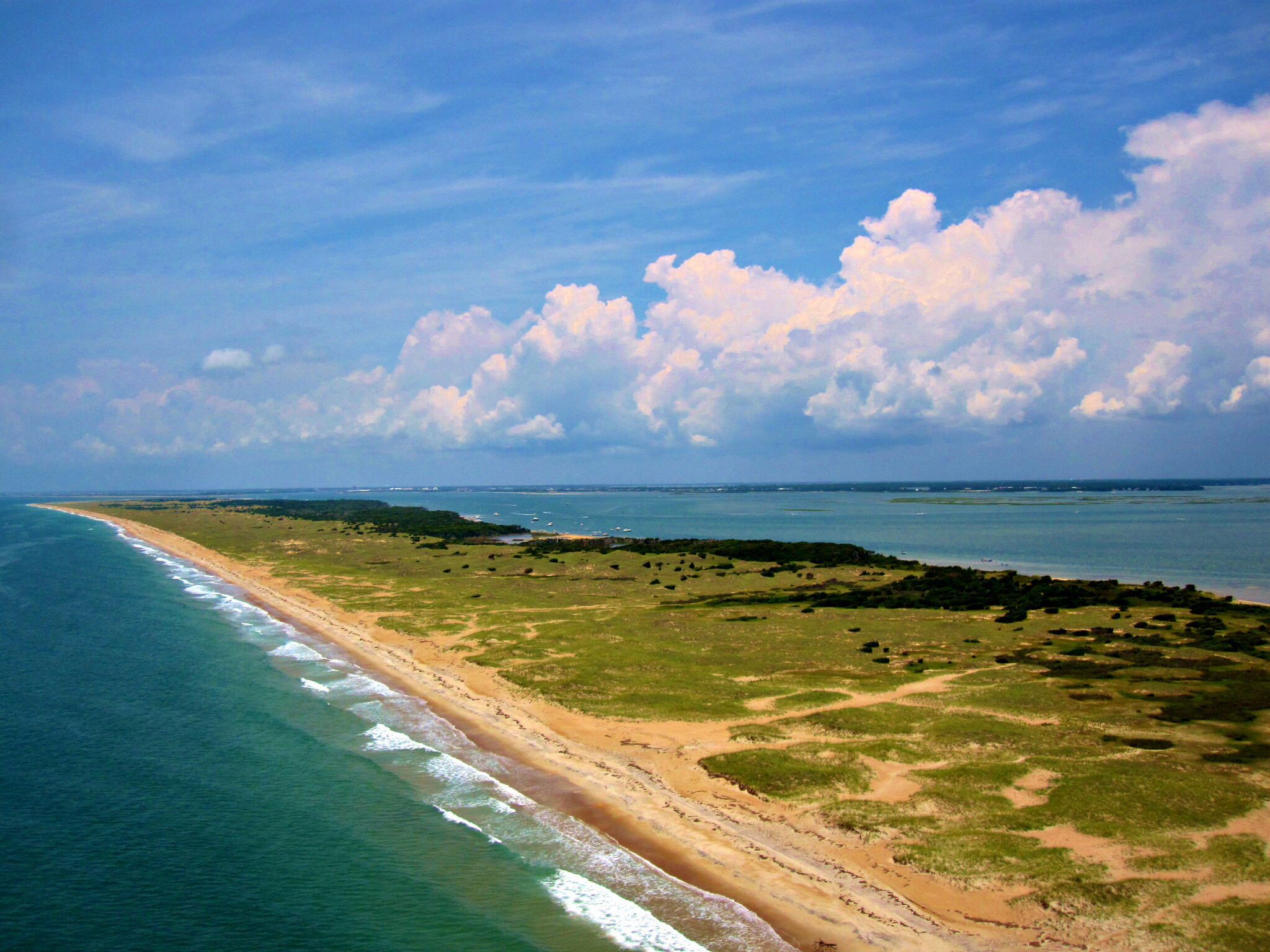
“Proggers”—the local term used for those that harvest fish, shellfish, shrimp, turtles, crabs, waterfowl, and whatever is available day to day— (from the 1700 and 1800s) along Back Sound were making most of their living amid the marshes and on the tide plain that skirted their island home (Shackleford Banks, Diamond City and Cape Lookout Village)—there, literally at the waters edge, was everything necessary to sustain their humble ,manner of living.
One distinctive tradition that followed the “newcomers” (on their eventual exodus to areas like Harkers Island after the severe 1890s storms) was their passionate love for both the hunting and eating of loons. The agile diving birds were found in large numbers in early spring both at the Banks and the Island. A visitor in 1900 observed, as many of those still living at Diamond City gathered on the beach to “shoot at loons.” That same ritual would be repeated each spring at Harkers Island for several generations.—(Joel Hancock interview, CALO project)

A Diamond City home–photo from NPS files
Life on the Banks meant using what was seasonally available—fish, oysters, clams, waterfowl and turtles—augmented by what was raised—vegetables, chickens and livestock. Loons were a welcome, treasured Spring commodity.

NPS file photo of a Diamond City family leaving the Banks (c. 1899) and carrying household possessions to the waiting boat.
As families left their homes during the “exodus”, they remained connected to the Banks in spirit and in the practicality of their livelihood. Many continued their harvest of the same waters, and emotionally—spiritually—retained their traditions where possible. One, among many ways of staying connected to home was their uncommon relationship with loons—their hunting and their eating.

Not a few from the Bank communities moved their homes to locations where they could look across Back Sound to their former homesites. These Bankers may have moved their houses but did not “uproot” their spiritual connections to the Banks or their traditions, their livelihood of harvest from the marshes, and the part loons contributed to their lives.


Fishing lures were made by locals from the leg or humerus of loons as a favorite rig for mackerel and bluefish and, besides personal use, local shops sold them for a nickel.

Locals today sill talk of grandma’s ability to cook loon and merganser into a desirable feast. (yes, turtle too)
Boiling in salt water, poured off, boiling again and poured off–preceded the final cooking. Rodney Baker describes also the gravy made from the skillet droppings as a luxury.

Loon hunting seems not to have evolved elsewhere except for indigenous native groups of the Yukon and Canada who hunted for meat and had many other uses for skin and other body parts. The “Loon Woman” and other myths are cultural consequences of their relationship with the loon.
In Carteret County, loon hunting was considered the “Sport of Kings”-“the sport …has been part of their lives since the earliest days on the island” (Paul, 1996). Community and group hunts were consistent, but also, spontaneous hunts without deliberate organization also occurred (persisting certainly into the 1970s and possibly today). The sound of the morning guns carried by prevailing wind, “was as good as an alarm clock”. Heavy shot was used–#2-#4–easily 25 shots could fail to bring a single loon down. They were not field dressed, but instead, piled along the beach and later carried on a pole between two hunters to the boat (18 loons weigh 200#). Sons were roused from their beds before daylight. Youth carried the birds long before they could carry a gun–even if small, kids would get to drag one to the boat. At the home shore, each loon could bring 50 cents each. “You weren’t a man until you had shot a loon”–their father had done it, their grandfather before theirs– in line from forefathers who had moved from the banks. It was a rite of Spring.”

James Guthrie was a witness (The mailboat)–
May 6, 1950, James was commercial fishing in Cape Lookout Bight–within earshot and sight the daybreak events.
“There was much excitement–“the most people I had ever seen in one pile”–loons filling the sky at daybreak–400 guns flashing out–shouting when a loon was hit”–2,000 to 3,000 shots fired—TILL–it got quiet. I am told many looners threw their guns in the ocean–one young looner sat and cried–another hunter said “Let’s shoot ’em and throw them in the ocean”.
The end of a tradition–(–or not).—–read more
James A. Rose –(CALO interview)–told:
asked– Did you ever eat loon?
No, now there was a strict law on that, that was a Federal law—in fact, I have been awakened a number of mornings to get up to go to school with the hunters on Shackleford Banks, it sounded like an army over there, it sounded like we were being attacked by the Japanese. Bobobobobom. I got up, it was as good alarm clock that you wanted, get ready to go to school, and that went on for a while until they got serious about it. And there was a number of copters and Federal agents that just stormed Shackleford, one particular morning, there were a number of tickets written. Some of them, they managed to get out of it—course if you did have a loon anywhere nearby you, you were just sightseeing, you know. With a gun. You were sightseeing with a gun.
Well, Delmar Willis had bought a brand new 12-gauge gun and he saw the men way up the beach there, coming towards him, and he said, “My god, I’m going to be locked up forever.” He takes that brand new 12-gauge, sticks her down in the mud and puts his foot on it and shoves it right on down. And he’s standing on the butt plate of the new, brand new 12 gauge when the man walks up to him and Delmar says, “You know what, all this is unnecessary.” He says, “I can’t understand why they want to eat and shoot these loons, that’s not right, to kill these birds like this.” And the man says, “You got a good point there, but we’re gonna have to do something with this.” So he said, “Well, look, you have a good day,” and whatever, you know. And they just left and went on walking past. He’s still standing there on the butt plate of that brand new 12-gauge, brand new, gas-operated, automatic 12-gauge shotgun. He stayed there till everybody was gone, he stayed right there in the same place, looking on, you know, like he was distraught and this was bad, this is really bad, killing all those loons. Told the agent, “This is the worst thing I’ve ever seen,” and he got away with what he was doing. He just hadn’t been in action yet, you know.
But he finally got the gun out?
He got it and it was bad, you know.
But it’s better than going to jail!

Robert Halstead was the only federal wildlife agent for all of the North Carolina waters. He was on the docks in Morehead City in 1949 to hear a “rumor” of an upcoming loon hunt. The full moon meant migration was in full swing and favorable winds and weather made the morning of May 6th optimal—locals set their plans but Halstead did too. Enlisting Carteret County Game Wardens, Halstead flew in from his home in Washington, N.C.
Eleven wardens in all—they took the “Claude C. Patton” over to the Banks at 1:30 am and hunkered down—spread out in the dunes as the boat was taken back to the docks to avert suspicion. Early morning, a flotilla began to arrive on the Banks—skiffs, clam boasts, oyster boats, fishing craft—all types began approaching. A line of “poachers” extended 3 miles along the shoreline. Daylight and loons arrived together—a thick curtain of fire for 30 minutes and 3,000 shots met the migration. “Loons fell from the skies like autumn leaves”—if one hunter missed the kill, the next drew aim. Then quiet came as the wardens stepped out. “Jesus Christ, it’s the Game Wardens” was heard—even with the abbreviated hunt, 250 loons died and 150 were crippled.
72 hunters were apprehended and plead guilty—those 18 and under were not charged. For the following three years, monitoring was close. No further community hunts occurred.

Read More from the Halstead story
——————————————————————————————————————

Continuing Traditions—
—–It is altogether likely that, although community loon hunts have vanished, locals from Salter Path, Harkers Island or further Down East still occasionally harvest loon for their tables in the Spring.
—–The Core Sound Decoy Guild recognizes this cultural custom as an important part of the regions historic past and heritage and honors this with an annual Loon Day event in early May.
Serving as a celebration remembering resilient forbearers of the Banks and recalling their spirit in challenging times, the guild holds a community gathering and decoy competition.
——Cooking and eating loon is not infrequently discussed, even if it cannot any longer be common practice. (Yes, several variety of turtle also graced tables)
——Loon Decoys—
Full-size and miniature Common Loon carvings are frequently made. Loons do not “decoy” to (pay attention to or come to) decoy rigs as do other waterfowl hunted by sportsmen. Carvings likely have been created as a heritage presentation, though they can be included in floating carving competitions. Through this continent, loons are depicted in flat art, t-shirts and various ways, but no example of decoy use for loons has been found. Many locals have such carvings in their homes as a remembrance.
CREDITS
The Last Loon Hunt—James F. Guthrie—The Mailboat—Annual Edition, 1993
Biological, Geological, and Cultural Origins of the Loon Hunting Tradition in Carteret County, North Carolina—Olson, Loftin and Goodwin—The Wilson Journal of Ornithology—122(4); 716-724, 2010
Cape Lookout Oral History Project—James A. Rose, interview by Connie Mason
Undercover Wildlife Agent—The casebook of conversation officer Robert O. Halstead—by James H. Phillips
Island Born and Bred—Karen Anspacher—1987—United Methodist Women, Harkers Island— cookbook excerpt

Leave a Reply