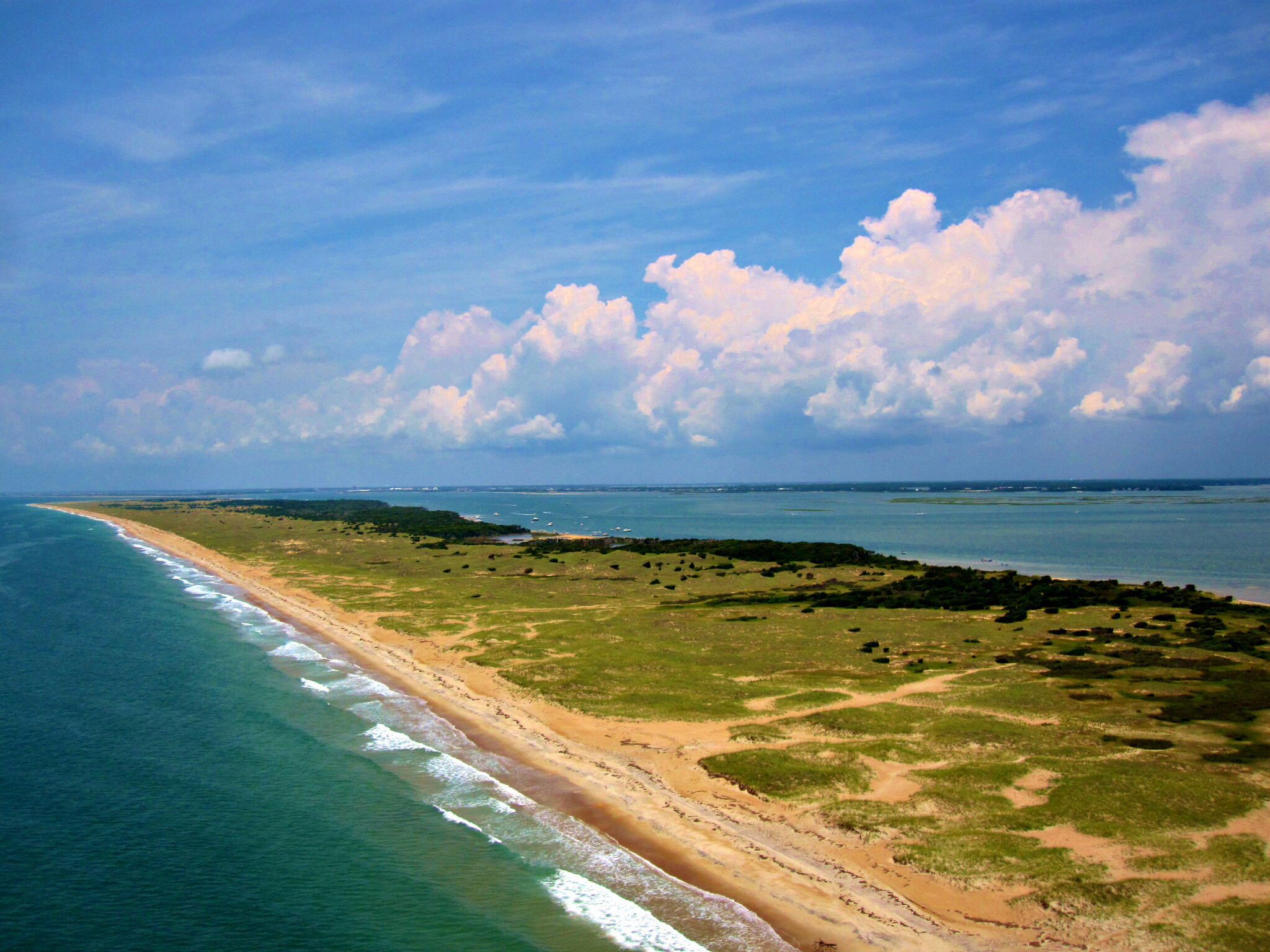



The Portsmouth Marine Hospital was completed in 1847 following the 1842 Congressional appropriation of $8,500 to provide the two story structure. Though now deserted, Portsmouth Village was an important port and community with special issues needing solutions. This resulted in the island building the first structure in N.C. designed and dedicated to use as a hospital.


Learn more about Portsmouth’s history at this link:
https://www.nps.gov/maps/stories/history-of-portsmouth-island.html
Portsmouth Village had a problem with success as a lightering port in the early 1800s. Thirty to sixty sailing ships were in the roadsteads daily. A local population of almost 700 burgeoned with the crews of the transient vessels. Unfortunately, to avoid potential quarantine at the next port of call, sick sailors were “dumped” on the Portsmouth Island to fend for themselves. Sick seamen arriving from abroad with scurvy, dysentery, venereal disease, infected wounds and broken bones were a frequent, if not constant problem. Since no physician was within 40 miles, haphazard care was provided in local homes. The enormity of the problem can be understood by the fact that the hospital, when established, served 100 to 288 patients (seamen and locals) per year (with 5 to twelve employees).
It was not until 1798, that Congress established and President John Adams signed into being the “Relief for Sick and Disabled Seamen” legislation which enacted a compulsory payroll deduction for all sailors to provide health care. A Collector of Customs in each port collected fees (from the captains) and disbursed funds to procure medical care, lodging and board for such medical needs of seamen provided by using local resources. This enabled reimbursement of expenses by those locally assisting in such care. Recruitment of a physician was also now possible.
In 1828, the government contracted with Dr. John W. Potts to establish a marine hospital at Portsmouth (paying $1,500 annual salary). Potts rented a small house which one writer described in 1831:
A small house has been rented and occupied for the purpose at $30 to $40 per year. The house stands about two feet above the level of the ocean and not too far from its margin, upon the Portsmouth Banks and on the naked sands, without the benefit of shade. The house itself is 16 to 18 feet by 20 or 22 feet in size, without plastering or as I believe glass windows. About six cots, a pine table or two and a few benches or chairs, and the furniture of the hospital has been described. There being no cistern to contain fresh water, the water used is gotten out of a hole about a foot depth in the sand….
Before his two-year contract was up, Potts left the position –finding that the private practice in a population of 300 along with the hospital contract in such a remote setting did not offer desired expectations, Potts was succeeded by Dr. Samuel Dudley, who would serve as physician intermittently for more than thirty years and became one of the wealthier men in Portsmouth. Dudley had been born in New Hampshire around 1790. Records show that he owned seven ships in the 1830s, and he provided the land on which the first Methodist church was constructed. Dudley’s home was located along a creek that became known as Doctor’s Creek. Dudley treated both local inhabitants, as well as, sailors.
“The initial hospital staff included Dr. Dudley, his nurse, and three slaves. Although Dudley’s medical qualifications were suspect and his dilatory and erratic behavior prompted numerous public complaints, he continued to serve (off and on) as late as 1844.” (NPS documents )
In 1842, a federal appropriation was made to construct a new marine hospital near the site of the original rented building. Inadvertently, the property purchased by the government in 1845 included the two-story house built by Otway Burns in 1842. Burns was the captain of the U.S. privateer Snap Dragon and a hero of the War of 1812. He also served in the North Carolina General Assembly and chose to retire to Portsmouth. Burns died in 1850, and the government then took possession of the house, which was used as a dwelling for the marine hospital physician in the 1850s. (excerpted from the NPS Cultural Landscape Report, Portsmouth Village)

Congress appropriated $8,500 to build a substantial two-story structure built on piers, with a fireplace in each room, primitive running water, spacious porches, and separate quarters for the physician (and sometimes a medical student).
The new marine hospital opened on October 1, 1847.
It was a large, two-story shingled frame building, measuring 50 by 90 feet, with ten rooms on the first floor and two on the second floor. The building was considered the best built in Portsmouth to that time, and it featured piazzas on both the north and south sides of the building, seven fireplaces, and exterior cypress shingle siding. Shortly after the building was completed, a picket fence was built around the hospital to keep out grazing livestock. A new wharf was built for bringing patients and supplies ashore.
The initial staff included one physician, one nurse, and three slaves. The hospital at first had wooden cisterns, one of which was replaced with a brick cistern in 1853. The brick cistern, which still exists, was 8 feet deep and 10 feet in diameter, and included piping to run water directly to the hospital kitchen. The hospital served 100 patients in 1852, and 288 in 1854, but there were periods when no patients were present. The number of employees ranged from five in 1847 to twelve in 1857, but only six in 1860, the year in which the hospital was discontinued. During the Civil War, the hospital provided treatment for wounded Union soldiers under the Federal Medical Service.
(NPS Cultural Landscape Report, Portsmouth Village)
The stone cistern that remains in Portsmouth Village replaced the original wooden cistern that rotted and tended to leak. Cisterns held rainwater from gutters and was carried through downspouts to the cistern. The stone cistern was a “fine” brick/stone cistern built in 1853 at the cost of $150. “It once contained the sweetest water” on the island (Rozear)
Rozear writes that “during the 1850s, a varied, but steadily dwindling hospital population sought relief at the United States Marine Hospital at Portsmouth. At times, during the last half of the decade, the beds were empty. The expense of maintaining such a facility at his remote and meteriologically hostile site became apparent to Congress, and plans were started to construct North Carolina’s “main” marine hospital at Wilmington. The Civil War put an end to both endeavors.”
Federal forces dislodged Confederate forces on Portsmouth in 1861. Most residents had fled, with their slaves, to interior towns–less than half returned after the war. The hospital building was never again used as a hospital and in 1872 was abandoned by the government. It found use as a community dance hall, weather station and telegraph station till it burned in 1894.
The United States Hospital Service was later reorganized and has become the U. S. Public Health Service (1912) that serves the country today. Now, a multi-billion dollar agency that had its humble beginning in such sites as Portsmouth Village.
Portsmouth Weather Station
After the Civil War, the U.S. Army Signal Corpsbegan to establish weather stations along theAtlantic coast. In 1876, one was installed in two rooms of the Marine Hospital at Portsmouth, but it was short-lived. It closed in 1883, reopened for a few months in early 1885, and then closed permanently as increasing vessel size rendered Ocracoke Inlet less and less navigable. For most of the time, the station was manned by only one person, who at times had a single assistant. Interactions with townspeople appear to have been strained and infrequent. An 1880 inspection report noted that the keeper of the station spent most of his time in study and considered local residents “an ignorant class of people . . . [who] take no interest in the service, further than to make what they can from it.”
Clifton Noe and Jack Gardner have each told of their fathers (Earl Mac and Jack, respectively) clearing remains of the Marine Hospital as they constructed the landing strip alongside the Portsmouth Life Saving station.
Dr. Martin Rozear, North Carolina’s First hospital, in “Tributaries”, October 1996
NPS Cultural Landscape Report, Portsmouth Village–Cultural Landscape Report: Portsmouth Village, Cape Lookout National Seashore, Carteret County, North Carolina (Wiss, Janney, Elstner Associates, Inc. and John Milner Associates, Inc., December 2007)


Leave a Reply