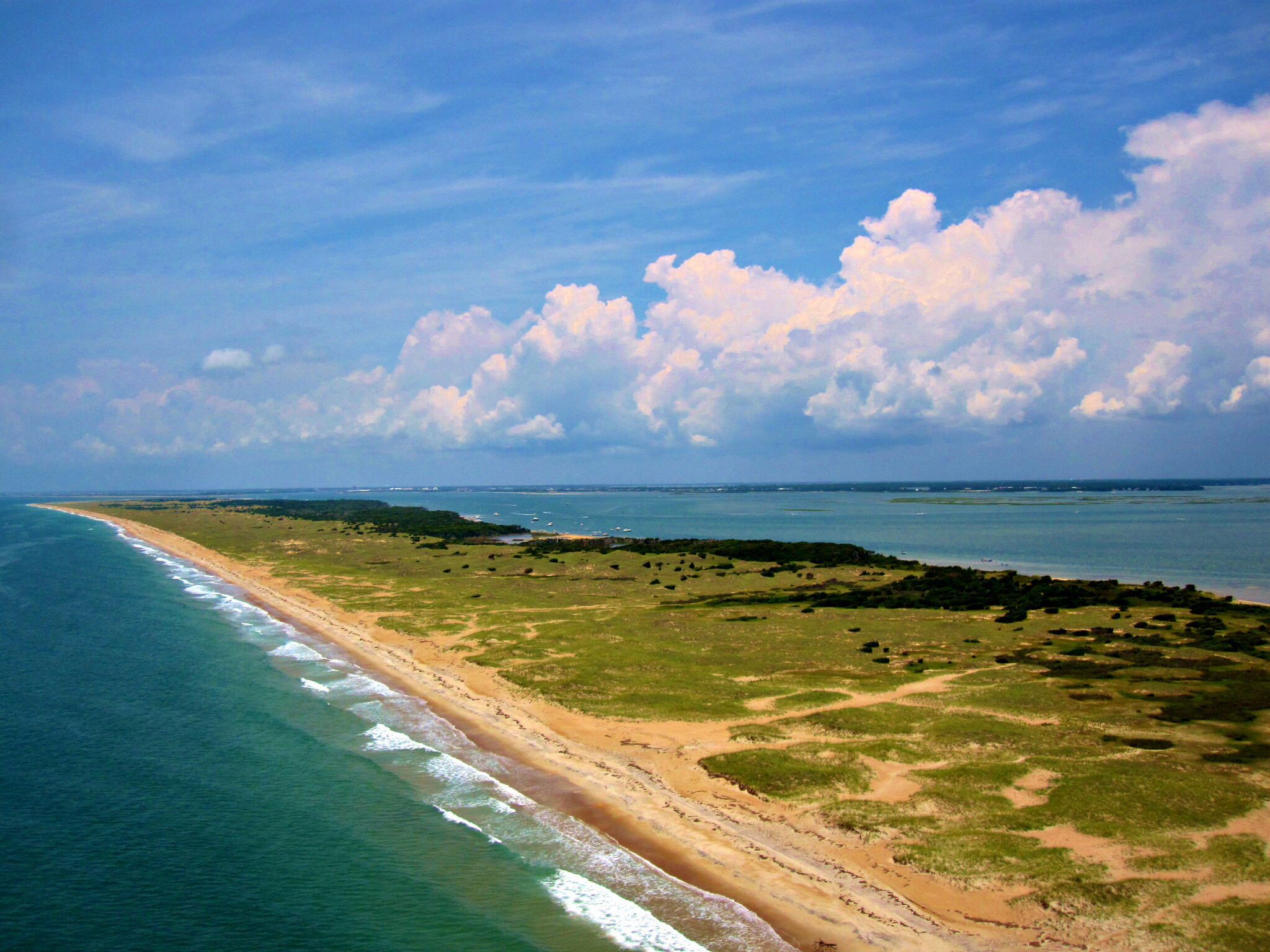

Belle of the Banks

Scott Taylor photo
———————-
“I stood on the shore of the Outer Banks, my gaze fixed on the horizon. I was 16, and I was waiting for the arrival of 18 egrets that returned every year. As time passed, doubt began to creep in, and my shoulders slumped. Could this be the year the egrets failed to return? But then I caught sight of them—18 dark-winged shapes careening through the gray dawn— and I smiled as they swooped low to skim the breaking waves.
Ever since those moments on the Outer Banks, where my family had a cottage, I have felt a deep—even sacred—connection to natural places.”–Melissa Moye

Melissa Moye is senior director of conservation finance at World Wildlife Fund. https://www.worldwildlife.org/magazine/issues/spring-2020/articles/melissa-moye-s-economic-approach-to-conservation —for the complete article
“Casablanca” at Cape Lookout Bight was that cottage.
When the story of this cottage is told by its people, repeatedly it evokes communication of gratitude for special times of fellowship with friends and family, a sense of community and communion with and reverence for nature. There was joy in sharing the experiences at the Cape with others.

Scott Taylor photograph
The two earliest vacation cottages, the 1920s Seifert-Davis House (Coca Cola House, #3) and the circa 1930 Baker-Holderness House (Casablanca, #1), are completely different in form and construction from the earlier traditional houses.
At two stories high, Casablanca looms as the largest house on the Cape, perched on pilings on the west edge of Lookout Bight near Wreck Point. (NPS document)

The Baker House, later called Casablanca, is near the top. The lighthouse was across the Bight.
The story begins in 1929 when R. W. and Penelope Baker of Greensboro built the cottage as a getaway retreat. The 1928 Seifert “Coca Cola House” preceded it as these folk “from off” discovered this special place.—locals with ties to fishing or the lifesaving service had made up the community prior. There was then a small community at the Cape, though most permanent inhabitants had left after the late 1800’s storms and closure of all local services in 1915-1916.
————————
Ann Baker Beale remembers rides along he beach and her mother catching flounder for lunch and, most special, when Mr. Ivey Scott would come from Harkers Island to play fiddle and call square dances in the great room for whomever was on the island at the time. Existence may have felt simplified on these Banks in contrast to Greensboro where Mr. Baker served as President of Blue Bell Company (the world’s largest denim producer).
Emma Rose Guthrie, 90, of Harkers Island, also remembers the music and dancing, but being younger at the time, most fondly recalls Ms. Baker standing on the porch smiling as she watched Emma and friends play in the spray of the artesian well that was alongside the cottage.
Ann Baker Beale’s additional recollections are available on the Casablanca Camp Page. Casablanca

Emma Rose keeps the blue coffee pot found in the ruins and a brick from the foundation of Casablanca as her touchstones for her memories.

Scott Taylor photo
World War II brought a real submarine threat to the Banks and especially the Cape, where ships sought refuge. On July 23, 1942, the U.S. Government obtained temporary rights to all private structures—the Baker property included.
July 19th, 1945, the Bakers sold the cottage and land to William G. Clark, Jr., George N. Earnhart, R.W. Moore, Henry I. Johnson and Robert P. Cherry (often referred to as the Tarboro Men’s Group).—names taken from copy of the deed.
Melissa Moye adds: “ My father Milton Moye, Jr. bought his first one quarter share from R.W. (“Wilton”) Moore. Milton was friends with Wilton’s son (I think also named Wilton) when they were boys. Milton fell in love with Cape Lookout —so —many years later he asked to buy Wilton’s share. He purchased his second quarter share from another owner who dropped out (Marvin Horton, also of Tarboro). Also, we retained our 50% ownership after the USG condemned the property and a 25 year lease was issued. The Holderness Family sold half of their share to the Barnhills. At the time the Holderness’ were not using the cottage.”

Milton Moye, Jr. is remembered as a “hardcore fisherman”–”everybody was very happy when he showed up”–“a character”-”–as related by Cape neighbor Joe Bourne. Milton was a lifelong farmer from Farmville and Greenville.
Robert Barnhill remembers that they came in later, by invitation–to be part-owners of Casablanca, located at the end of the Coast Guard dock. Robert was 11-12 years old at the time–in the early 80s. Rusty and Haywood Holderness and the Moye family from Greenville were the owners. They had acquired a 25 year lease from the NPS.
Jokingly, Robert thinks they “ may have been invited since they had construction experience (Barnhill Construction Company) and the structure always has needs—’all I remember is fixing things, painting or repairing the foundation’”.
The Barnhills spent their time fishing, roaming the beach and just getting away.

Watercolor of Casablanca by Tanglier, 1994 (courtesy of Melissa Moye)–It was not uncommon for Casablanca experiences to evoke creativity.

Another evoked emotion.

Haywood and part of the Casablanca gang—backed by Rusty (Deere Sweatshirt). Rusty and Haywood’s father, “Dail”, loved the Bogart movie Casablanca and bestowed upon the cottage its contemporary name. (renaming the Baker House )

Mary and Haywood–family photo

After the war, my father and others, four of them, bought into Casablanca (the Howards, Moyes and Holderness’ and another)—right after the war, in the early 50s sometime. I cannot verify the details—these are stories I have been told. I began coming over here at 4 or 5 years old with my family–in fact, the family was here during hurricane Hazel. My father was one of 7 and there were 26 first cousins. We would come over here in mass and stay two weeks. And we would bring a jeep over and just invade the place .(Rusty Holderness)
We’ve been going 45 years–a week in the fall and a week in the spring. (Rusty, Dave Clough of Richmond, Steve Hassenfelt of Greensboro, Mike Warlick of Stafford, Va. and Tom Reams of Southern Pines, and others)
I remember waking up in the morning with a horse or cow outside the window or a cow moo-ing outside.
My mother was famous for coming over bringing a couple cases of beer and three or four cakes and she immediately took them down to the Coast Guard Station for the crew. They, therefore, loved her–they couldn’t wait to help us out—it was like having a 50 man waitstaff –because she would feed them stuff. All of us learned to feed them stuff. All of us also learned how to drive at 12 or 13 years old. Dad was H. Dail Holderness, Sr.

Rusty Holderness
They (the community) were all friends and buddies–there were 14 houses in the bight and 3 or 4 of them were owned by people from Tarboro–they would come down- the sheriff would come down-they would drink and play cards–do what they couldn’t do at home with their wives, probably during prohibition. We came down till the early 60s and when I was 11 or 12 years, we didn’t come down here- again—till I was 20 or something. We just didn’t come down here-they sold a share to Marvin Horton of Tarboro. We got out of it with a 25 year lease as the government took over. We got in a debate with the Reeves’, the government recognizing their ownership more than ours, through torrenization–It kind of startled us–because we had no idea–we settled with the Reeves–they got the land and we got use of the the house.
We were so surprised that we didn’t own the house or property–it had been torrenized by the Reeves from Sanford. A similar thing happened to the Bournes and Longs. Reeves got all the money from torrenizition of Casablanca, paralleling a similar situation for the Longs.

Steve Hassenfelt in the kitchen
Steve relates that on the first two trips, Rusty had his truck. He brought vienna sausages and cheetos and all that crap–that’s what we ate for a week. I’ve never been so constipatd. When I got back, I told Rusty–if you ever ask me to go again there , I’m doing the cooking–or I’ll organize it–so I’ve always done the cooking since.
(He does a great job !)
Back then, you had to have a week’s worth of food, had to be in coolers


Mid-century photo with Baker House in the background.

When I was asked, “Which is your favorite camp story?”, I picked with surity “Casablanca” (the Baker House)—but work on this piece provoked me to reflect upon why.
More than Casablanca’s 90 year longevity or its striking appearance and setting across from Lookout light, this is one strong example of the Banks culture and spirit represented in that history–adding to the predominant stories of locals and their relationship with the Banks. Individuals with success “away” (in business, ministry, farming or activism) put on their jeans, shorts, t-shirts and sandles and stepped into the Banks life that was predominantly a local culture story. At the Bight, they chose confident humility and entered the “equalizer” that the Banks represents. It was a community of mutual support and growing friendship found as they emersed deeply within nature and simpler life.
I suspect the term “get-a-way” could be exchanged for “get to”—an anticipated journey to an experience of joy and freedom—to seek something/not just escape. There existed a passion for life and thoughtful gratitude for this joyful experience of being closer to nature and sharing with family and friends. Almost like a pilgrimage to a precious place.

When you experience something special, it is enhanced by sharing—embracing and expanding the joy for each. And when recognized as special, and even fleeting, the gratitude and reverence did spur action to preserve the experience for self and others. This group recognized the special gift of this natural place —special with or without themselves there.


“Casablanca” shared its joy with community. Square dances, card games, feedng the Coast Guardsmen, children playing in the artesian well, inclusion of thousands of family and friends and new friends-to-be. And Nature, as always, shared all she had—it was no little offering.

It appears as second nature that responsibility to the setting and this small community provoked action. From the simple tasks like clearing litter and debris or assisting others with necessary projects, to the substantial support for Keith Rittmasters Marine Science School and research studies standing as examples.

Keith–“I credit Haywood for a part of every success in my career.”
Haywood Holderness and this group of men helped Keith Rittmaster buy his first research boat (The SkyHops) and later help fund the establishment of Bonehenge Museum. Besides helping with finances, they reported strandings, helped free turtles from entanglements, helped with beached mammals and physically helped Keith with necr opsy dead of marine mammals for research. They were not passive. One was a whale washed up in front of the Barden house.(1990s)

Dr. Keith Rittmaster his director of Bonehenge Museum and studies marine mammals.
One could ask, “Did Casablanca bring these traits out of its families and visitors or did they bring this passion and spirit with them?” As a result of the sharing of their stories with me, I am sure the answer is “both” —with each individual given different remembrances to carry away home. They did not travel away unchanged, I am sure.
——————————————————————
2007 was the last trip we made to Casablanca.
Haywood died June, 2022. His obituary aptly stated: “His heart belonged to his wife, his family, the city of Durham, and an old beach cabin named Casablanca.”—“He had an infectious laugh that filled up any room”.
Milton Moye, Jr. was lost in June 1996.
After damage from repeated storms, Casablanca was eventually lost as well.

The site was cleared for due to safety concerns. A clearing in the marsh echoed decades of memories.

A few years ago a marker appeared in that marsh remembering one of Casablancas lovers.
For more:
Cottage Curiosities—Coastwatch Winter, 2003 —Ann Green/ photos Scott Taylor
The Hook—Coastwatch, Spring, 1998 —Eddie Nickens/ photos Scott Taylor
Casablanca’s camp page Casablanca


Leave a Reply