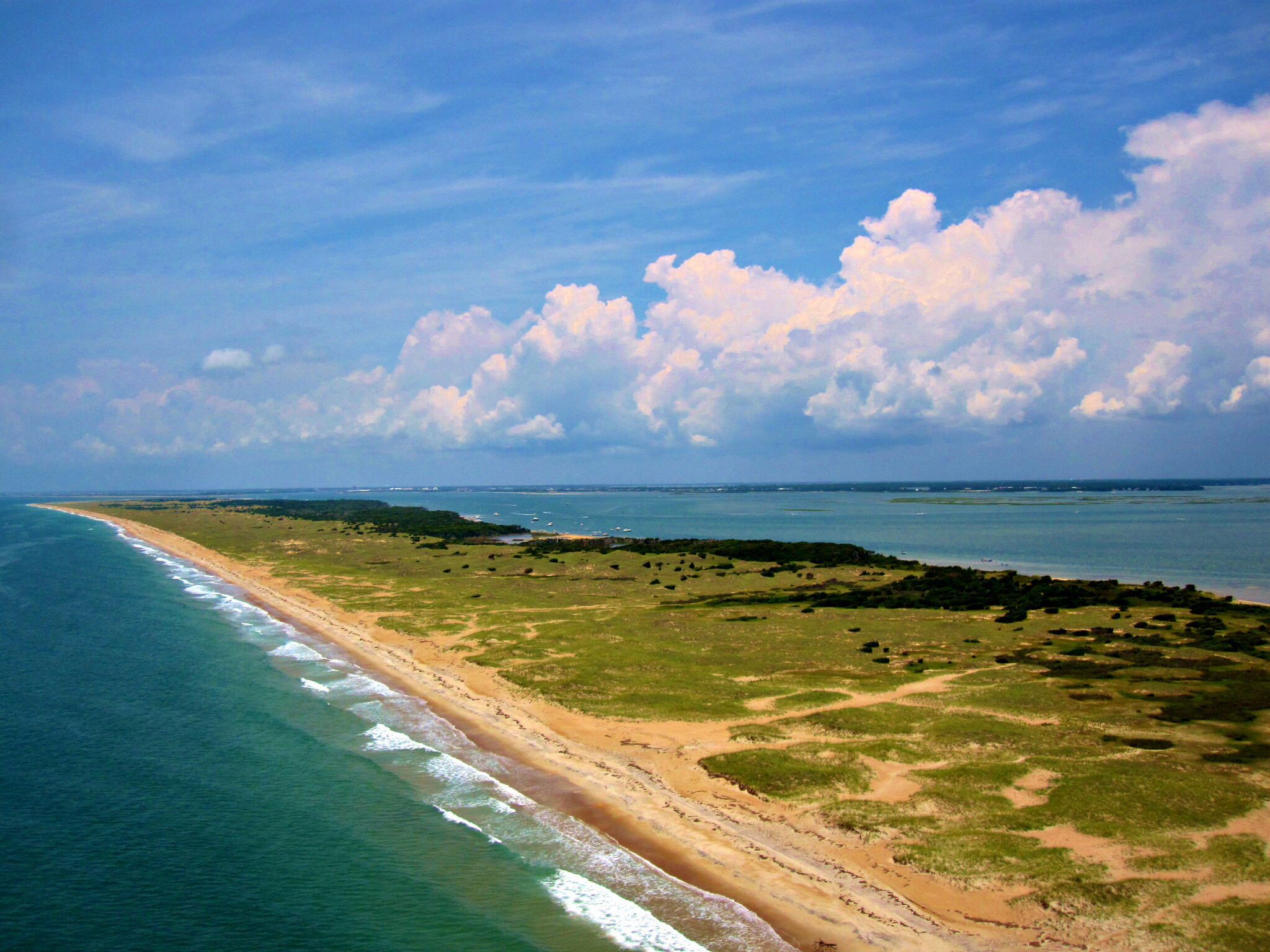


Shackleford Banks, adjacent to Cape Lookout, stretches to Bogue Inlet, across from Fort Macon. Connected to the Cape early in the century with only small cut-throughs of shallow water to cross, Shackleford Banks became physically separated from the Cape area with the dredging of Barden Inlet following the 1933 un-named hurricane, but the emotional and generational attachment of Cape and Banks persisted and played a part in the attachments to and magnetism to the area, causing ongoing visits to, or establishment of homes and cabins on these Banks. Diamond City, the villages at Wade Shore and a cluster of homes near Bell’s Island held a substantial population at the turn of the century, at which time, the mass exodus from the Banks occurred following severe hurricanes. Recurring references to generational family attachments drew and draws many locals back to the area and, in some instances, the establishment of cabins or recreational homes serve as reconnection with their past. Even with less historical connections (accepting that almost all “locals“ are inter-connected in genes or history), Beaufort and Morehead City residents also used the area through the century, and especially since the Second World War, as their get-a-way for recreation and re-attachment to nature and the Banks culture. Focusing on the cabin culture of this area yields stories of rich love of nature and interpersonal relationships in a resilient and self-sufficient group of people that is worth documenting and supporting its remembrance.

NPS map depicts general terrain prior to 1933 un-named hurricane.
Following is one Ca’s Banker story:
Interview: Shackleford Banks—-H. Orlandah Phillips
(By Bruce Weber)— 02/10/80
————————————
I’m an 80 year old man, but I still remember the tales my grandmother and others told me about Shackleford Banks. My grandfather, Jim Hancock, was born on Shackleford. How he got there, how anyone got there, I don’t know.
Folks had lived there for a long time. In those days, Shackleford was known as “Cay Banks” and people lived in hamlets along its entire length. They fished and gardened, built boats and hunted whales.
My grandmother was Martha Ruffin Mason. She was familiar with the banks in another way.
After the Civil War, her father had been associated as keeper of the Cape Lookout lighthouse. She and her sister Charlotte Ann frequently went to the lighthouse with him to tend the light. In those days the lighthouse ran on lamps, wicks and whale oil and there was always something to do.
They sat up in the tower as the light burned at night.

The glass lens in use then was so large that it was possible for both Martha and Charlotte Ann to sit inside it . I remember her telling me that’ on stormy nights, it wasn’t uncommon for birds to break their necks and wings against the lighthouse and afterwards the two girls would gather up the dead birds from along the platform that encircled the top of the lighthouse. Then, sitting inside that lens, they would put the birds on forks, and roast them over the burning wick. Oh, how they looked forward to doing that every fall.
Martha made many trips to the banks as she was growing up. Eventually, she met my grandfather, Jim Hancock, a sharp looking man from the Banks. She said he looked like Gary Cooper. They married, lived on Shackleford for a short time and then left sometime in the 1880’s for Morehead City where they settled in a house in the 1000 block. That’s where I’d visit and hear these tales.
Everyone was gradually moving off the banks then. The sand was blowing, killing the trees and filling the creeks the people depended on for keeping their boats in . Some people went to Harkers Island, others went to Beaufort. Many people ended up in the area adjacent to Morehead Village called the “Promised Land.” No one really knows why they called it that. But Morehead was developing, there was a port terminal and many job opportunities.
My grandfather, known to everyone along the waterfront as “Uncle Jim,” was 6 feet 2 inches tall, handsome and an excellent swimmer. He could even catch and ride sea turtles with his bare hands. He’d go out in a small boat and seeing a turtle in the water would dive for it. The turtle would try to swim away but my grandfather could follow it down in ten feet of water, grab it by the neck and back, and hold on.
If things went right the turtle would hold its head up and swim right to the surface. The turtle couldn’t dive so long as it was held in this position. Eventually, someone sailed the small boat, a sharpy, back to my grandfather and they’d haul the turtle aboard. People ate turtles then, even the eggs. They said there was nothing better than turtle cooked with onions and potatoes.

—— from Island Born and Bred—Methoidist Women’s Cookbook
There once were many settlements along Shackleford Banks. Generally, they consisted of only two to four houses each. Creeks determined where people would settle. They lived at the head of these creeks, each of which had’ six to eight feet of water, deep enough for boats to enter and leave.

“Bell’s Island”—a “community enduring pre-1900 till late 1970s.—this NPS aerial is from the 70s.
Usually, they had a landing to pull their boats up at the head of the creek. of course, they were all sailboats in those days. The creeks are all gone or very shallow now. The place called Mullet Pond, which can still be found, once had an outlet large enough to float a boat in and out of, but now it too is only inches deep. I remember the names of most of the settlements. From Beaufort Inlet east—you’d come to places called Joe Lewis’ Breakwater, Yellow Hill, Bottle Rum Point, Whale Creek, Wades Shore, Bells Island, Guthries Hammock, The Haulover and finally one they called Diamond City. Diamond City, of course, was a name only. It wasn’t a city; I doubt if there were more than twenty houses there. They didn’t have a school or church. Diamond City was located right in the middle of where Bardens Inlet is now.
The people of Shackleford Banks lived in small houses and generally cookedin their fireplaces. Few had stoves. Today if you wander the banks you can find chunks of brick and mortar which probably indicates the site of these early fireplaces. Usually, nearby you can also find stuff used in the kitchens; oyster and clam shells, broken bottles and dishes, and pieces of rusted metal pots.

Forest once extended the entire length of the island; from the lighthouse to Beaufort Inlet. Trees were as high as 75 feet. Where those trees grew, there are none today; at least not any higher than a man. Something killed the trees, probably sand. Sand was blowing across the island then. When sand accumulates around the roots of trees, it kills them.

Divine Guthrie built boats on Shackleford Banks—source, Emma Rose Guthrie
Men once made boats on the banks and women made the sails. They produced two-masted vessels that were 75 feet long which were sold and used down south to haul rice and lumber. The men cut the ribs from the tremendous curved limbs of the live oak trees. They launched the boats in the creeks. Today, both the forest and the creeks are gone.
As a boy, I remember being told how the old Cape Lookout lighthouse was knocked down. One had been built in 1812. A taller one was put up in 1859, to replace it. All during the Civil War, the two towers stood side by side until eventually a contract was let to knock the old one down. This is how they did it.
The contractor had beat apart the brick at the base of the old lighthouse until only a few critical key bricks were left supporting the whole structure. When these key bricks were knocked out, the whole thing would fall . But who would risk his life to knock out these last few bricks? The contractor said: “I’ll give anyone $5.00 to knock them bricks out. If he can run fast, he can run out from under it before it falls on him.”
Now a man by the name of Bill Hancock was known locally as the fastest man in the world. Since $5.00 was half a months wages, he agreed to knock out the remaining bricks. Word spread and soon everybody came from all the nearby hamlets to watch Bill risk his life. They carefully measured off the area ‘where they thought the lighthouse would fall and sat nearby on the sand hills so falling bricks wouldn’t hit them. Bill got ready. He took his maul and began to knock out the remaining bricks. He got down to the last, gave a hard swing, turned around and ran. When the old Cape Lookout lighthouse came down and splattered, Bill Hancock was so fast that he was the farthest man away from it.
Whaling on ShacklefordBanks.
My grandmother used to tell me tales of whaling on Shackleford Banks. The people of the banks were generally poor and there were few opportunities to earn cash money. In the fall of the year, they caught mullet whicht h e y salted right on the beach and sold or traded to the fish houses in Beaufort. They traded for corn and salt pork and sometimes when these ran out they substituted their diets by eating loons, a large tough bird of the sounds that is now illegal to kill.

A loon near Rachel Carson Reserve.
(Stan Rule photo)
In the spring of the year, they got money by hunting whales.
It was normal for whales to migrate north in April and May and some would end up in the relatively shallow waters off Cape Lookout bight. There, they became easy targets for the whale crews of Shackleford Banks. There were at least six crews, most being located down by the bight.
The practice in those days, was that when a whale was sighted, the six men in each crew would jump into their boats and the whale belonged to whichever crew got to it first. They always set put in at least two boats so that if one got into trouble, there was another nearby to help out. They used a very efficient boat called a pilot boat. It was 21 feet in length, five feet wide and built of 3/4 inch juniper. It was relatively light in weight. They used a lap streak design because i t was less likely to leak. The water pressure, pushing against all edges, tightened the boat and bouged it up when it went through the surf. It had ribs made out of cedar roots, striped.
The boat was a double-ender, sharp at both ends with the back being a little wider than the front.
Pilot boats were fine boats but there are none of them still in use around heres. In fact, I haven’t seen any in a long time. Sometime people put center boards in these boats and sailed them. They sailed better than a skiff. However, because they were so light, they couldn’t stand rough use.
Six men rode the boat. Four would row. A man would stand in the head (bow) with the shackle iron and lance and a man in the stern steered. The captain usually steered, and the most dependable man was selected to use the shackle iron.

A humpback off Shackleford Banks in 2003—Bobby Marshburn photo—NPS files.
The men of Shackleford generally only killed the Right whale. They didn’t bother with the humpback or sperm whales because they were scared o f them A sperm whale could come up to a pilot boat and cut it in two, which was very risky for the crew. The number of whales caught in any one season usually averaged one to the crew but a smart and ambitious crew might get as much as three whales.
Whale oil was the major reason whales were hunted.
It was the oil that brought in the big money. However, baleen, the whalebone out of the mouth of the whale, was also sold. In those days, baleen was used for corset and collar stays, and whale oil fueled lamps throughout the nation.
Here is the way they’d kill a whale. when a whale boat crew went after a whale they’d try to get close enough to drive a shackle iron into it. The shackle iron was a harpoon-like device, six inches long on the end of a shaft. When they drove it into the whale, it came off the shaft, turned crossways, and wouldn’t come out . They then tied it to the boat and wherever the whale went it would pull the boat right along.
At precisely the right time, when the crew thought the whale would surface, they’s haul the line as hard as they could and come up along side the whale. Then they’d pierce i t with a long sharp bladed shaft called the lance. They aim for the lungs and “cut the lights”, causing the whale to bleed to death. They knew they’d hit the lungs and the whale was dying when it began to spout blood.
Bringing a dead whale back to shore was no easy task and many people were involved. Each crew had a small house on the beach where the equipment they rendered the whale with was stored. As soon as the whale was caught, people would set up the big pots and prepare cooking fires .

If the whale was killed several miles off-shore, it was often a time-consuming task to bring it back. Lines were tied to it from each boat and the men had to row ashore. Sometimes this took many hours for the whales were often 50 feet long and the small pilot boats could only pull a mile an hour. This is another reason whey they needed two boats. And sometimes, to get the whale in position for butchering, they had to wait for high tide.
The people of Shackleford often named individual whales and the one called the “Mayflower” was one my grandmother told me about many times. It gave so much trouble and fought so hard that the story of how that whale was caught spread up and down the banks.
Two boat crews had gone out to catch this whale. It dived and before they knew what was happening, rose up between the two boats. It passed so close with its body, that it knocked the whole side out of one of the pilot boats causing the entire crew to be in the water. That wasn’t all, one of the men in the remaining boat got so scared that he jumped his full length out into the ocean to get away from this whale. The remaining men in the boat then had to keep him from drpwning and at the same time pick up the men from the damaged boat.
Meanwhile, they still had their line in the whale. They eventually pulled up to it when it rose up from about 25 feet of water and pierced it with the lance.
My grandmother said that whale then bellowed like a calf. But the bellow was so loud she felt the vibrations of it clear over at the lighthouse. It was one of the biggest days ever on Shackleford Banks and the people talked about it for years afterward.
CAPE LOOKOUT NATIONAL SEASHORE ORAL HISTORY PROJECT
Interview with: H. Orlandah Phillips
Date of interview: Feb. 10, 1980; Location: Morehead City, N.C. Interviewer: Bruce Weber

Leave a Reply