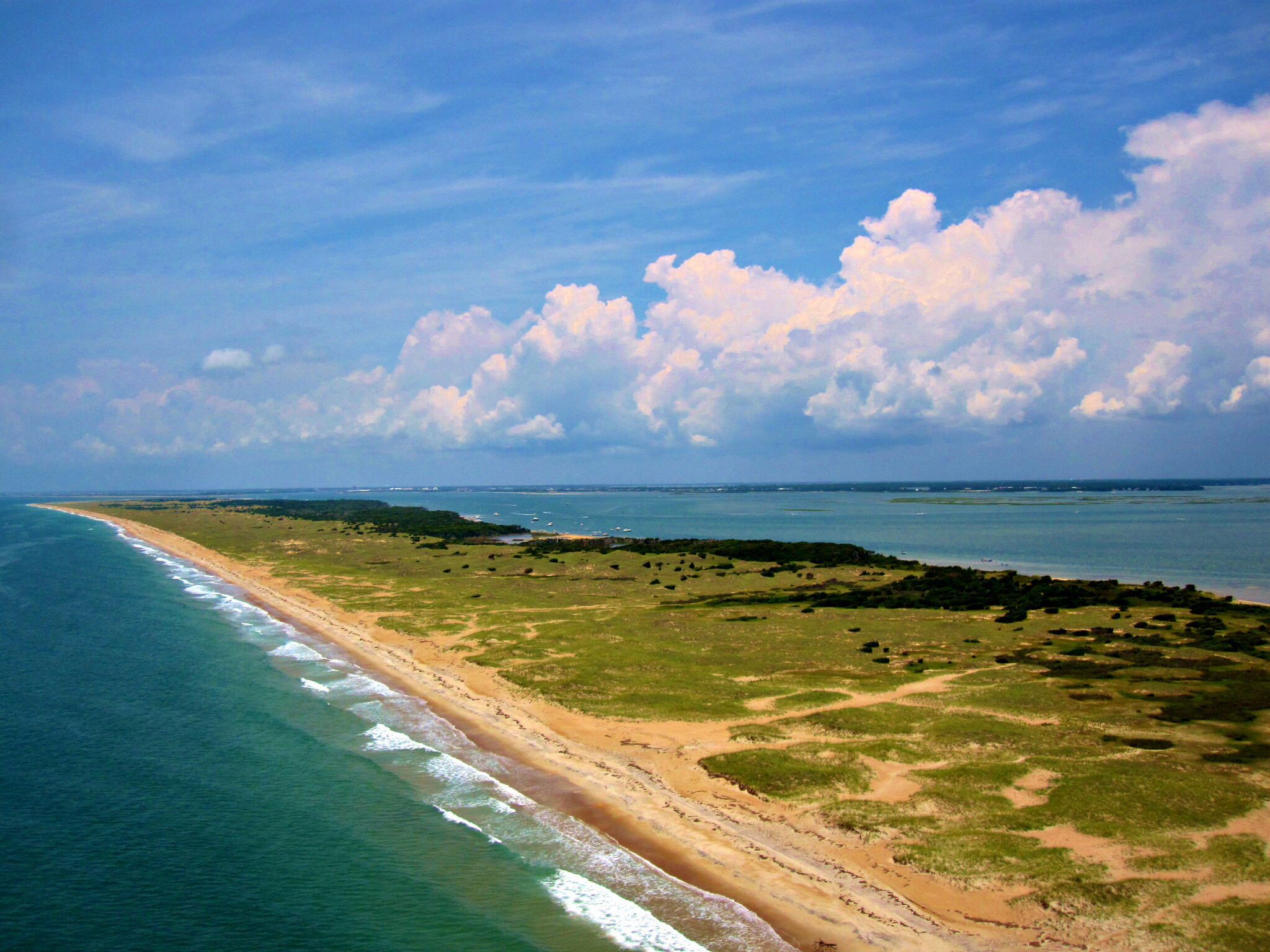

The Lewis family lived at the west end of Shackleford Banks at an area called “The Mullet Pond”. With family ties to life on Shackleford since the mid-1700s and ongoing till establishment of Cape Lookout National Seashore, the historical and spiritual ties to the Banks shows broad multi-generational and deep roots. When their feet hit the sand on Shackleford, even today, family members describe experiencing a feeling of connection and harmony special to the Banks.

Losing their home near the Mullet Hole in the 1933 un-named storm, Charlie Lewis built a camp on Wades’ Shore in 1935. The Lewis camp became the Holland camp in 1954 after Joseph Lewis died. Both families shared use before and after the ownership change.
Whether being displaced by the 1933 storm, a part of the “exodus” from the Banks after the hurricanes the end of the 19th century or later leaving as Cape Village withered in 1915-1918, many Bankers retained a foothold , physical and spiritual, on the their old stomping grounds. A foothold on each new and old home sites found them spiritually straddling the sound–leaving their hearts hovering above the sound that had and did sustain them.

The 1935 Lewis Camp, later purchased by Holland. Whoever the owner, both families shared use of the camp till it was lost to arson.


On the Northern end of Core Banks. Earl Noe had several camp experiences in Portsmouth. His camp logs document the richness of the culinary offerings (including SPAM) along with participants and events.

In three years of Earl Noe’s camp log, it is clear they ate well. Entries often mention the fare of the day, including:
Oysters stewed or fried, stewed flounder, biscuits, clam chowder, oyster cocktails, hush puppies, fish roe, oyster fritters, kippered salmon, lima beans, soft crabs, SPAM, fried sweet potatoes, blueberry pancakes and sausage, hard crabs, fried spot, corned beef hash with biscuits and peaches, fried mullet, french toast and sausage and eggs, pork and beans with hush-puppies, clam dip, corn meal dumplings, baked beans, Portsmouth Stew, black-eye peas with mullet, fried potatoes, slaw, cucumbers and tomatoes, drum, boiled fish and bacon grease and corn bread for breakfast, beans, hot red peppers and onions, minced drum with meat grease with onions, hard-boiled eggs, tomatoes and tea, rice custard, home-made rolls, tossed salad, pork chops, eggs and coffee, cabbage sprouts, collards, turkey with trimmings, mince-meat pie, fruit cake, potato pies, roast pig-pig pickings, and only an occasional mention a drink.

At the Fulcher camp (above) on North Core Banks, terrapin and turtle stews were a family favorite. They called this the “Big Camp” or the “Pilentary”, to distinguish it from the camp of Clay, III which was at Wib’s.

Many Banks cabins, just as the Fulcher’s, were depicted as artist renderings placed on the walls of their mainland homes–staying connected when away from the Banks.

The Evergreens was the camp of Julian and Jule Hamilton near Three Hat Creek. Jule would go to the Banks carrying just “onions and flour”, willing and ready to live off what he could catch, gather or shoot. The sound provided the mainstay portion of most meals.

Known for his likable personality and honored by the State as a Heritage Artist for his carvings, he followed his dad’s footsteps on the Banks where dad Julian had a camps before and just after WWII.
As Core Sound sustained so many in bounty and spirit, it was also discovered by wealthy northerners a a hunting site and vacation spot. It became precious to them as well.

Known by locals as the “club house”, The Carteret Rod and Gun Club (1902-1999) was not only built by locals on land purchased from Davis community families, but its caretakers, cooks and guides were local and the facility was used by locals outside of the hunting season–for family outings, church picnics and such. Community use and spiritual ownership was always a component of activity there. Feasts were held at days end, preceded by hearty breakfasts and lunches for the hunters on season.

The Pilentary, 1895-1933, and initially the camp of Theodore Rogers, followed by Jordan Mott and later Robert Lassiter, was the premier of all Southern Banks camps or lodges. Franklin Roosevelt hunted with Mott at the site. Destroyed by the 1933 storm, the Pilentary had Atlantic, N.C. community roots back to 1859, especially with the Mason family.
Whether visiting “from off” (NY, NJ, Conn.,non-coastal NC), or local, the setting was precious to many. Theodore Rogers wrote in his hunting journal that he always returned to NY “feeling rejuvenated”.
Romance on the Banks–Charles and Cindy Styron spent their honeymoon in their camp at “Wib’s Creek”

Shared with me while working on goose decoys for him, the story of Charles Perry Styron’s beloved camp began me on my journey to learn and document this story of the Banks.

Charles and Cindy Styron–Charles Mason Camp

“The last wedding on Shackleford Banks”–the James and Ollie Moore wedding–courtesy of Wayne Davis
Other courtships and marriages occurred along the Banks.
Nurturing family ties———–the Banks were conducive to nurturing connections and fostering joy mixed with self-reliance and reverence.

Chris and Gray Sabiston walk along the beach during a stay at Edna Heslep’s camp at Wade’s Shore. She encouraged many to enjoy her treasure.

Mark Hooper at Edna’s camp–assisting Eda Burke in her cowgirl role. Not quite the “school-bus distance” or separation from the ponies required now.
Multi-generational because the experience was valued and wishing the next generation to have the same opportunity.

Three generations of the Fulcher family of Atlantic, with Clay III as young man to the right. Great, great grandfather James Mason had purchased lands in 1859 from the state which they still use.

Three more generations in more recent years. Clay (in back) and June fought to retain the rights to their property and for the experiences and enjoyment the Banks fostered.

At several sites along there Banks, in the years after WWII, there evolved a sense of community.

Bell’s Island (the site of the prior 19th century community) had about 14 camps–evoking the nickname -“little Miami”.

Pictured above, sound-side gathering at Bell’s Island. Bald Head Bay (below) had several camps, many connected to ancestor William Hedrick Moore.


A visitor at Jack and Susanne Guthrie’s camp.
“Wib’s”, on North Core, was the site of George Hill’s house–destroyed in the 1933 storm. A community cropped up there due to water access and opportunity of acquiring valid leases. Charles and Cindy Styron had their camp up the sand road.

Fishing–began with the early indian culture and extended to many varieties through the years-dependent on the seasonal variations in fish and shellfish.

Shore-side mullet fishing camps of the late 1800s and early 1900s were documented on Shackleford Banks and Cedar Island by Collier Cobb and others.

At least since the 1930s, fishing along the shore became a beloved hobby and setting for many.

Sterling Dixon, Marvin Murphy, Algier Willis and others established fishing camps on Core Banks. The 3,400 abandoned vehicles would later become an issue. The debate about them fostering dune formation persists today.
Again, people “from off” found something new to love on Core and Shackleford Banks.

Horse pennings were a regional event drawing helpers and observers for the July 4th round-up. (from NPS files)
There exists a sense of mourning for the loss that the change to Cape Lookout National Park brought. Mandated by Congress that the Banks return to wilderness, the Park Service was directed to remove the 400 homes, camps, structures and the abandoned vehicles. Though pleased that the Banks are preserved, many paid a heartfelt price.

With grandparents that left Cape Village behind in 1915, and memories of playing as a child at the Coca Cola and Baker houses at the Cape, using a cottage along the Cape beach that later washed to sea in a storm, and loving her Bell’s Island cottage on Shackleford till it was burned–her life centered more across the sound than anywhere mainland.

Emma Rose’s mantle displays her creed.

Family were also left behind in the three larger cemeteries and several family plots.

Above, the Wade Shore Cemetery remains the only currently findable c cemetery. Diamond City’s cemetery, as told, held 400-500 gravesites (now under the waters).
Camps and cottages were often offered for family use to others for 1-2 weeks at a time. If 50 friends(a reasonable estimate) used each of the 400 camps ( the number there in the mid-70s), then thousands- local and regional – had physical and spiritual experiences on the Banks.

Edna was the beloved and respected nurse of Beaufort’s Dr. Laurie Moore. Her camp is a good example of an owner sharing with others.

Legacy–the experiences on the Banks have and do inspire–people leaving more than footprints in the sand.

Based on her times at “Casablanca” or the Baker-Holderness House–in the hook of the Cape.


Joel Bourne’s family owned the 1915 Jetty-worker’s Cottage at the Cape.


Keith taught a university-level marine science program for several years, using the Cape Lookout Coast Guard Station as dorm and classroom.
It would not be a surprise if there were many that share Bill Hooper’s continued loving connection with the Banks expressed to the late Clay Fulcher III—


Leave a Reply