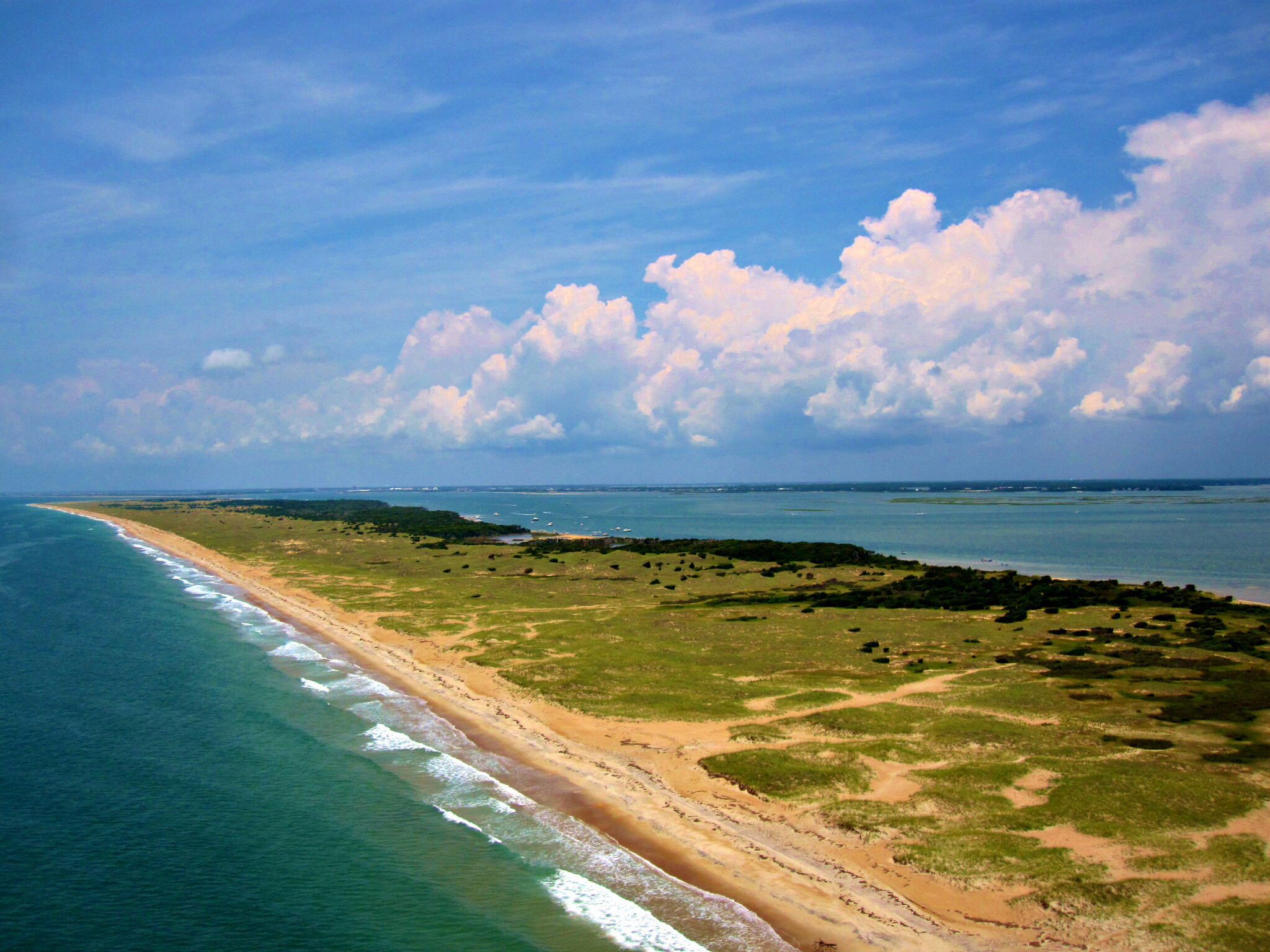

Nina Gordon Lewis gathered her girls—Kathryn Ray, Ina and Iris, along with her granddaughter into the skiff at the shore of Harkers Island on this and some other Sundays. As they climbed aboard, Nina told the girls: “we’re going to have dinner at home”. The skiff, loaded with a basket of food and a large cast iron skillet, carried them to the area known to locals as the Mullet Pond– a landmark at the western end of Shackleford Banks. Coming ashore, they dug a pit in the sand for a fire and Nina prepared to fry mullet in the skillet. She wore what is commonly called a frock dress with an apron around her waist. The apron came in handy to shew away the wild boars from the gathering as she cooked. Though this was in the 1950s, the persisting spiritual attachment to this area of the Banks originated from the turn of the century when this was the actual home for her family.
When Joseph Lewis, Sr. acquired the 450 acre “Mullet Pond Tract” in 1899, he was preceded by Lewis family members present on Shackleford Banks since the 1700s. One ancestor, Thomas Lewis, Sr., of the Wades Shore area is thought to be the progenitor of most of the Lewises in eastern Carteret County. The deed used landmarks documenting predecessors of other Banker families as well—“Jechonias Pigott lands”, “Beckett Creek”, “Zack’s “gut’”, and “Lewis Creek”. This western end of Shackleford Banks (bordered by Old Topsail Inlet) was the base for the Lewis family fishing endeavors and served as their living accommodations especially during fishing seasons. They lost their home in the devastation of the 1933 storm which provoked their move to Harkers Island.
Joseph Lewis, Jr. (seen here at Harker’s Island) decided to ride out the 1933 storm on Shackleford Banks, according to Patsy (Lewis) Walston. He survived by tying himself to a tree. He was “never the same again after that” according to the family. James Lewis of Harkers island confirms hearing of the story of his ancestor’s experience.

Captain Charlie Lewis was Joseph, Jr.s brother.
Houston Salter of Harkers Island, now 102, tells that his mother Foy Lewis was born “at the Mullet Pond” homesite.

Captain Charlie Lewis and wife Nettie (above) in the kitchen of their Harkers Island home. They had moved off Shackleford Banks after the 1933 hurricane destroyed their home there. (photos courtesy of Patsy Walston)

in 1935, Charlie built a new camp on the sound-side facing Middle Marsh. This became one of the best known Shackleford camps known as “German’s camp”—having been purchased in 1954 by German Holland but the Lewis family initially owned the camp where their friend German often visited.

After Joseph’s death, the property came to wife Letha and brother Fred, who sold it to Holland.
In front of the camp, Charlie Lewis with the Captain’s cap, German at the far right and Charlie Russell standing alongside. (photo courtesy of Wayne Davis)
Patsy Walston remembers her time there and helped draw a schematic of the interior.
Patsy remembers going there every weekend and for their weeks of vacation. Gherman would be there weekends if not working as Sheriff or in his business.
She remembers them carrying large ice blocks to the camp, but later ,they had a gas refrigerator, gas stove, a bathroom with a pump into the tank of the toilet, kitchen with hand pump, bedrooms separated by walls, gas heaters in the bedrooms, lanterns for light and a septic tank back into the woods edge. Patsy went there beginning in her early teens.
Little remained of the original homesite near the Mullet Pond —a mound was behind the site, yielding a lot of bottles (trash pile?-)—even some round bottom bottles—given later to Parsons store—and a cistern remnant, with piles of bricks, less than 10 yards off the shore at low tide—left over from the site
Joe Lane Lewis, Patsy’s uncle, had a camp to the west of ‘Ghermann’s Camp” (spelling varies).
Patsy believes that the earlier Joe Lewis is likely the one in the Wade’s Shore Cemetery. The property which he owned, she believed, stretched from the inlet to Dr. Moore’s property (deeds seem to confirm her description).
Grandfather Charlie built the camp (about 1935) along Wade Shore. Cedar posts were used for the foundation pilings. We “absolutely loved that camp!”. When built, “it used to be “shoaly” up where the camp sat. Initially, the camp “was all up and away from the water”. The family went to the camp every weekend and for vacations, staying a week.
Patsy’’s grandfather was a fisherman and Gherman was sheriff and a fish house owner in Beaufort. Gherman came along on weekends if possible.

The camp had a bathroom with a hand pump to pump into the tank of the commode, separated bedrooms with bunks in the far room to the west, kitchen area with table, a hammock on the porch and a long Coast Guard table on the east side of the porch. There were gas heaters in the bedrooms, lanterns, a septic system that ran into th back edge of the woods. They had an ice box and she members them carrying big ice blocks. She doesn’t remember when they got the gas stove. The porch had waist high siding with screens above—in earlier days. After Gherman acquired the property, Patsy and her grandfather still visited there frequently. Gherman maintained the camp for both families to use. (see Patsy’s schematic layout). Patsy, now 88, was there when 14—to 16 years old.
Kathryn Ray Russell Thomas writes a memoir to her family titled ISLAND GIRL.
She was born January 16, 1926 and her mother’s father —Martin Thomas Lewis (her beloved “Old Pa”) was born on Shackleford Banks and had lived at the Mullet Pond through his childhood. Repeated severe storms drove his family to relocate on Harkers Island. Till age twelve, Martin Thomas would wear the skins of a whale serving as his shoes.
“My dad and his brother, Uncle Charlie, would often go oystering, clamming and hunting to keep food on the table… Old Pa would sometimes come in with a big turtle……When I was very young, my father and Uncle Charlie (Russell) would sell the fish and shrimp they caught for money…to get by.
In the summer, we would go to Shackleford Banks or Core Banks and stay for a week….would stay in old cabins left over there from when the crowd lived on the banks. We would build a big fire on the shore and then roast clams, conchs and oysters….
My dad and uncle Charlie would go to the Banks all summer to set the net for shrimp. Uncle Fred Lewis was born and raised on the Banks. He stayed with Old Pa’s sister,
Old Pa would tell me stories of going whaling on the ocean side of the banks when he was a boy.
The Lewis-Holland camp was in use at least into the mid-1960s when it was used as a dormitory for a marine science school. It also continued in use by the Lewis and Holland families, regardless of owner of record, and by friends who were gifted one or two weeks holiday there. In 1985, a 25 year lease was obtained and Holland heirs received one million dollars for the tract. The camp fell victim to arson not long after the transfer to the United States.
This history of multigenerational connections, multiple families owning or using the camps and homes, ancestors buried alongside and its existence as a sound-side landmark— all led to the leaving of deep roots in sandy soil, upon warm hearts and a legacy of sustained memories.
Contributing Interviews:
Patsy (Lewis) Walston
Brooke Lupton
Houston Salter
James lewis
References:
(1) Early Lewises of Carteret County, Robert Lewis—The Researcher/ Spring 1994—published by the Carteret County Historical Society
(2) Island Girl—Kathryn Ray Russell Thomas—courtesy of Brooke Lupton
(3) Deed Book UU, page 487—March 20th, 1899—regarding the Mullet Pond Tract—acquired by Joseph Lewis from W. S. Chadwick and W. F. Howland—450 acres. **
(4) Deed Book 153, page 12—February 19, 1954—the Mullet Pond Tract—from Letha F. Lewis (widow) to C. G. Holland. **
(5) Deed Book 316, page 104—November 11, 1969—Mullet Pond tract—from C. G. Holland and wife Mildred W. to C. G. Holland, Jr. **
(6) Judgement—U.S. District Court—May 13, 1985—conveying to the U.S. A. of tract 102-08, 439 acres—Book 526, page 223—from C. G. Holland, Jr. and mildred Holland—for $1,000,000. **
**Referenced deeds are located at the Carteret County Register of Deeds
additional photos——
This drawing transcribed from a December, 1900 publication shows a “Lewis” presence near the Mullet Pond, as well as, fishermen’s Shacks on the western sound shore.

The property like extended up against the structures in from Bottle Run Point where the Moore land began

Nettie with her “snuff stick” at work in the kitchen of their Harkers Island home.

The Mullet Pond area, sometimes called “The Mullet Hole” 1854, Beaufort Harbor Survey.

Nettie above the steps and Fred to the right. (photos courtesy of Patsy Walston)
Patsy Walston interview—excerpts:
The family had a home on the west end of Shackleford, near the Mullet Pond —a mound was behind the site, yielding a lot of bottles (trash pile?-)—even some round bottom bottles—given later to Parsons store—and a cistern remnant, with piles of bricks, less than 10 yards off the shore at low tide—left over from the site.
They moved to Harkers Island after the ’33 storm—and Joe eventually moved to HI—he was, said by the family, to have never been the same after the experience
This end (western Shackleford) moved to HI and those, from Diamond City moved to Morehead—this west end belonged to the Joe Lewis, likely the one in the cemetery on Wades Shore—that Joseph Lewis likely sold the property to German Holland—while on his deathbed or near his end of life. (actually, Holland purchased from his widow in 1954).
The property line extended east to some line between it and Edna Heslep and/or Dr Moore’s property—somewhere along there.
At Diamond City– where my GM was from—(Armies, we called her granny)—she was a Willis.
She was “probably a Methodist because of the Methodist church at the Diamond City area—Armeese Willis.
Joe Lane Willis— married a Mormon lady—his camp was here beside the beacon—the Wade Shore in-water beacon at the turn toward HI—grandparents not Mormon—their only son married a woman that was Mormon—Joe Lane Lewis.
When we go over on weekends, we would get in small boat and went to Methodist Church in Beaufort each Sunday—”don’t know if it did any good.”
German acquired the camp when the Joe Lewis died—Joe Lewis , Sr—left to oldest son Joe Lewis—German got it from him (actually brother Fred and widow Letha owned and transferred the property to Holland).
My grand-dad (Charlie )built that camp—I still have 3-4 cedar posts left from that camp—we absolutely loved that camp!!
Charles and Joe’s father—Joe Lewis’ father—initially owned the property—Charlie built the camp—they had lived down at the Mullet Pond—it used to be “shoal-y” up here (site of the 1935 camp)when it was built. When built, it was all up and away from the water.
Porch (of the camp) was screened in, the waist high siding on porch unto screens, tide would come up under the camp—
Dad was in the Coast Guard, was transferred to Puerto Rico . Grandfather took us fishing out in the sound— one photo shows Gherman, little Gherman, GF and blue fishing—-Mildred, Ghermans wife and me.
Went every weekend and or our weeklong vacations, we would stay a week.
Ivey Scott—played at sites on Cape Lookout. At 7,8 or 9—dad was stationed at Cape Lookout—we used to go over on weekends to visit dad—they would have square dances.

Nettie, at Harker’s Island home


Leave a Reply to Christopher YeomansCancel reply