
Contents
Story
Decoys
Credits

🟡 LIMITED RESEARCH VOLUME
OWNERS
Sam Windsor
1801 and years following
OTHER ASSOCIATIONS
Sam Wade–name assumed by 1817
Bill Moore camp
Jack’s Island
LOCATION
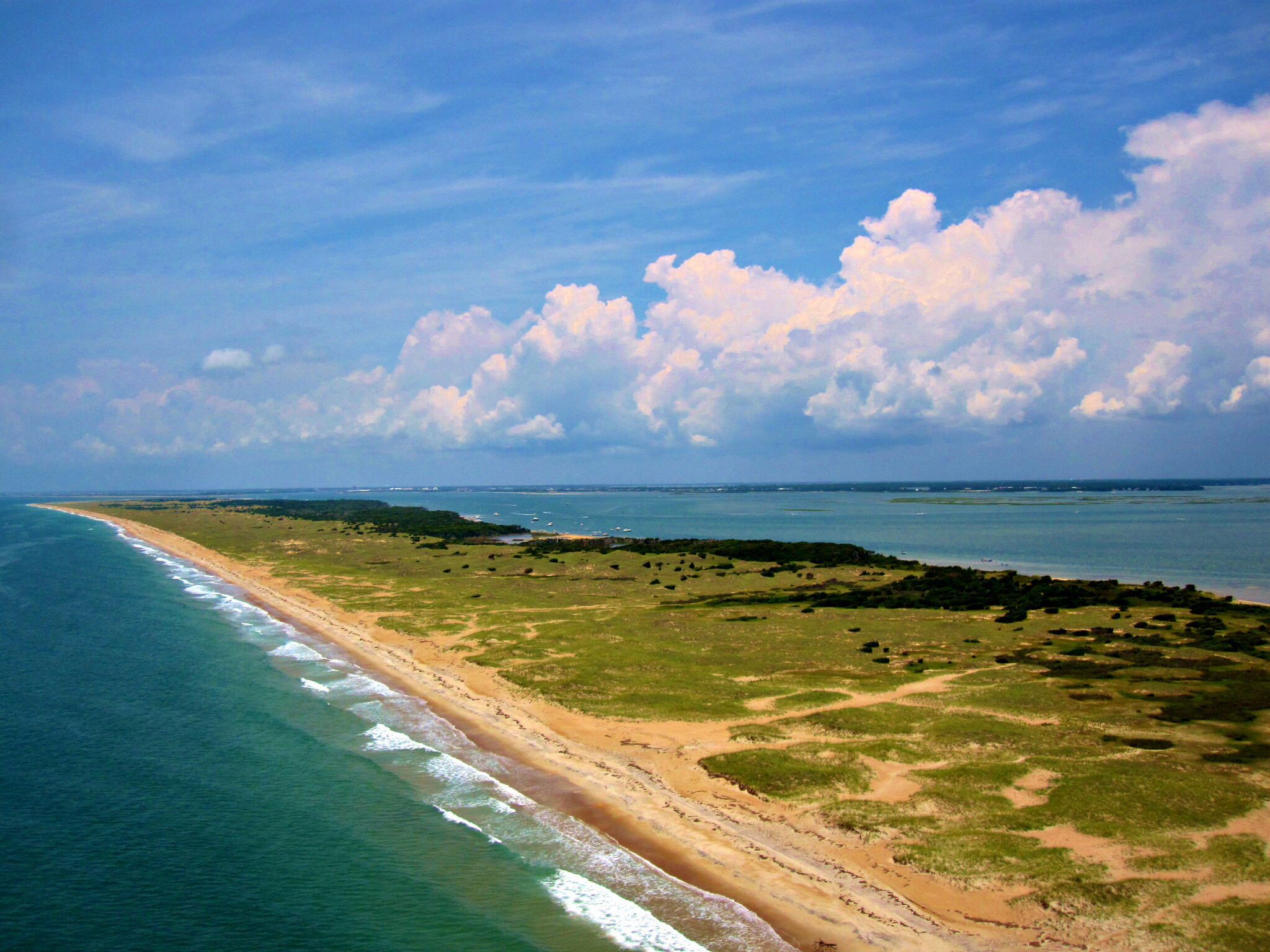
Shackleford Banks, between Whale Creek and Bald Hill Bay–#44 on NPS survey map
Story


do you know more? contact me.
Sam Windsor and descendants
Sam Windsor was given his freedom from slavery along with 50 acres on Shackleford Banks in 1801. Living on the Banks, he and his descendants were fishermen and whalers. Beaufort history includes references to a Sam Windsor relating to the Queen Street School, among other connections.
Sam Windsor was in the crew that captured the “Mayflower Whale”.
“The Emancipated Windsors of Carteret County”
Abraham Wade, having attained a ripe age in 1801 took an unprecedented step some 62 years before Lincoln’s Emancipation Proclamation. A Carteret County deed records that Abraham purchased from cousin, James Shackleford, 50 acres on Shackleford Banks on April 20, 1801. The plot was described as “Jack’s Place”. Three days after the purchase, Abraham had entered on the official records that upon his death his slave “Windsor was to be a free man” …..”Not to be enslaved or subjugated by my heirs.” He further went on in the record to state so he (Windsor) will not be an expense to my children.
“I give and bequeath to him a parcel lying on Core Banks or what is known as Shackleford Banks. …containing just 50 acres, what is called Jack’s Place, the said land of John Shackleford.”
By 1815, the free man “Windsor” had assumed the surname Wade.
Cavano Windsor on December 13, 1817. married Lucy Guthry (she appears on later census as Lucinda) before witnesses, Stephen Guthry and Anson Harker. The son had dropped surname Wade in favor of Windsor. Stephen Guthry is understood to be a son of Samuel Guthrie (per L-254 deed of gift of June 20, 1789).
The definition achieved by the 1850 Carteret County census shows Cavino Windsor (Mulatto) and located in a household on Shackleford Banks, occupied also by a son Samuel, age 25 (who had married May 26, 1846, Mary Whittington) with grandchildren, Elizabeth born .c 1846, Anna Maria and Johanna born c. 1848 and an infant David. The occupation of Cavino and Samuel Windsor appears as fishermen. An adjacent household was occupied by Sila (?Celia) Windsor, born 1790 and Nancy born c. 1830.
In the town of Beaufort, NancyWindsor born 1795 was then living with a farmer, Henry Windsor. born c. 1820 and harriette born c. 1825, Orpha c. 1828, Catherine c. 1828, Ann c. 1840, and Oliver c. 1841.
It is apparent from the records that Cavino Windsor and his son Samuel continued to live on the banks as fishermen and they and their descendents were the neucleus of one of the noted whaing crews operating during the 19th century there. Others who were closely associated with the Windsors were Dennis Jones and Louis Davis, who were possibly also related to the Windsors by marriage.
Samuel Windsor and his wife, Mary, had two sons, David M. born .c 1851 who married Harriett Davis and Ananias Windsor born c. 1853 who married Gatesy Jones on December 5, 1874, who carried on this Windsor line. David and Harriett Windsor named a son Samuel after his grandfather. Ananias Windsor made his will on February 21, 1884 (Will Book B-165), which bequeathed:
excerpted from “The Researcher”, Ethel C. Phillips—Vol. V, No. 3, August 1981
CALO Oral History Project 10-020 February 18, 2011
One of the “Sam Windsors” was a well remembered baseball player for the Beaufort team . Joel Hancock remembers some of that history.—-
JH: That’s right, they had to be soaked with the ball. Alright now, for one, they used a much softer ball, it wasn’t hit far or anything but you had to actually catch someone between bases for them to be out. You couldn’t throw just tag the base out. And so he had the reputation because of his speed of being great for that on the banks. But in the county, the one that had the greatest reputation we know was Sam Windsor, the black man who had lived in Beaufort and would eventually move to the banks and to this day Sam Windsor’s Lump is a portion of the banks, between Dr. Moore’s camp and Bell’s Creek.
So, they challenged Sam Windsor’s, the team from Beaufort, which had Sam Windsor, which says something itself that a black man was playing ball for them. Which, by-the-way what it does tell us was that the Jim Crow world that I grew up in was really a creation after the Civil War and even after the late 1800s when the separate but equal came in. But before that, there was much more mixture of the races including playing baseball here in Carteret County and throughout the
JH: country as well. Anyway, they challenged them to a game and Sam Windsor had the reputation as having never been put out, never been put out! So, his first at bat, he hit the ball to Billy, the pitcher was always the fastest man, of course, he would have been the most obvious man to get a ball.
CM: He was equi-distance from all the bases…
JH: Right. So Billy fielded the ball and tried to run down Sam Windsor. And I can see the emotion in which my dad would describe it, that he held his hand back pretending that he couldn’t catch him. Until at the last moment, soaked him just before he got to the base and put him out the only time in his life! Now, my dad, he would become animated as he told that story about how Billy Hancock soaked Sam Windsor for the first time in his life. And Diamond City won the game.
————————
Archeologists have been here before. This is from their 2009 report: The hammock is quite large, and, based on a map (Survey of Shackleford Banks, by William H. Utley & Assoc., New Bern, NC, 1977), there is supposed to be a small cemetery at the site. Interestingly, in a 1971 inventory of structures at CALO, a cemetery was described as being 100 feet behind the structure at CALO-2, which included the grave of Sam Windsor (Sam Winter), among others. These graves may have been moved. Hardy and Rikard walked over much of the island looking for evidence of this cemetery and encountered two small stones in roughly the same location as indicated on the map. Shell was also observed in the roots of overturned trees located primarily along the eastern side of the hammock. On the eastern side of the hammock were the remains of wooden pilings for a footbridge connecting this hammock island to the next one to the east. These pilings were visible only at very low tide and leads straight to the highest point on the neighboring hammock, along its back side.
—Jeff West communication (see NPS survey map showing structure #44, Bill Moore’s camp, to see general location of the cemetery. It is unclear, as yet, which Windsor was buried there.
Additional Information/corrections–
Hello! I was reading through your page discussing Sam Windsor and his descendants and I have a minor correction to submit. I’m a Windsor descendant through Sam’s brother Ananias – Sam’s son’s namesake – and it was actually this elder Ananias Windsor who wrote the 1884 will referenced in the article. Ananias Sr died in 1888, listing his daughter Alice Melissa Gaskill (wife of Sylvester Brown Gaskill) as executrix. I’m happy to share additional information about this line to the extent that it would be of interest, but I wanted to just make this one clarification.
J.R. communication about corrections to the story above from “The Researcher”–01-10-2026
Credits
- The Researcher, Cartereet County History Association publication–referenced above
- Cape Lookout Seashore Oral History Project–Connie Mason, interviewer of Joel Hancock
- NPS files, maps and archives
- Other references within text