
Contents
Story
Decoys
Credits

🟡 AVERAGE RESEARCH VOLUME
OWNERS
Les and Sally Moore
late 1950s
OTHER ASSOCIATIONS
“Cape Lookout Sports Center”
LOCATION
Cape Lookout Bight
Story


do you know more? contact me.
Les and Sally Moore
At about 11 years age, Jon Riggs and friends spent their time at Les and Sally’s—it had a restaurant, a store, a landing strip, parking lot and more
One time, going into L&S, and without two nickels in his pocket, he entered the store with his uncles—a crowded place that day—they had had to park way down the sandy road away from the structure—Jon entered and, shortly after, felt Sally snatch up his shirt collar and pull him along—Sally was formidable and not to be resisted—and reaching the end of the counte sher told a patron to move off his stool—“I a’int done”, he said— “move away”, said Sally——“I’m going to feed the youngster” (then proceeded to return with fries, sandwich and drink)—Jon didn’t know what to think, since he had no money—he looked around at uncle Roland Davis who winked at him and Jon knew it was alright.
Les and Sally had no children and Jon says that many a youngster got spoiled a little there.

For 18 years, the Moore’s lived on and ran a store on Cape Lookout. They and the Coast Guard crew were the only year-round residents. They closed their store in 1978 as part of the Park Service stipulation prohibiting private business within the Park. They moved to Morehead City but found difficult the adjustment. Tears would come to Sally’s face when she talked about their home at the Cape. Nostalgia is shared repeatedly as others recall Les and Sally’s “The Store”.

Sally’s earlier family (grandparents) had lived on the Banks and her dad had been a Carteret County fishing boat captain, but Les was from Idaho. Les told one reporter that he “was born a long way from his home”. Les met Sally while stationed in Morehead City in 1942. After returning from two and a half years in the Pacific, the Moore’s decided to build a motel at Atlantic Beach—across from Freeman’s Tackle on the causeway. They ran it for 13 years until Atlantic Beach grew to be too crowded for them. They sold the motel and bought five and a half acres on lookout Bight.

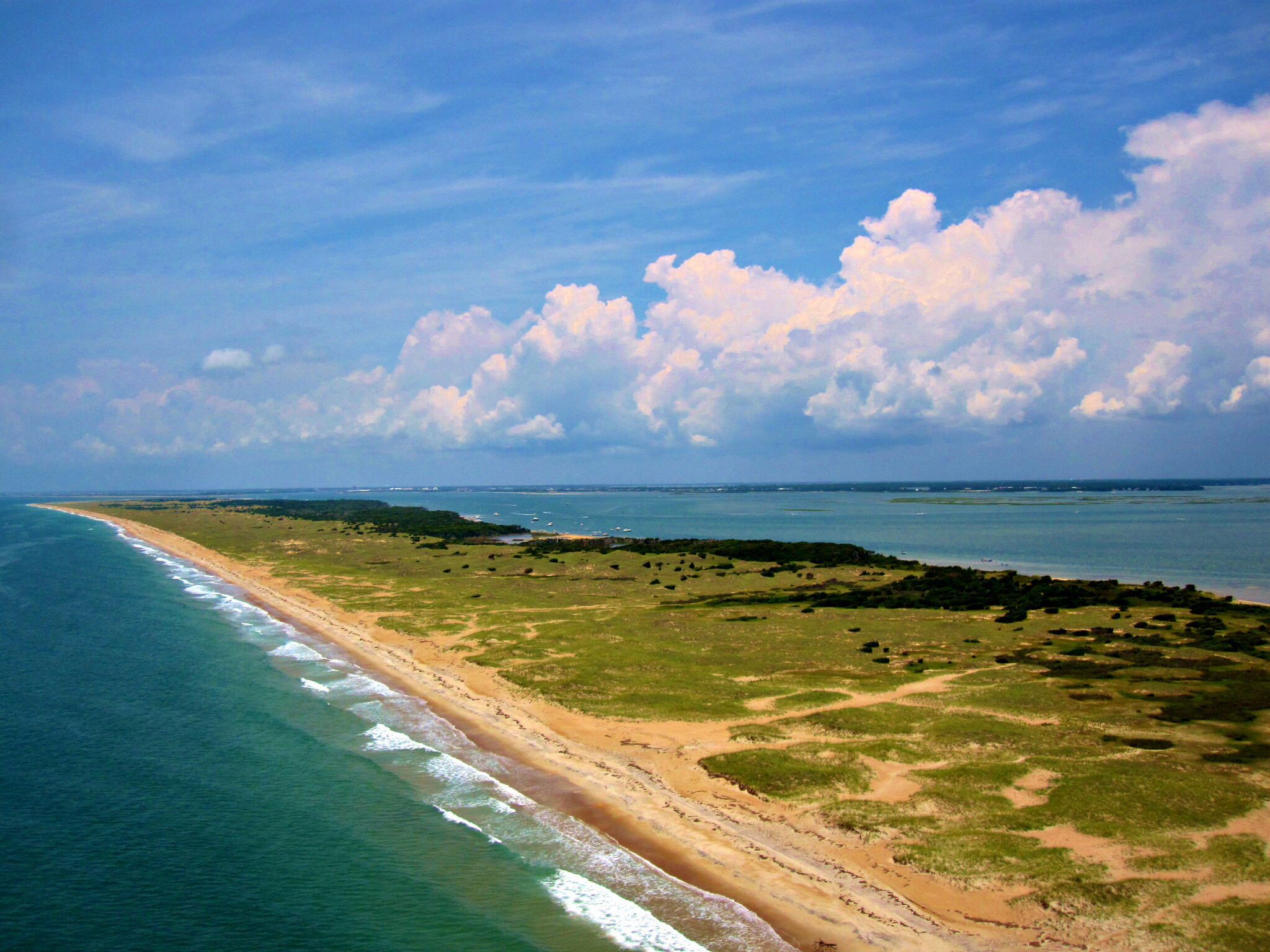
Early on, Les built a houseboat and they would spend a lot of their time at the Cape—“every chance we got”. Hauling materials over by barge, they built their home, a store and four rental cabins. They called their store “Cape Lookout Sports Center” but people just called it “Les and Sally’s” or “The Store”. While catering to fishermen and campers, they also were a valuable resource and great friends to the cottage owners and guardsmen. The store became like a museum, filled with bottles, shells and other treasures found washed up along the beach.

Les and Sally had the whole island to themselves—well, Gypsy (their pet hound dog) kept them company. When they first went over to the Cape, it was without dunes, the island and beach were just “flat”. Being conservation minded, the Moores planted trees, sea oats, yuccas, beach grass and more during their time there. Their efforts changed the eye-scape and durability of the area. The Moore’s also developed a program to secure the success of loggerhead turtle hatchlings. Sally seeded scallops in the area and old tires under the dock created habitat for stone crabs.

Hurricanes were weathered in place during their years there. Sally went to town in a small run-about about every two weeks for supplies, for visits with family and to retrieve mail. Les, on the other hand, once went two years without leaving the Cape until Sally mandated he accompany her on one of her trips..

Sally died in 1985. Les and she never had children but “would have wanted them to live the same kind of life’. “On a beautiful day out there, there is peace and quiet” she had said—“You’ll never get closer to God Almighty I do believe”.

Susan Spence Moe (The News and Observer—Dec. 24, 1977) wrote— “One last Christmas at Cape for couple”— documenting Les and Sally’s last Cape Christmas season. They awaited a U.S. Marshall coming to enforce their eviction. It had taken the action of a Congressional committee to make a declaration mandating their move. “We’re going to be lost, like a fish out of water”, Sally said. Lease agreements (non-commercial residential use only) were available to the Moore’s, but prohibited their business—which was their sole livelihood. Complementing their simple existence (they had a TV and a two-way radio) and the diminutive Christmas tree on the counter, Les told the reporter—“Santa Claus?”—“We don’t see any need for him to waste time coming out here. Let him go on to the mainland. We’ve got enough.” Sally added: “We feel fortunate to be able to live out here, it’s Christmas everyday”.
Fighting hard to hold back tears—Sally shared, “There’s no other place in the world like it.” “I expect there’ll be a few tears when we have to leave. But we’ll get over it……Maybe”.


———————————————————-
CALO Oral History Project 10-023 March 17, 2011
NORMA CLARK 20
The whole mess out there, Bruce Weber and I— we had to go out there. Remember when the cabins were turned over to the Park Service? Mr. Riddle got Bruce and I to go out and accept the keys [Laughter] from. I never will forget standing on the end of the dock wanting to get off of there so bad.
CM: You had to accept the keys from Les and Sally Moore?
NC: Yes! Let me tell you what she gave us. [Laughter] I wondered what ever happened to it, I really have. It was a big picture of [Laughter] a horse with no head! I’ll be nice!
CM: So a rear portion of a horse.
NC: And that’s what she called me! [Laughter]
Bruce and I accepted that very graciously. You know, in a way, I really could relate to them. I’ve often thought about it.
CM: When Mr. Riddle asked you and Bruce to get those keys was this a photo-op? Were there journalists there? Was it a formal thing? Was it documented? [Laughter]
NC: Yea, I think somebody did. If you ever get a hold of Bruce, he might be able to share whether they took any pictures of us.
CM: He was a photographer, so he might have taken some.
NC: He might have had somebody there. I just remember that picture and I had to hold onto it. He probably had us holding onto it or something. I remember the boat ride back.
CM: Where you on the same boat with Les and Sally?
NC: Oh, no! [Laughter] They stayed over and we came back after they gave us the keys and stuff. They were…it was hard for them. They had been over …but they were doing things that was, Land Management-wise, was not legal. They were taking other buildings and bringing it all down into one site………………………..

LES AND SALLY’S—
ACQUISTION—by the Park
tract #105-20————————-one document shows as $103,740—August 17, 1994. Another, on 8-20-81—as $201,930 paid on Notice of Closing—for 5.45 acres.


Album
additional scenes


Credits
- NPS files and archives
- Susan Spence Moe, The News and Observer–Dec. 24, 1977-“One last Christmas at Cape for couple”
- W. B. Wright, “World Enough”–The State–Aug. 1, 1966
- Jon Riggs interview
- CALO Interview series (by Connie Mason)–of Norma Clark, Park administrator
- photo contributions by Geoffrey Adair, New Bern-Beaufort
- Other references within text