
Contents
Story
Decoys
Credits

🟡 MODERATE RESEARCH VOLUME
OWNERS
John Wallace Salter
Date 1873-1950
OTHER ASSOCIATIONS
Salter-Battle Hunting and Fishing Lodge
Portsmouth Hunting and Fishing Club
The Salter Gun Club
LOCATION
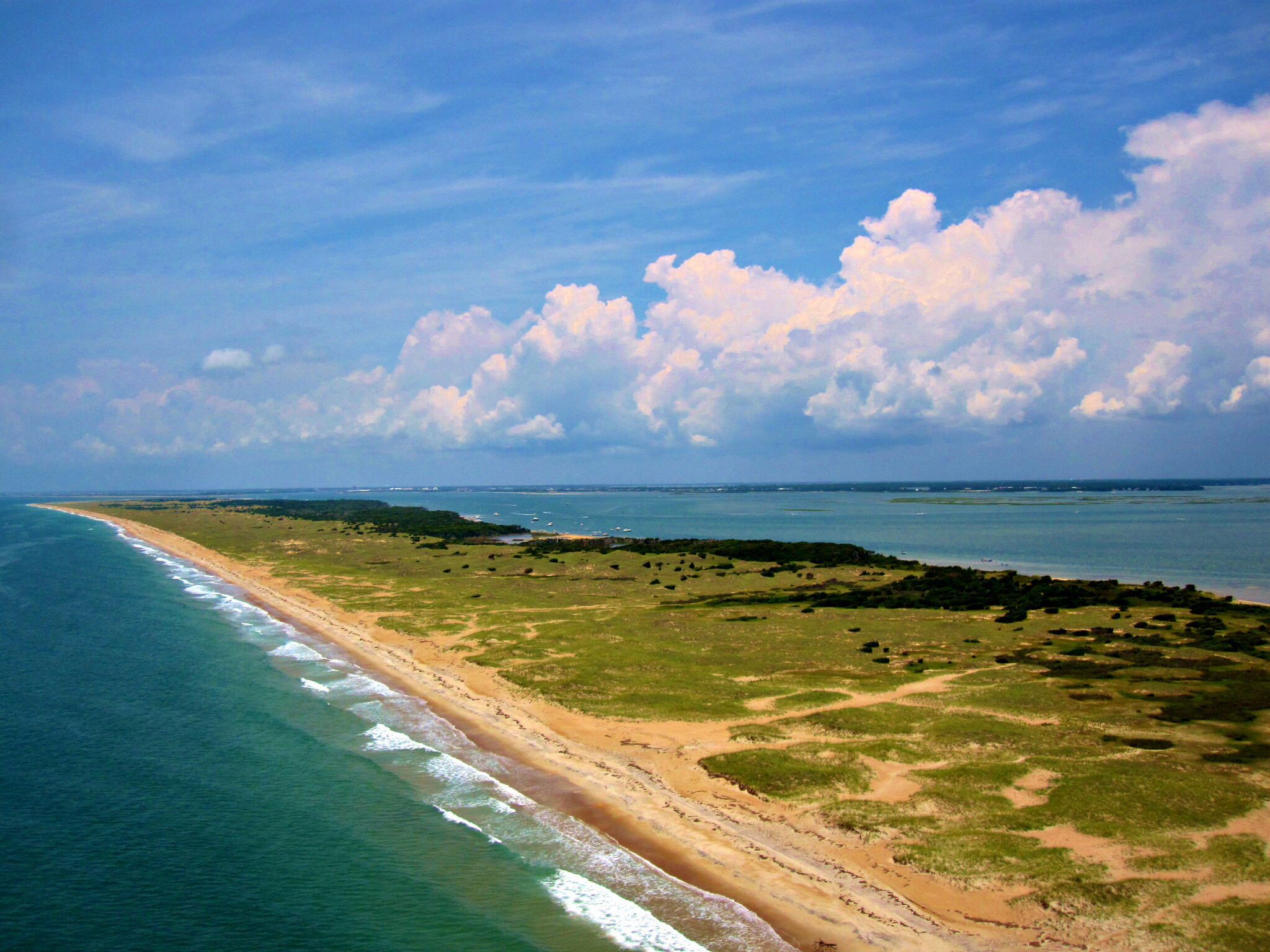
Sheep Island, Portsmouth, North Core Banks
Story


do you know more? contact me.
Interwoven–the Salters
The Salter family has been associated with the Outer Banks since the settlement period. The 1790 census listed only twenty-five family heads living on both Ocracoke and Portsmouth Islands. Among the names listed was Henry Salter. The Salter family was intricately involved with life on the island for over two centuries, marrying fu”‘1d raising families, and making a living from the’ sea. Annie Salter, wife of Theodore Salter was postmistress on the island from 1926 until 1955, when her daughter, Dorothy took over until the island’s post office was closed in 1959 (Salter, p. 41)~ .
John Wallace Salter (b. 8-15-1875, d. 7-20-1950), the son of Christopher Thomas Salter and Matilda Robinson, was born and raised on Portsmouth Island. One of nine children, he was thirteen when his father died. John helped to support the family through oystering, fishing, and hunting (Dudley, p. 65).. He married Sidney J. Styron (b. 12-16-1876, d. 7-23-1959) in a ceremony on Portsmouth Island on December 24, 1895 (Carteret County vital statistics). John and Sidney Salter also had nine children: five boys and four girls. Most of the children attended grammar school in the one-room schoolhouse in Portsmouth Village. The Salters lived in an eight-room, two-story, side-gable house on Sheep Island, immediately west of Portsmouth Village. During the 1920s, he moved his family to the mainland so his children could further their education, since the school in Portsmouth only went thorough grade seven (Dudley, p. 65).
Seasonally, John Wallace Salter and his family returned to Portsmouth for fishing and hunting, and the home remained a hunting lodge for many years. The hunting lodge became known as “The Salter Gun Club.” John Wallace Salter would shoot waterfowl for market, shipping geese, ducks, and brant by the “sugar barrel full” to markets in the north. The plumage from the birds was often used to decorate women’s hats.
Battle family records show that the Salters sold two parcels of land on Sheep Island to J. R. Battle, L. F.Kirby, and W. G. Nichols ofMarion County, South Carolina in 1927 and 1928 (Book 00, Page 100 and Book 2, page 18).’ It is not known if the new owners had a separate building constructed for their use or if the Salters and the new owners shared the Salter House for hunting and fishing purposes. It is known that the partially-destroyed Salter house was dismantled and moved to Atlantic after a 1938 hurricane. In ca. 1945, the Salters dismantled
another building in Atlantic, moved it to Sheep Island, and rebuilt it as a replacement for their first hunting and fishing lodge. (According to family oral history the building was a barracks building at a military installation at Atlantic.) The new lodge was situated on the banks of the Pamlico Sound, near the burial site of John Wallace and his wife, Rebecca. The Salters and their children continued to return periodically to the lodge to hunt, fish; and relax.
The National Park Service has an un-dated aerial photograph of Sheep Island showing no buildings on the island. It is possible that the photograph dates from between 1938, when the first Salter House was removed from the island, and ca. 1945 when the current building was moved to the island.
On May 20, 1948, John and Sydney Salter’ sold the lodge and one-and-one-half acres of property to James R. Battle, his brother, R. Frank Battle, S. P. Wood, N. E. Smith, C. S. Beard, W B. Schofield, J. K. Williams, T. R. Simpson, W. Lipcomb, and C. C. Smith, who made up the Portsmouth Hunting and Fishing Club (Deed Book 120, p. 287). (It has not been determined whether the two earlier land transactions included the current lodge property.) The lodge continued to provide shelter for the Salter family during the week while they pursued their commercial hunting and fishing enterprises on the Core Banks. On the weekends, however, the lodge functioned as a retreat for members of the Portsmouth Hunting and Fishing Club, with members of the Salter family often acting as guides for the club members. The club built a separate storage building to house their collection of buoys, decoys and fishing equipment. The Battle family eventually bought out the other members of the Portsmouth Hunting and Fishing Club, becoming sole owners of the clubhouse by the late 1950s. The Battle family has continued to use the Lodge as a seasonal retreat from the i950s to the present. (at time of writing) Although the Salter family no longer uses the house, a similar relationship exists today between the Battles and other members of the Core Banks community. The Battles have hosted many CEOs from Fortune 500 companies, who have stayed in the present house and hunted ducks and geese from Sheep Island.
Salter-Battle Boys Historic Registry application
Horse Wrangler–
ROSCOE SALTER
phone interview 8/6/21
of Stella
Roscoe’s parents were John Wallace and Sydney of Portsmouth who till the 1933 storm lived on Sheep Island near where the North end of the Battle Boys runway would eventually be located. They relocated to Atlantic. John Wallace worked at the shipyard in Newport News, Va. till, at onset of war, he transferred to the shipyard in Wilmington, N.C. to be closer to home.
John Wallace wanted to have a herd of horses on Portsmouth and went north to Kinakeet or Avon where he purchased a herd of 25 horses which he drove down the banks to Portsmouth Island. His partner in the endeavor dropped out but John Wallace persisted. Roscoe, as a youth, asked his dad what he did when he came to an inlet–to which his dad answered that the walked or swam across. There were several wide inlets to cross. John Wallace had an “old lead mare” that the others followed, and when she was in the water, the others followed. When it was to deep to walk, they swam till they could stand again. John Wallace would slip out of the saddle when time came to swim and holding the tail of his horse, he followed along/ or was dragged till his horse could again get a footing. He paused in Ocracoke for a while before crossing to Portsmouth where they were set loose. There was a stallion leader of ther herd that was a Palomino or Sorrel. Over time, the herd split into two herds–one at the Bay Marsh and the other staying around the High Hills.
With their home long gone, they would stay at the Battle Boys Camp every July 4th for the horse penning. The group would be dropped off by boat near the morris Marina. Spread out and waving rags they would move up the banks pushing the horses ahead of them. Near the Battle Boys camp, a fence-like structure ran inland side from the marsh to the pen. Horses were herded to that barrier that led them to the pen. The horse pen was a litle north of the Battle Boys Camp and not far from where the family home has been. A gentleman from Bridgeton, now deceased, had made a video of the process–but whereabouts unknown.
Once penned, some were broken to ride, some branded and then with all done, were set loose till next Independence Day.
After the initial horse project, John Weston Smith, John Wallace Salter, Ben and Ross Salter and others got into cattle. After horse penning, a repeat process occurred for the cattle. Not branded, they were identified by ear notches. Bulls were castrated, marked and turned out.
As Park Service takeover approached, brother-in-law Jimmy Chadwick, Len Salter, Forrest Daugherty and a few others built a simple “slab” camp on one of the creeks. Not owning the land, the Park /service burned the camp at takeover. Jimmy Chadwick took down some of his structure and took it to Ross’s camp for use. Ross had an “unbreakable deed”. Roscoe remembers that Sam Jones helped Ross obtain the deed (using Torrens law maneuvers). Roscoe thinks that may have occurred about 1941, when he was 10 years.
A nicer camp was built across the creek a little to the south–?owned by Earl Hamilton. Earl and John Wallace jointly owned some horses together after they had to be moved to Cedar Island due to NPS mandate.
Phone interview with Len Salter: (8-6-21)———————
—spent a lot of time on Portsdmouth with his uncles–Ross Salter was Tom’s uncle–raised him—Tom and Ross’s camp was on the south side of Big Creek–just south of Portsmouth but on Sheep Island.
—further south was Battle Family camp–a family from South Carolina who moved a structure from the closing Atlantic base and moved it tio Sheep Island. A runway in from their camp allowed them to fly in from S.C. This was in the early 50s.
Len was there as a youth much of the 50’s with Tom, Charlie, Ben and David.
On Uncle Billy’s Creek, Len’s dad and Tom built a camp after the NPS was getting involved in things. His dad, Leon Salter, with Forrest Daugherty from Dover, Charlie Berry of Craven ‘County (it’s sheriff, )uncle Tom Salter, Dallas Willis and Earl Hamilton were partners. The NPS burnt the camp-“the land wasn’t ours”–”no leg to stand on”
Across the creek, Jimmy Chadwick (otf the tire/garage shop) built a camp on property he had a deed to.
Southiof these camps, Len felt there were no casmps till you reached the Evergreens. Then the High Hills area (Judge Morris and Dick Smith had camps there)
PONIES ON PORTSMOUTH_____________________________
Len mentioned the Spanish heritage of the Banks Mustangs.
There were two groups of horses—”two gangs”–
The Bay Marsh group stayed around the marsh going down to the big creek on Portsmouth…they rarely came into the village—(though the Bull and the cattle did).—there was a stallion and his mares in each group.
At the High Hills, a stallion and his mares stayed in that area consistently. These horses were not “riding horses”, though some from the Bay Marsh group were. Uncle Tom gave Len a 2 year old stallion for his 12th birthday from the Bay Marsh group. He named it “Pal” and expectred to have other horses through his life, but the NPS mandates put and end to that dream. Len says he is not happy with Raleigh with this. In th 50’s, about 1955 he believes, they were forced to take their livestock off the island. Uncle Tom and uncle Charlie had gotten into the cattle project, he remembers–but admits he was young and away when some events occurred.
Horse Pennings—
Every year in June, they would do a horse penning on Portsmouth. They would do the Bay Marsh herd first. Some of these horses were riding horses which they could use later in the penning process. Colts were branded, hooves were trimmed if needed, some were castrated–then they were turned loose.
They used the riding horses to drive the High Hills horses to the pen–reaching a fence like barrier near the Battle Boys Camp that funneled them into the pen. The horse pen was mid-way on Sheep Island.
Next they turned to the cattle. Len tells that it was no easy task to run the cattle out of the merkle bushes on foot. Cattle were marked and bulls castrated then released to the “open Range” as long as it lasted.
Horses were rarely seen in the village but cattle and the Bull were a problem more often.
JULY 4TH Penning
—this was the time for the penning of horses living from Drum Inlet to the High Hills area.
—this was the BIG Penning drawing people from all over the state to watch.
—The pen used was near and north of the Don Morris Camps.
Brantley Morris owned the stallion of this herd—”Sam”–a pinto, Len remebers.
Branding—
Uncle Tom branded the Bay Marsh herd with a diamond with a bar going thru the side corners placed on their left fore shoulder. When it came to branding his (Len’s) own horse, the diamond iron was not available and he got two staight parallel verticle lines “11”
—therefore , he was known as “Number Eleven”.
You could ride Number Eleven but not the other stallions–even “11” could not be bridled till he was put on the ground—when the bridle in place, he was fine
Len knows nothing of the camps or history on the banks before WWII–his family had already moved to Atalntic–but he visited uncle Tom’s camp often.
Please also see the Ross Salter page for his interview.
Decoys

Credits
- Goose decoy–Robbie Smith Collection
- Other references within text
- https://files.nc.gov/ncdcr/nr/CR0965.pdf–for Historic Registry application and history