
Contents
Story
Decoys
Credits

🟡 LIMITED RESEARCH VOLUME
OWNERS
Fred Willis
WWII and prior
OTHER ASSOCIATIONS
Earl and Janice Fulcher
LOCATION
Southern Core Banks, Great Island Bay
Story

do you know more? contact me.
Fred Willis Camp
FRED WILLIS
of Davis/ at Great Island Bay
CALO PROJECT (6)
EARL FULCHER AND JANICE FULCHER 15
CM: Did your daddy(Weldon) or the families in Stacy make a lot of use of Core Banks?
EF: Yes. Before the Park Service got it, it was accessible to everyone. A lot of the local people had camps over there in the spring of the year the men that did the peeler crabbing had camps over there. They would go over there and stay three of four nights at a time. Then other people had camps just for the pleasure of it. A lot of churches didn’t have services every Sunday back then; I remember my mother would cook chicken and fix other things and we’d get on the boat and go over to the banks spread a sheet and have a picnic. Even go swimming in the ocean. The hunting in the wintertime back in those days in the twenties and thirties; a lot of waterfowl over there: ducks and geese.
CM: It was primarily ducks and geese there, maybe brant further north? Did you have brant?
EF: We had a few; not very many. Brant were down around Portsmouth, Cedar Island to Portsmouth.
CM: Did you eat them or sell them what was the inspiration to go hunting?
EF: Loving to do, the liking to do it. Back in those days, people took hunters out for pay. Of course there’s still some of that going on, but there was a whole lot of it going on then.
CM: Did your daddy do that?
EF: A little bit, some. Now not like some of the Davis people. The Davis people were BIG in that.
CM: That was Ammie Paul
EF: Ammie Willis and Ammie Paul probably, too but, oh, my there were so many of them.
CM: There were two Ammies then; Ammie Paul and Ammie Willis.
EF: Yea.
CM: What was Ammie short for, do you know?
JF: That was their names as far as I know. They were like Cartie. Ammie was their name, I don’t know that it was short for anything.
EF: These Pauls down to Beaufort today came…
CM: We were talking about when your family went over to spread sheet and have a little picnic, did Weldon have a camp over there?
EF: No, we never did have one.
CM: Did you ever use somebody elses?
EF: Sometimes.
CM: Do you remember whose it was?
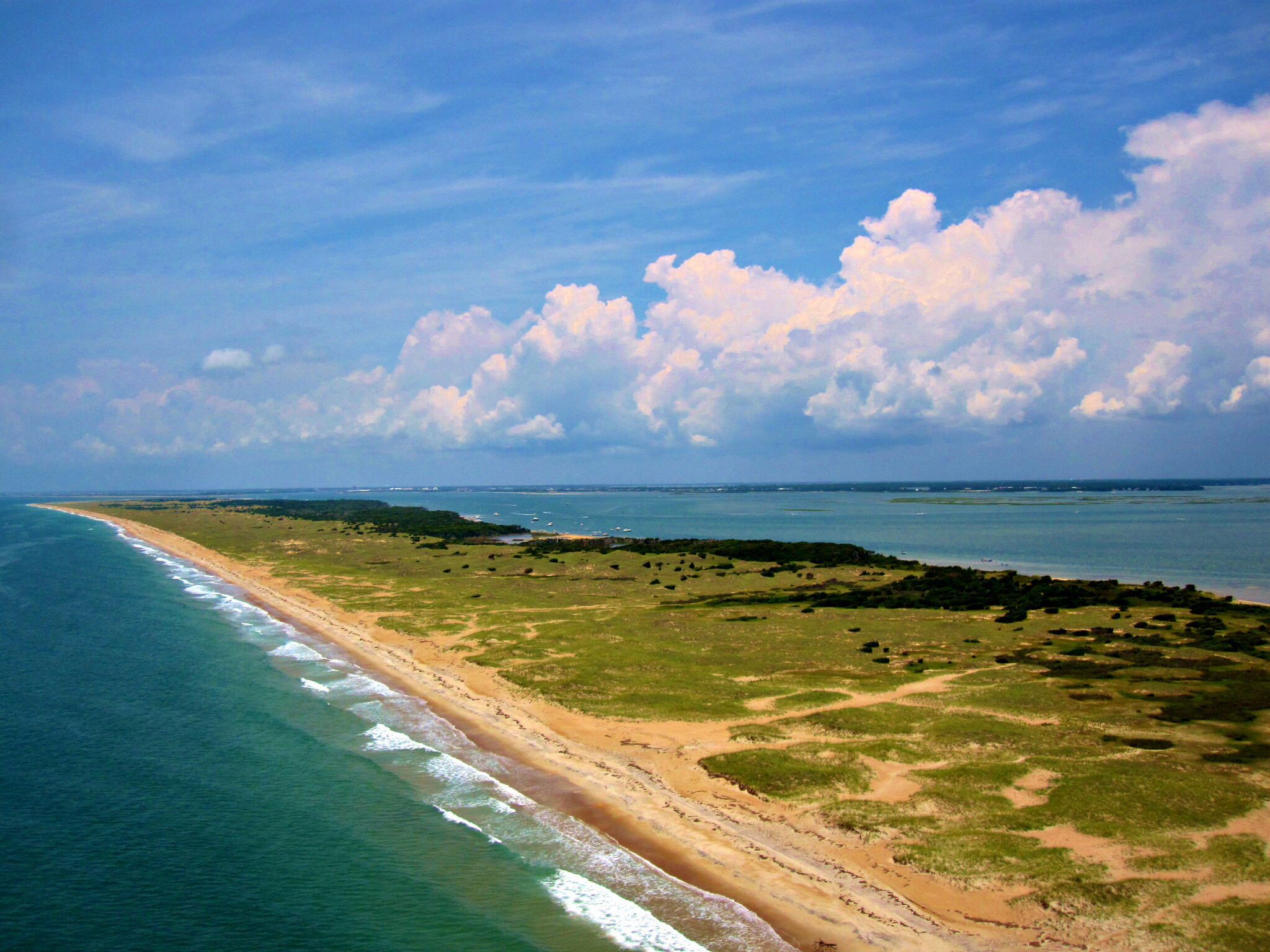
EF: Yes, Mr. Fred Willis from Davis had a camp in the Great Island Bay, which is near where the Park Service has got those camps now.
CM: Near where the Algier Willis camps are?
EF: Near the east end of them is just about the same area. We would go over there during the war years, World War II. We would have to spread towels over the windows; you couldn’t have a light; it was black out. We’d go over there and clam, all of us, my mother, daddy and Dare and I, we’d all go clamming and we’d sell them; that was the purpose. We stayed over there we had cooking facilities…
CM: How did you go clamming? Were you signing?
EF: Mostly, yes. Had a little four prong rake about four or five inches long with four teeth on it. They’d make a little mud sign on the sandy bottom and you reach right down and pick him right up!
CM: There you go!
I guess there were no regulations about how big they had to be at that time.
EF: No. Or how small.
CM: The camp. Can you describe what it was like?
EF: Yes, usually a little 15 by 20, or 12 by 18 built on some little stakes to hold it up off the marsh. It was floored inside. One single wall, no ceiling inside and cathedral type ceilings. You could almost see the stars sometimes between the
CALO Oral History Project 10-026 August 16, 2011
EARL FULCHER AND JANICE FULCHER 17
EF: shingles. Never-the-less it was enjoyable. Enough wind to be comfortable.
JF: They had built-in bunks.
CM: Built-in bunks. About how many people did they sleep in something like that? EF: Usually about four.
CM: Four. Before I get to that, did they like to hunt in stake blinds or from the shore?
EF: Both. Stake blinds out in the open water and along the marsh usually on a projected out point would be the best place and sometimes in ponds. Especially what we call pond ducks: like mallards black ducks and teals and sprigtails and that kind of stuff.
CM: So there are natural small ponds on the banks over there?
EF: And back in those days everybody used corn. We really feed them. That would attract the birds to the blind and at the same time the quality of meat was much better.
CM: I bet it was.
EF: It’s the same as putting a young cow feeding him out on corn before you put him on the table.
CM: Getting that fish out of the bird first instead of having to parboil him for two or three hours.
EF: The Rod and Gun Club over there. I don’t remember how far back, I reckon back in the early twenties was when that was built. We always called them the “Yankees” the wealthy people from up-north built that thing.
CM: Did you ever go inside?
EF: Yea, I’ve been inside a number of times. It’s a nice place. They would hire a guide, a resident guide that would go over there and live, move his family and cook for them.
CM: Did you know any of those people that went over to cook for them?
EF: Leroy Davis, from Davis was the main ones, what was his wife’s name?
JF: Bertha
EF: They were over there for years. I believe they were the longest caretakers there
CALO Oral History Project 10-026 August 16, 2011
EARL FULCHER AND JANICE FULCHER 18
EF: was in that club. This same Cartie I mentioned a while ago was a caretaker for a number of years. As were others, there were others besides them. Leroy would fill the stern of his boat with two hundred pounds of sacks of corn. Every evening, he’d go out to them blinds, they had eight or ten of them and put a sack of corn around each blind. That will bring the ducks. [Laughter]
CM: THAT will bring the ducks!
Wasn’t there another hunting club on Core Banks but it was further up from you?
EF: There was at Harbor Island.
JF: The Pilentaries
EF: And the Pilentaries, too which was almost across on the banks from Harbor Island. Harbor Island was out in the middle of the water, surrounded by water.
CM: Is there anything left of that on Harbor Island?
EF: No. They tell me there’s just a little small place of sand left and you can’t even detect where the hunting club was. There was five or six acres over there at one time from what I understand.
CM: Was that where there was a community?
EF: You talking about Hog Island?
CM: Yea, Hog Island.
EF: Not far from it. No more than a mile back toward Cedar Island. CM: Do you remember anything about Hog Island?
EF: Not the people living there I don’t but Hog Island is still there, part of it
JF: They have a big building there now.
EF: They had a school there, children went to school there, they had a post office.
CM: Do you recall when it declined, when people came off of there?
EF: The end of it was probably the ’33 storm. That changed history downeast.
Credits
- Connie Mason–CALO interview
- Other references within text