
Contents
Story
Decoys
Credits

🟡 LARGE RESEARCH VOLUME
OWNERS
R.A. and Penelope Baker
Holderness and Moye Families
built 1929-1930
OTHER ASSOCIATIONS
Baker-Holderness House
WWII military use
LOCATION
Cape Lookout Bight, Southern Core Banks
Story


do you know more? contact me.
Baker-Holderness House
Note: This Camp Page has very large content and is being frequently expanded–this note will be removed when complete or nearly so.
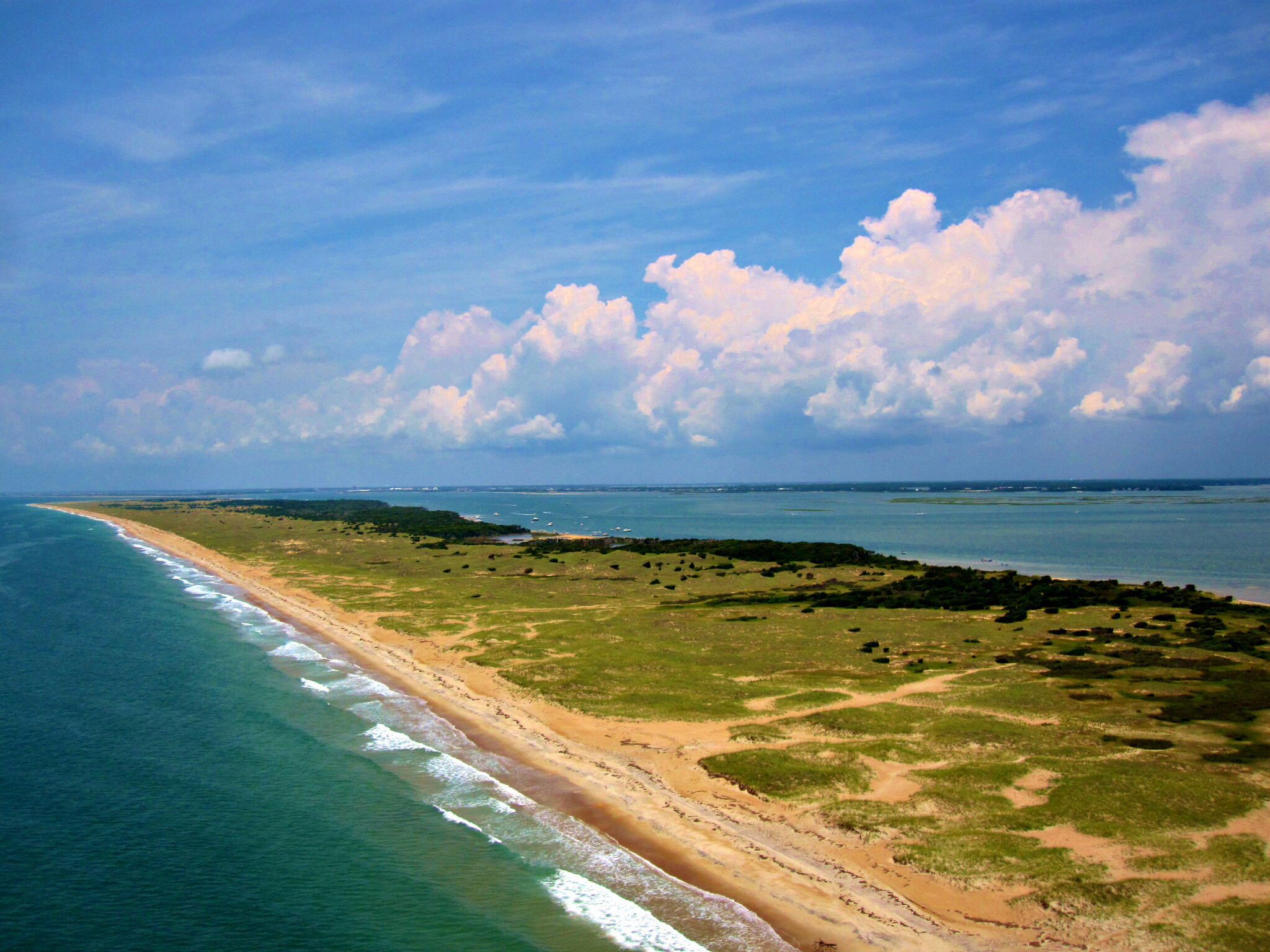
The aerials show Casablanca (Baker-Holderness House) and the view with Coast Guard station in foreground gives perspective on location.

Bob Blevins–CALO Artist in Residence–depicted Casablanca
Baker Family History–


2011 photo from NPS files–the Moye, Holderness, and Barnhill lease had run out earlier.
Notes from National Registry Nomination
At two stories high, Casablanca looms as the largest house on the Cape, perched on pilings on the west edge of Lookout Bight near Wreck Point. One large living room with a huge brick fireplace and French doors opening onto the porch, which wraps around three sides, occupies the first floor of the main block. The kitchen and dining room occupy a one-story side wing. Bedrooms are in the second story, originally constructed with bare stud walls. The Craftsman style of the house, its size, and its minimal finish express its resort function.
C 7. (Bl Baker-Holderness House (Casablanca). ca. 1930. The largest private house standing at the Cape, Casablanca is a two-story frame, three-bay-wide house with a low-pitched hip roof, and a large one-story west wing. The house sits prominently on the southern shore of the inlet, its physical allure enhanced by its name evoking tropical intrigue. The house stands on pilings, has white painted weatherboards, and exposed rafter tails along the eaves. A large painted brick chimney stands at the east end. The front door and rear doors are double French doors, and windows have some original 6/6 sash and some replacement 1/1 sash. A one-story shed porch (apparently always screened) with plain square posts and exposed rafter tails wraps around the front, east and south sides. The house was built about 1930 as a summer cottage by one Mr. Baker. Around 1940 George Allen Holderness of Tarboro purchased a part-interest, along with several other Tarboro families, who shared use of the cottage for many years. The Holderness children currently hold a lease from the Park Service. A long pier extended out from the house until recent years, Cape fiddlers held many a square dance for residents and visitors in this house in the pre-Park era.
The first floor of the main block consists of one large living room, with a huge Craftsman-style brick fireplace at the east end, plaster walls, and a board-and-batten ceiling. The one-story wing contains a kitchen with a thick red brick exterior chimney. The upstairs bedroom story is said to have originally been left unfinished. with bare stud walls.
Ca. (B) Outbuilding. c. 1930. Front-gable building built on pilings, with weatherboard walls, six-pane casement windows, and exposed rafter tails. Its original use is unknown.
NC b. (B) Garage. c. 1980. One-car front gable frame garage, with plain weatherboard, a plywood door, and exposed rafter tails.
- The well near Casablanca was drilled about 1941 by R.W. Baker. It draws from the upper confined aquifer to a depth of 98 feet, and has yielded 1 gallon per minute.
- Secondary roads lead to the dwelling clusters not located within the village—the Coca Cola house, Casablanca, and the Les and Sally Moore complex.
- A dock extended out to the bight from near the rear of the house for many years.
- Casablanca sits within a U-shaped dune network for protection against the wind.
- Casablanca is a typical cape residential structure—wooden, balloon-framed, with a low-angle hip roof, and set on a raised foundation.
- From the Coast Guard Station, the Concrete Road leads west and north to the Coast Guard dock. Along this road near the shoreline of the bight is one other house with two adjacent sheds, Casablanca (Figure 3-104). This is a large two-story wood framed building with a hipped roof that was constructed circa 1930. The two-story portion is almost completely surrounded by one story additions, including a screened porch that wraps around three sides of the building. The walls are wood siding painted white, and the roof areas are covered with asphalt shingles. Adjacent to Casablanca are two small wood framed gable roof outbuildings, both clad with wood siding painted white.

R.W. and Penelope Baker of Greensboro built their Cape home across from the lighthouse in 1929-1930. Baker at the time was the president of Blue Bell (the world’s largest denim wholesaler) and their Greensboro home (the Latham-Baker House) and the Blue Bell factory (on Elm Street) are on our City’s Historic Registry.

Emma Rose Guthrie of Harkers Island remembers Ms. Baker as kind and gentle. As children played in the water from the artesian well alongside the structure, Ms. Baker would come to the porch to watch the fun. Emma Rose remembers Penelope being there a lot but does not recall Mr. Baker. Although then younger than ten years old and before WWII, Emma recalls the gatherings and parties at Casablanca.


In April, 1942, the Dept. of Defense decided to establish Cape Lookout as an anchorage for convoys. Defended by a submarine net and shore guns, the Bight gave a harbor of refuge. Private properties, the Baker House among them, were required to lease to the U.S. at a nominal fee and were not returned till ate in the war.
The Baker house, according to interview notes with Mr. Yelverton, was a station for spotting submarines and a platoon may have been stationed there. A red alarm button, similar to the one in the C.G. Station observation tower, remained as a remnant .

In 1945, R.W. and Penelope Baker transferred their house to a group of men from Tarboro, N. C. (William G. Clark, Jr., R. W. Moore, George N. Earnhart, Henry I. Johnson, and /Robert P. Cherry–9-5-45).
Melissa Moye shared the following:
Haywood’s description of the original Tarboro owners is not accurate. I have the original deed. My father Milton Moye, Jr. bought his first one quarter share from R.W. (“Wilton”) Moore. Milton was friends with Wilton’s son (I think also named Wilton when they were boys. Milton fell in love with Cape Lookout so many years later he asked to buy Wilton’s share. He purchased his second quarter share from another owner who dropped out (Marvin Horton, also of Tarboro). Also, we retained our 50% ownership after the USG condemned the property and a 25 year lease was issued. The Holderness Family sold half of their share to the Barnhills. At the time they were not using the cottage.


Sadly, the toll of repeated storms atop the daily impact of the elements brought the story of Casablanca to an end.

Credits
- NPS files and archives
- Haywood Holderness
- Rusty Holderness
- Anne Baker Beale
- Emma Rose Guthrie, Harkers Island
- Other references within text